

























 14 Min


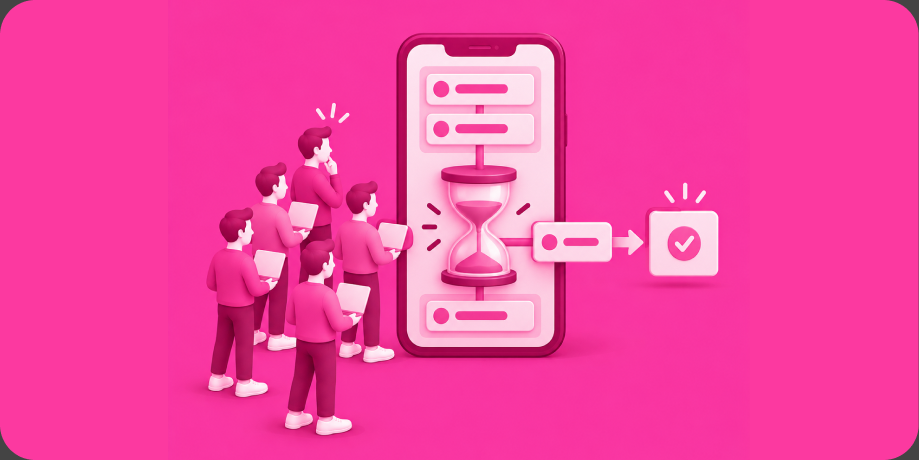
Adding more developers will not ship your app faster. In most cases it does the opposite, a phenomenon software engineering has understood since 1975 and founders rediscover the hard way every year. The instinct is understandable: the project feels slow, so buy more hands. But the research on runaway software projects is sobering. Oxford researchers Bent Flyvbjerg and Alexander Budzier, writing in Harvard Business Review, found that one in six IT projects becomes a black swan, with cost overruns averaging 200 percent and schedule overruns of almost 70 percent. Panic staffing is a classic accelerant. Here is why headcount is not speed, and what actually compresses an app timeline.
Key Takeaways
- Brooks’s Law, from the 1975 classic The Mythical Man-Month, holds that adding people to a late software project makes it later.
- Every added developer multiplies communication paths: a team of four has 6, a team of ten has 45.
- New developers subtract senior time before they add output, because someone must onboard them.
- Parallel work on an unstable core creates house-of-cards code that collapses during integration.
- Fast decisions, tight scope, and strong documentation compress timelines more reliably than headcount ever does.
Brooks’s Law, Explained for Founders
Brooks’s Law says adding manpower to a late software project makes it later. Fred Brooks, who managed IBM’s massive OS/360 effort, published it in The Mythical Man-Month in 1975. Fifty years later it still holds, because it describes people and communication, not technology.
The core insight is that software work is not like harvesting a field, where ten workers finish five times faster than two. Building an app is a web of interdependent decisions: the payment flow depends on the account system, which depends on the data model, which depends on choices someone made in week three. Work like that cannot be divided cleanly among strangers. Brooks called the assumption behind panic hiring the “mythical man-month,” the fantasy that people and months are interchangeable units. They are not, and treating them that way is how six-month projects become ten-month projects with twice the payroll.
Why Adding More Developers Backfires: Three Hidden Costs
Across 500+ launches since 2009, we have watched three costs eat every panic-staffed project: coordination overhead, onboarding drag, and the structural risk of parallel work on an unstable core. Each one is invisible on a staffing spreadsheet and painfully visible on a calendar.
Coordination costs grow faster than headcount
Communication paths grow by the formula n(n-1)/2. Two developers share one line of communication. Ten share 45. Every path is a place where a decision must be relayed, a change announced, a misunderstanding corrected. Past a certain size, developers spend more time synchronizing than building, and meetings metastasize to keep everyone aligned.
| Team size | Communication paths | Practical effect |
|---|---|---|
| 2 developers | 1 | Alignment happens in one conversation |
| 4 developers | 6 | Standing meetings become necessary |
| 6 developers | 15 | A dedicated project manager becomes essential |
| 10 developers | 45 | Coordination rivals coding as the team’s main activity |
Onboarding subtracts before it adds
A new developer cannot contribute until they understand the architecture, the codebase, the conventions, and the product itself. Who teaches them? Your most productive senior engineers, who stop building to explain. For weeks, the new hire is net negative: they consume more senior capacity than they produce. On a five-month minimum viable product (MVP) build, a developer added in month three may never repay that debt before launch.
Parallel work on an unstable core is a house of cards
Early in a build, the foundation is still moving: data models evolve, application programming interface (API) contracts change, core services get refactored. Pile five developers onto features that all sit on that shifting foundation and every foundation change ripples through five workstreams at once. Integration day becomes demolition day. Teams that respect this sequence foundations first, features second, ship faster with four people than chaotic teams do with ten.
What Does Parallelize (and What Never Will)
Some work genuinely benefits from more hands, and knowing the difference is the skill. Work parallelizes when it has a stable interface to build against and minimal dependence on other in-flight work. Work serializes when it depends on unsettled decisions.
- Parallelizes well: design running ahead of development, frontend and backend once the API contract is agreed, quality assurance (QA) testing each sprint alongside the next, an admin panel built as a separate module, documentation and store assets.
- Never parallelizes: core architecture decisions, the data model, scope debates, founder approvals, and app store review. These sit on the critical path no matter how many people you hire.
There are legitimate moments to pay for a larger team, and that is a budgeting decision with its own math. This post is about the why: a bigger team only helps when the foundations are stable and the workstreams are genuinely independent. It never rescues a project that is late because decisions are slow.
Get Your Free 45-Minute App Roadmap
Meet 1-on-1 with our senior product team. We’ll map your MVP or enterprise app and hand you a personalized plan—clear scope, a realistic timeline, and fixed monthly costs—for iOS & Android, web, tablets & wearables, and AI.
What Actually Compresses an App Timeline
Three things shorten timelines reliably: decisions made fast, scope kept tight, and documentation done up front. None of them costs headcount, and together they routinely save more weeks than a doubled team would.
Fast decisions matter because founder approvals sit on the critical path; an answer in hours instead of weeks keeps specialists moving. Tight scope matters because the fastest feature to build is the one you cut; a focused MVP with eight features ships months before an unfocused one with twenty. Documentation matters because a written specification and an approved clickable prototype eliminate the rework loop where engineers build, founders react, and everyone rebuilds. Modern tooling helps too: AI-assisted engineering, with senior engineers reviewing every change, has roughly halved 2020 to 2023 build times. Notice that all of these compress the work itself, not the org chart around it.
How Chop Dawg Builds Fast Without Bloating Teams
Our answer to Brooks’s Law is process, not headcount: thorough strategic planning before code, right-sized senior teams, and a proven process that keeps decisions moving through daily Slack and scheduled Zoom check-ins, with Figma, GitHub, Jira, and Confluence visible to you at all hours. Fixed monthly budgets keep team size deliberate instead of reactive, which is a big part of how we stay on time and on budget.
The structure behind those teams: Chop Dawg is US-headquartered and US-led, with American leadership, product and project management, senior development, senior design, and senior QA, working alongside our in-house Brazilian design team and our in-house development, QA, and project management teams in Pakistan and India. No subcontractors, no middlemen, everyone assigned directly to your project with fluent English and US working hours. That model exists because founders told us their two fears: a lone American salesperson fronting hidden offshore developers with no accountability, and a faceless overseas shop with no US business norms and no time-zone overlap. Neither survives an all-in-house, US-led team. It is the same discipline that has earned trust from organizations like NASA, MIT, and Siemens.
Two builds that prove the point. Obras, a workforce scheduling platform for field-service businesses, invested heavily in design before a line of production code. Co-founder Joshua Alves: “Their meticulous design process highlighted the importance of thorough planning before coding…” And Ninth Wave, an enterprise open-finance developer portal, beat its own calendar through process rather than panic staffing. Chief Product Officer Cameron Taylor: “Chop Dawg delivered our project ahead of schedule and stayed exactly on budget… They were highly professional, kept everything on track, and consistently delivered updates right on time.”
Frequently Asked Questions
What is Brooks’s Law in simple terms?
Brooks’s Law states that adding people to a late software project makes it later. Coined by Fred Brooks in The Mythical Man-Month (1975), it holds because new developers multiply communication overhead, consume senior time during onboarding, and increase integration risk, all of which outweigh their added output on an already-late project.
Why does adding developers slow an app project down?
Three reasons: communication paths multiply far faster than headcount (ten developers share 45 of them), new hires drain senior engineers’ time during onboarding before contributing, and parallel work on a still-changing core architecture creates integration failures. The overhead routinely exceeds the extra output, so the schedule slips further.
Does a bigger development team ever ship faster?
Yes, when workstreams are genuinely independent and the foundation is stable. Design ahead of development, frontend and backend after the API contract is fixed, QA alongside sprints, and a separate admin panel all parallelize well. A bigger team helps planned projects; it does not rescue late ones.
What team size is right for a focused MVP?
Most focused MVPs ship fastest with a small senior team: a designer, two to four engineers, a QA tester, and a project manager, phased so design leads development. That size keeps communication paths in single digits while covering every specialty. Complex, multi-sided platforms justify more, added deliberately as foundations stabilize.
How do I speed up my app project without hiring more developers?
Answer approvals within a day, cut scope to what launch truly requires, and insist on documentation plus an approved clickable prototype before development. Those three moves shorten the critical path itself. Modern AI-assisted engineering, with engineers reviewing every change, compounds the gains, roughly halving what builds cost and took a few years ago.
Speed Is a Process, Not a Headcount
When a build feels slow, resist the instinct to buy bodies and audit the critical path instead: pending decisions, unstable scope, missing documentation. Fix those and a small senior team will outrun a crowded one every time. If you want an experienced read on your project’s real bottleneck, book a free 45-minute consultation. Founders and established companies both welcome, and the advice is yours whether or not we ever work together. Chop Dawg has been shipping on time since 2009, now in our 18th year, with 500+ products launched, over 1 billion end users, 92% repeat partners, and 300+ five-star reviews across trusted directories including Clutch, GoodFirms, G2, Google, and TopDevelopers.




 15 Min