






















 12 Min



Someone already built my app idea: if that sentence just ruined your week, here is the reframe. Competition is validation. It proves people want the thing, proves money changes hands, and hands you a free map of the baseline experience users expect. It is also unavoidable: an average of 2,413 new apps land on Google Play every single day, according to 42matters, so a market with zero competitors is more likely a warning about demand than a hidden jackpot. The question is no longer “is my idea original?” It is “which angle lets me win?” Below are the five proven differentiation paths, plus the pattern we keep watching win firsthand.
Key Takeaways
- Existing competitors prove demand, a working business model, and an educated market: three expensive things you now get free.
- There are five reliable paths past an incumbent: narrower niche, new geography, better business model, superior experience, and underserved segment.
- Taking a model proven in one market to a new region is one of the most repeatable wins in app history.
- Ideas are shared by thousands of people; execution and momentum are what separate winners.
- Almost no category king was first: search, social, rideshare, and lodging were all “already built” when the eventual leaders started.
Someone Already Built Your App Idea? That Is Validation
An incumbent in your space means the three riskiest questions in startups are already answered: people have the problem, people will adopt an app for it, and somebody figured out how to get paid. First movers spent years and millions establishing all of that. You inherit it on day one, along with a public record of their pricing, features, and angriest reviews.
History is blunt about this. Google was not the first search engine, Facebook was not the first social network, and neither Uber nor Airbnb invented their categories. Each entered a “solved” market and won on execution, focus, and timing. Being first matters far less than being right for a specific set of users.
The Five Differentiation Paths
You do not need to beat an incumbent everywhere. You need to beat them somewhere that matters to a reachable group of users. Five paths cover nearly every successful challenger we have seen:
| Path | What it means | The question to ask |
|---|---|---|
| Narrower niche | Serve one vertical or use case so well the generalist feels clumsy | Which user group does the big player treat as an afterthought? |
| New geography or region | Bring a proven model to a market the incumbent has not localized for | Where does this model not exist yet, or exist without local payment, language, or culture fit? |
| Better business model | Change who pays or how: lower fees, flat pricing, aligned incentives | What does everyone hate paying for, and can I restructure it? |
| Superior experience | Win on speed, simplicity, design, and reliability where the incumbent has aged | What do the one-star reviews complain about most? |
| Underserved segment | Rebuild the product around a group with specific trust, compliance, or workflow needs | Who uses the incumbent today while feeling it was never made for them? |
Pick one primary path and commit. Challengers who claim all five at once usually deliver none, because every screen, feature, and marketing dollar ends up negotiating between strategies.
The Pattern We Keep Seeing Win: Proven Model, New Region
One pattern deserves special attention because we keep watching it work firsthand: taking a model proven in one market to a new region. A concept that has already trained millions of users in one country carries its validation with it, while local payment methods, regulations, languages, and habits keep the global incumbent from simply flipping a switch. Rideshare, delivery, marketplaces, and fintech have all minted regional winners this way. It remains alive and well in 2026: among the products we are actively designing and building this year are platforms bringing proven marketplace models to regions the category leaders have barely touched. If you know a market intimately (its neighborhoods, its payment quirks, its trust dynamics), that knowledge is a genuine moat.
Execution and Momentum Beat Ideas
Any idea worth building has already occurred to thousands of people; a handful started, and fewer kept going. That is the real filter. Execution compounds: every shipped release, every batch of user feedback, every retention improvement widens the gap between you and the people still describing the same idea at dinner parties. Incumbents, meanwhile, move slowly in exactly the places challengers attack. Their roadmap answers to their biggest customers, their legacy code, and their quarterly targets, not to your niche. Speed of learning is the one advantage a new team always holds, and momentum, not novelty, is what investors, users, and future hires actually respond to.
Get Your Free 45-Minute App Roadmap
Meet 1-on-1 with our senior product team. We’ll map your MVP or enterprise app and hand you a personalized plan—clear scope, a realistic timeline, and fixed monthly costs—for iOS & Android, web, tablets & wearables, and AI.
How Chop Dawg Helps Founders Out-Position Incumbents
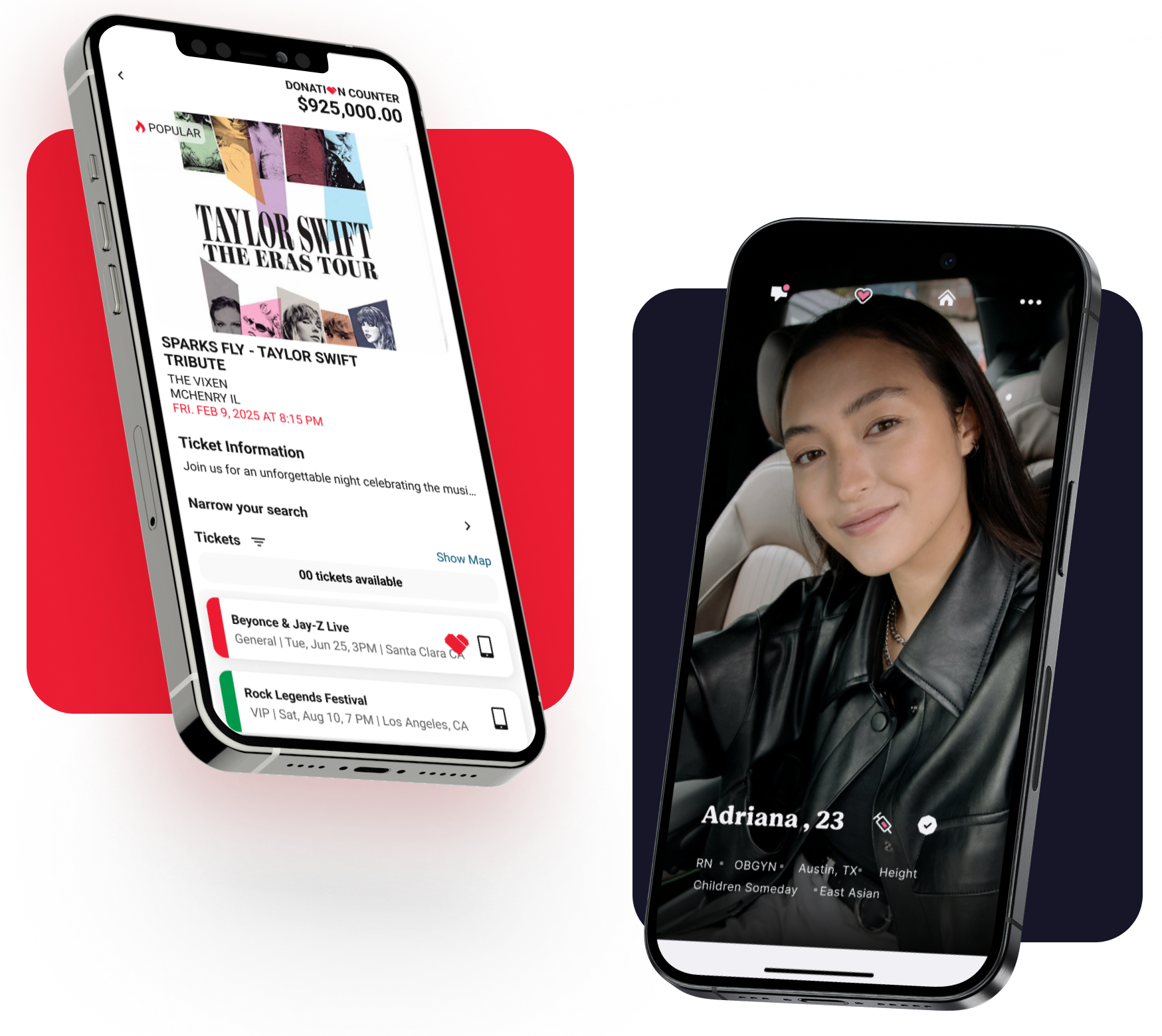
Turning “it already exists” into “here is our angle” is the heart of our strategic planning work, and our development team builds to that angle rather than to a feature checklist. Two partners lived this playbook. GaRGaR entered a world owned by entrenched review giants and differentiated on authenticity: peer-to-peer recommendations from real locals instead of pay-to-play rankings. The community answered with a 75% return rate on recommendation lists, 1,000+ new recommendations daily, and a 4.8+ App Store rating in its first three months. ForeveRx walked into dating, arguably the most crowded consumer category alive, and won an underserved segment: a dating and networking app exclusively for verified healthcare professionals, with every user checked against license and credential databases. It launched with 25,000+ verified healthcare users, converted 33% to paid subscribers, and reached an 85% match success rate. Co-founder Shivani Shah put it simply: “I appreciate that Chop Dawg takes this project as seriously as I do. Chop Dawg is fully invested in our project.”
Who does that work matters as much as the strategy. Chop Dawg is US-headquartered and US-led: Americans run leadership, product and project management, senior development, senior design, and senior quality assurance (QA), backed by our in-house Brazilian designers and in-house development, QA, and project management teams in Pakistan and India. Everyone is in-house, assigned directly to your product, fluent in English, working US hours. That design eliminates the two fears that haunt founders: the lone American salesperson fronting hidden offshore developers with zero accountability, and the faceless overseas shop with no US business norms and no time-zone overlap. Regulated or government project? Choose the fully American team. Otherwise, most partners take the blended model: identical quality and timelines, meaningfully lower cost. It is the same in-house team organizations like the NFL, Six Flags, and Mister Softee have trusted.
Frequently Asked Questions
Is it too late to build an app if a big company already dominates the market?
No. Category leaders are strongest at the center of their market and weakest at the edges: niches, regions, and segments their roadmap ignores. Nearly every giant app displaced an earlier leader. What matters is choosing one differentiation path and executing it faster than the incumbent can respond.
How different does my app need to be from existing competitors?
Different enough that your target user notices in the first session, on a dimension they care about: trust, price, speed, or fit. You do not need ten unique features. One meaningful difference, plus competent table-stakes execution, is how most successful challengers actually win their first market.
Should I worry that a competitor will copy my app idea?
Worry less about theft and more about speed. Incumbents rarely copy niche challengers quickly because their priorities sit with their largest customers and legacy systems. Your protection is momentum: shipping, learning from users, and deepening a moat of community, data, or brand faster than anyone can clone it.
How do I choose which differentiation path to take?
Follow your unfair advantage. Deep industry relationships point to an underserved segment. Local market knowledge points to a new region. Frustration with fees points to a business model play. Then check the choice against competitor reviews and 15 to 20 user interviews before committing your budget.
How much does it cost to build an app that competes with an existing product?
A focused minimum viable product (MVP) typically runs $25,000 to $60,000, while complex platforms run $75,000 to $150,000 or more, and AI-assisted development with senior engineers reviewing every change has cut 2020 to 2023 era costs roughly in half. Matching table stakes plus one sharp differentiator keeps most first builds in the MVP range.
The Market Picked Your Idea. Now Pick Your Angle
An occupied market is a validated market, and validation is the most expensive thing a startup ever buys. Choose your path, study the incumbent’s reviews, and start building momentum they cannot match. If you want help finding the angle, bring your idea to a free 45-minute consultation: new founders and established companies welcome, honest guidance either way, no obligation to hire us. We have been the team behind challenger apps since 2009. Now in our 18th year, Chop Dawg has shipped 500+ products used by more than 1 billion people, holds a 92% repeat-partner rate, and carries 300+ five-star reviews across trusted directories such as Clutch, GoodFirms, G2, Google, and TopDevelopers. Explore our transparent pricing and our proven process when you are ready to move.




 15 Min