





























 14 Min

Start with a monolith when you are building a new platform or moving fast with a small team, and move to microservices when scale, team size, and independent deployment make the added complexity worth it. A monolith is one unified codebase that is simpler to build, test, and run; microservices split the system into independent services that scale and deploy on their own, at the cost of real operational overhead. The pattern is mainstream now, with a Gartner Peer Community survey finding that 74% of respondent organizations use microservices. But popular is not the same as right for you. This guide weighs both honestly.
Key Takeaways
- A monolith is one deployable codebase; microservices are many small, independently deployable services that communicate over the network.
- Monoliths win on simplicity, speed, and cost early on, which is usually the right call for startups and most new platforms.
- Microservices earn their complexity at enterprise scale, with large teams, high traffic, and a need to deploy and scale parts independently.
- Microservices add real overhead: distributed systems, network failure, data consistency, and heavier DevOps and monitoring.
- A common, low-risk path is to start monolithic, keep clean internal boundaries, and split out services only when specific pressures demand it.
What the Two Architectures Actually Are
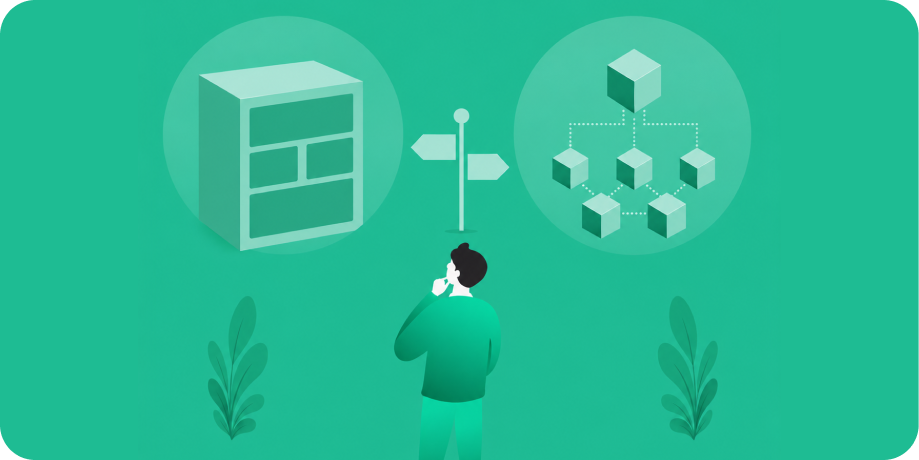
A monolithic application bundles all of your logic, the user interface, business rules, and data access, into a single codebase that deploys as one unit. Everything runs together, calls happen in-process, and there is one thing to build, test, and ship. Microservices break that same system into a set of small, focused services, each owning a slice of functionality and its own data, communicating through application programming interfaces (APIs). Each service can be built by a different team, deployed on its own schedule, and scaled independently. The first is simpler; the second is more flexible. Neither is universally better.
Monolith vs Microservices: Tradeoffs at a Glance
| Factor | Monolith | Microservices |
|---|---|---|
| Initial speed | Fast; one codebase, simple to start | Slower; services, contracts, and infrastructure to set up first |
| Operational complexity | Low; one app to deploy and monitor | High; many services, networking, and orchestration |
| Scaling | Scale the whole app together | Scale only the services under load |
| Deployment | One release; a change means redeploying everything | Deploy each service independently |
| Team fit | Ideal for small, tightly coordinated teams | Ideal for many teams owning separate services |
| Fault isolation | A failure can affect the whole app | A failure can be contained to one service |
| Data consistency | Simpler; one shared database | Harder; data spread across services |
| Cost and tooling | Lower infrastructure and DevOps burden | Higher; demands mature DevOps and monitoring |
When a Monolith Is the Right Call
For startups and most new platforms, a monolith is usually the smarter starting point. With a small team and an unproven product, your scarcest resources are time and focus, and a single codebase lets you build features, test end to end, and ship without standing up complex infrastructure. Calls between components are fast and direct, debugging is straightforward, and you avoid the distributed-systems problems that quietly consume engineering hours. The well-worn advice holds: do not solve scaling problems you do not have yet. A clean, well-structured monolith can take a product a long way, and premature microservices are one of the most common and expensive mistakes early teams make. Keep your internal modules cleanly separated, and you preserve the option to split later without paying for that complexity now.
When Microservices Earn Their Complexity
At enterprise scale, the calculus flips. When dozens or hundreds of engineers work on one product, a shared monolith becomes a bottleneck: teams step on each other, releases queue up, and a single bad deploy can stall everyone. Microservices let independent teams own, deploy, and scale their services on their own cadence. They shine when different parts of the system have very different load, so you can scale the busy services without paying to scale the whole platform, and when fault isolation matters, so one failing component does not take everything down. That flexibility is real, and it is why large organizations adopt the pattern. But it is not free. Microservices demand mature continuous integration and deployment, robust monitoring and tracing, deliberate handling of network failures, and a strategy for data consistency across services. Adopt them to solve concrete problems of scale, team structure, and independent delivery, not because they are fashionable.

Get Your Free 45-Minute App Roadmap
Meet 1-on-1 with our senior product team. We’ll map your MVP or enterprise app and hand you a personalized plan—clear scope, a realistic timeline, and fixed monthly costs—for iOS & Android, web, tablets & wearables, and AI.
The Pragmatic Middle Path
You do not have to choose perfectly on day one. The lowest-risk approach for most platforms is to start with a well-organized monolith, draw clean boundaries between internal modules, and extract services only when a specific pressure appears: a component that needs to scale independently, a team that needs to deploy on its own schedule, or a part of the system that fails in ways you must isolate. This staged path captures the early speed of a monolith and lets you graduate to microservices where they genuinely pay off, instead of betting the architecture before you have the evidence. Architecture is a series of decisions over time, not a one-time bet.
Where Chop Dawg Fits
Chop Dawg architects platforms for the stage they are actually in, and we are honest about when microservices help and when they only add cost. Since 2009 we have launched 500+ products used by more than a billion people, which means we have built lean monoliths that let startups move fast and scaled enterprise systems that needed independent services and serious resilience. We do not impose a trendy architecture; we choose the one that fits your team size, traffic, and roadmap, and we keep clean boundaries so the system can evolve as you grow. The goal is software that ships quickly today and scales cleanly tomorrow, without paying for complexity before it earns its place. For Commute My Kids, a family ride-scheduling startup, that meant engineering a backend designed to coordinate trips safely and scale with demand from day one, rather than over-engineering before the product proved itself. At the other end of the spectrum, organizations that have trusted Chop Dawg with large-scale platforms include Siemens, NASA, and Jefferson Health, where architecture has to hold up under real enterprise load.
We are a partner, not an agency, with no middleman and no subcontractors. Chop Dawg is United States-headquartered and United States-led: our American team owns leadership, product and project management, and senior development, design, and QA, supported by an in-house Brazilian design team and in-house development, QA, and project-management teams in Pakistan and India, all in-house Chop Dawg and assigned directly to your platform. You can run a fully-American team, the route most government and regulated work takes, or choose a cost-effective United States-plus-offshore blend that holds the same quality, timelines, and experience, and in both cases you work with the real senior team directly through daily Slack and weekly or bi-weekly Zoom, never a fully-overseas shop with no accountability or time-zone overlap. You also get fixed-monthly budgeting, the most comprehensive proposals in the business, and ownership of all your code and intellectual property from day one. Our stack is React Native with native Swift and Kotlin, React, and Node.js, hosted and scaled on Google Cloud Platform, Amazon Web Services (AWS), or Microsoft Azure. If you are weighing how to architect a new platform or modernize an existing one, our strategic planning and development services map the right approach for your scale. With 300+ five-star reviews across trusted directories like Clutch, GoodFirms, G2, Google, and TopDevelopers and a 92% repeat-partner rate, teams trust our architectural judgment. Explore our enterprise software development resources or our proven process to see how we work.
Frequently Asked Questions
Should a startup begin with microservices?
Usually not. Most startups are better served by a well-structured monolith, which is faster to build, cheaper to run, and far simpler to debug. Microservices add distributed-systems complexity that small teams rarely need early on. Start monolithic, keep clean internal boundaries, and split into services only when real scaling or team pressures appear.
What problems do microservices actually solve?
They let large numbers of engineers work and deploy independently, allow you to scale only the services under heavy load instead of the whole app, and contain failures so one component does not take everything down. Those benefits matter most at enterprise scale. If you do not have those pressures yet, microservices mostly add overhead.
Can I migrate from a monolith to microservices later?
Yes, and that is a common, sensible path. If you keep your monolith well organized with clean module boundaries, you can extract services incrementally when specific needs arise. Starting monolithic does not lock you in; it preserves your options while keeping early development fast and inexpensive.
Are microservices more expensive than a monolith?
Typically yes, in both infrastructure and engineering effort. Microservices require mature DevOps, orchestration, monitoring, and tracing, plus careful handling of network failures and data consistency. A monolith has a much lighter operational footprint. The added cost is worth it only when independent scaling and deployment deliver real value at your scale.
Does a monolith mean my app cannot scale?
No. A well-built monolith can scale a long way, often by running multiple instances behind a load balancer. Scaling limits tend to come from how the code is structured, not from the monolith itself. Many successful, high-traffic products run on monolithic or mostly monolithic architectures with great results.
How does Chop Dawg decide which architecture to use?
We base it on your team size, expected traffic, deployment needs, and roadmap, not on trends. For many new platforms we recommend a clean monolith to move fast; for large-scale enterprise systems we design microservices where independent scaling and delivery justify the complexity. We will explain the tradeoffs in plain terms so you can decide with confidence.
Architect It Right From the Start
Monolith or microservices, the wrong choice taxes you for years, either with a system that cannot scale or with complexity you never needed. The right choice fits your team, your traffic, and your roadmap, and leaves room to evolve. We would rather help you make that decision well than default to whatever is trendy. Book your free 45-minute consultation and we will talk through the right architecture for your platform, honestly and in plain language, whether or not you decide to build with us.




 15 Min