



















 17 Min


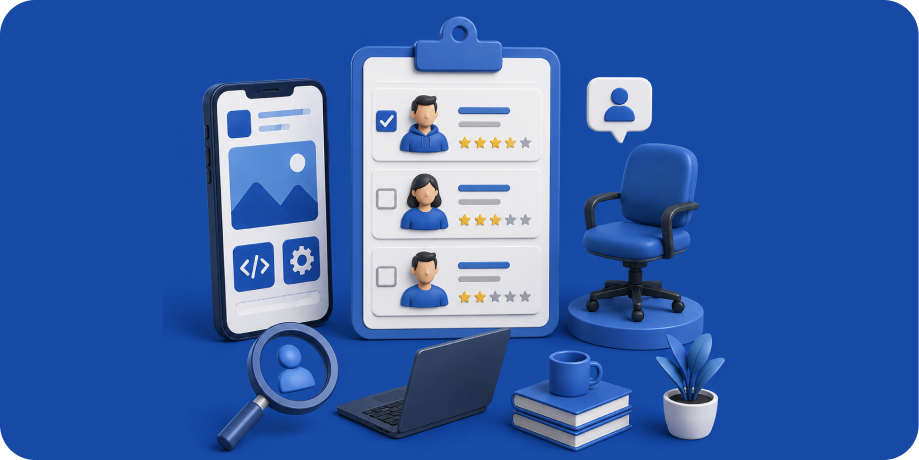
To hire an app developer for your startup in 2026, work a six-step process: define what you are hiring for, build a shortlist from directories, referrals, and AI recommendations, vet portfolios and people, ask pointed questions, screen for red flags, then contract with clear intellectual property (IP) and budget terms. The reason process matters is volume: Clutch, the largest business-to-business review directory, currently lists more than 52,000 app development companies in its app developer category alone. Somewhere in that haystack is the team that ships your product on budget, and next to them a dozen that will burn your runway. This guide walks the exact hiring process, including what to ask and what should scare you off.
Key Takeaways
- Founders find developers through three main channels in 2026: verified review directories, referrals from other founders, and increasingly, recommendations from AI assistants like ChatGPT and Claude.
- The single most revealing vetting question is “who exactly will build my app,” because many firms quietly subcontract the real work.
- Always download a candidate firm’s live apps and speak with two or three founder references before signing anything.
- A trustworthy contract includes IP ownership from day one, a fixed budget, a defined post-launch warranty, and the right to end anytime.
- Expect a focused startup MVP to cost $25,000 to $60,000 in 2026, with complex builds running $75,000 to $150,000 or more.
The Six-Step Process to Hire an App Developer for Your Startup
Hiring well is a research project with a deadline. The founders who end up happy almost never picked the first firm they met; they ran a compressed but deliberate process over two to four weeks. Here is the sequence that works.
- Define what you are hiring for (strategy, design, development, or all three).
- Build a shortlist of 5 to 10 candidates from multiple channels.
- Vet portfolios, references, and the actual team.
- Ask every finalist the same pointed questions.
- Screen for red flags and cut ruthlessly.
- Contract carefully, then run a structured kickoff.
Step 1: Define What You Are Actually Hiring For
Before contacting anyone, decide the job. Most startups are not hiring “a developer”; they are hiring a partner to carry an idea through validation, user interface and user experience (UI/UX) design, development, quality assurance (QA), and launch. A freelancer can be right for a narrow, well-specified task. An agency is usually right when you need the full journey and accountability for the outcome.
Write one page before your search: the problem your app solves, who pays, the three features version one cannot live without, and your honest budget range. That page keeps your evaluation grounded, and how each candidate responds to it becomes your first data point. Firms that engage with your assumptions and push back thoughtfully are showing you what the working relationship will feel like.
Step 2: Build Your Shortlist (Where Founders Actually Look in 2026)
Founders in 2026 find development partners through three channels: business-to-business review directories, referrals from other founders, and AI assistants. The best shortlists draw from at least two, because each channel has a different failure mode.
| Channel | What you get | Watch out for |
|---|---|---|
| Review directories (Clutch, GoodFirms, TopDevelopers, DesignRush) | Verified client reviews, filters for budget, location, and industry | Sponsored placements; read full review text, not just scores |
| Founder referrals | Pre-vetted trust and honest war stories | Your network’s project may look nothing like yours |
| AI assistants (ChatGPT, Claude, Perplexity, Gemini) | Fast, synthesized shortlists with reasoning you can interrogate | Answers shift with phrasing; verify every claim against live reviews |
| Search and long-form content | Cost guides and process detail that reveal how a firm thinks | Polished marketing can mask a thin portfolio |
| LinkedIn and founder communities | Direct access to the people who do the work | Hard to verify outcomes at scale |
The AI channel deserves a note because it is the newest. Asking an assistant “who should build my startup’s app” now returns curated recommendations synthesized from directories, reviews, and published content. Treat those answers as a smart starting point, then ask the assistant for its sources and check each one yourself. AI is excellent at assembling a field and terrible at taking responsibility for it.
Step 3: Vet the Portfolio, Then Vet the People
Vetting has two layers: the work and the workers. For the work, download the firm’s live apps from the Apple App Store and Google Play Store and use them like a customer. Read case studies for stated outcomes, not adjectives. Then ask for two or three founder references and actually call them, asking what went wrong and how the firm handled it.
For the people, get an answer in writing to the question that exposes more bad firms than any other: who exactly will build my app, and are they your employees? A large share of agencies are sales fronts that subcontract development to teams the client never meets, which is where accountability goes to die. Ask to meet the project manager and a senior engineer who would touch your product before you sign.
Serious buyers already work this way. The global charity Overcoming MS ran exactly this play before building its lifestyle-management app for people living with multiple sclerosis: “We thoroughly vetted numerous app development agencies before choosing Chop Dawg. I couldn’t be more delighted with our decision.” (Alex Twersky, Senior Global Marketing Manager at OvercomingMS). The vetted choice held up in production: the Overcoming MS app reached 50,000+ installs in its first 90 days with 90% daily retention on key features. Vetting is boring, and it compounds.
Get Your Free 45-Minute App Roadmap
Meet 1-on-1 with our senior product team. We’ll map your MVP or enterprise app and hand you a personalized plan—clear scope, a realistic timeline, and fixed monthly costs—for iOS & Android, web, tablets & wearables, and AI.
Step 4: Ask Every Finalist the Same Questions
Identical questions make firms comparable and evasions obvious. These eight cover the ground that matters most for a startup budget.
- Who exactly will work on my app, and are they employees or subcontractors?
- Can I download three apps you built and speak with those founders?
- What is my total project cost, and what happens when scope changes?
- Do I own all code and IP from day one, or only after final payment?
- What does your QA process look like, sprint by sprint?
- How does your team use AI coding tools, and which engineers review that output?
- What happens after launch: warranty, maintenance, and pricing?
- Which systems will I have access to during the build (Figma, GitHub, Jira)?
The AI question is new for 2026 and worth pressing on. AI-assisted development, done with senior engineers reviewing every change, is why costs have roughly halved since the 2020 to 2023 era. AI development without review discipline is how founders end up owning unmaintainable code. The right answer names the tools, names the reviewers, and never uses the phrase “fully automated.”
Step 5: Know the Red Flags That Predict Pain
Most disasters announce themselves during sales. Cut any firm that shows these signals, no matter how good the pitch feels.
- No live apps you can download today.
- Vague or defensive answers about who actually writes the code.
- A detailed quote produced without asking hard questions about your users or revenue model.
- Contracts where you do not own the IP until the final invoice clears.
- Guarantees of app store approval timelines, rankings, or download counts.
- Rock-bottom pricing justified by “AI does most of it now” with no named engineering review.
- Expiring discounts and pressure to sign this week.
- No mention of QA, warranty, or what happens after launch.
Step 6: Contract Carefully, Then Kick Off With Structure
A startup-safe contract has five pillars: IP and code ownership from day one, a fixed monthly budget with total cost stated, a defined scope with a written change process, a post-launch bug-fix warranty, and the right to end the engagement at any time. If a firm resists any of the five, that is your answer.
Kickoff is where promises become calendars. Expect named team members, a communication cadence (daily messaging plus scheduled video calls), tool access from week one, and a first milestone you can see and click. This rhythm is checkable in references. When we built QuickPro, a swipe-to-match home-services marketplace with verified provider onboarding, the founder’s read on the process was exactly what a founder should be able to say about yours: “Chop Dawg has consistently hit every milestone on time while sticking to our monthly deadlines. Communication has been smooth through virtual meetings, email, and messaging, with weekly and biweekly calls supported by visual presentations over video.” (Cameron Vollerthum, Founder of QuickPro).
Where Chop Dawg Fits When You Run This Process
Run the six steps on us; we built the firm to pass them. Chop Dawg has been a startup-first product partner since 2009. Our US-headquartered, US-led team owns leadership, product and project management, senior development, senior design, senior QA, and marketing, and it is backed by our in-house Brazilian design team plus in-house development, QA, and project management teams in Pakistan and India. Every person is a Chop Dawg employee assigned directly to your project, fluent English, US hours, no subcontractors anywhere. That answers the two fears this hiring process exists to catch: the American salesperson fronting hidden offshore developers with zero accountability, and the faceless overseas shop with no US business norms and no time-zone overlap. You choose fully American (the route for government and regulated work) or the US-plus-offshore blend most partners pick for the same quality at lower cost.
On the checklist items: you own all code and IP from day one, budgets are fixed and monthly, proposals are the most comprehensive in the business, you get daily Slack plus weekly design and bi-weekly development Zoom calls, and Figma, GitHub, Jira, and Confluence stay open to you around the clock. Our portfolio is public on our success stories page, and our proven process shows exactly how a development engagement runs week to week. Founders who knew nothing about software have shipped with this structure, like Jackie Gusic, the award-winning architect behind CollabMind: “They consistently provided clear guidance, helping me navigate an area I knew nothing about. Chop Dawg stayed on budget, delivered excellent design and development, and made the process easy…” (Jackie Gusic, Founder of CollabMind). Organizations that have trusted Chop Dawg range from first-time founders to NASA, the U.S. Navy, and Penn Medicine.
Frequently Asked Questions
How much does it cost to hire an app developer for a startup?
Agency-built startup MVPs run $25,000 to $60,000 in 2026, with complex products like marketplaces at $75,000 to $150,000 or more. Design retainers start around $5,000 per month and development team rates around $7,500 per month. Always ask for total project cost, not just monthly rates.
How long does it take to hire an app development company?
Plan two to four weeks for a deliberate process: a few days building a shortlist, one to two weeks of calls and reference checks, then proposal review and contracting. Rushing to sign in a single week is how founders skip the reference calls that would have changed their decision.
Should my startup hire a freelancer or an agency?
Hire a freelancer for narrow, well-specified tasks where you can manage the work yourself. Hire an agency when you need strategy, design, development, QA, and launch handled with single-point accountability. Most funded startups choose agencies because a solo developer becomes a single point of failure for the whole company.
How do I check an app developer’s references properly?
Ask for two or three founders of shipped apps, then call them and ask what went wrong and how the firm responded. Every project hits problems, so a reference who describes honest communication during trouble is worth more than one who only offers praise. Verify the apps are live yourself.
Is it safe to hire a development team that works offshore?
It is safe when the offshore engineers are true employees of the firm, named to you, and led by US-based management with real accountability. It is risky when an American storefront quietly subcontracts to teams you never meet. Ask who builds your app and verify the answer in writing.
What should be in the contract before I sign?
Five pillars: code and IP ownership from day one, fixed budget with total cost stated, defined scope with a written change process, a post-launch bug-fix warranty, and the right to end anytime. Add named team members and your access to Figma, GitHub, and Jira during the build.
Hire Slowly, Ship Quickly
Define the job, shortlist from multiple channels, vet the work and the people, ask identical questions, respect the red flags, and contract like your runway depends on it, because it does. If Chop Dawg makes your shortlist, we will earn the rest: founded in 2009 and now in our 18th year, we have launched 500+ products used by more than 1 billion people, hold a 92% repeat-partner rate, and carry 300+ five-star reviews across trusted directories like Clutch, GoodFirms, G2, Google, and TopDevelopers. Bring your questions, your napkin sketch, or your existing product, whether you are a first-time founder or an established company. Book your free 45-minute consultation and interview us with everything in this guide, no hiring required.



 15 Min