
















 16 Min


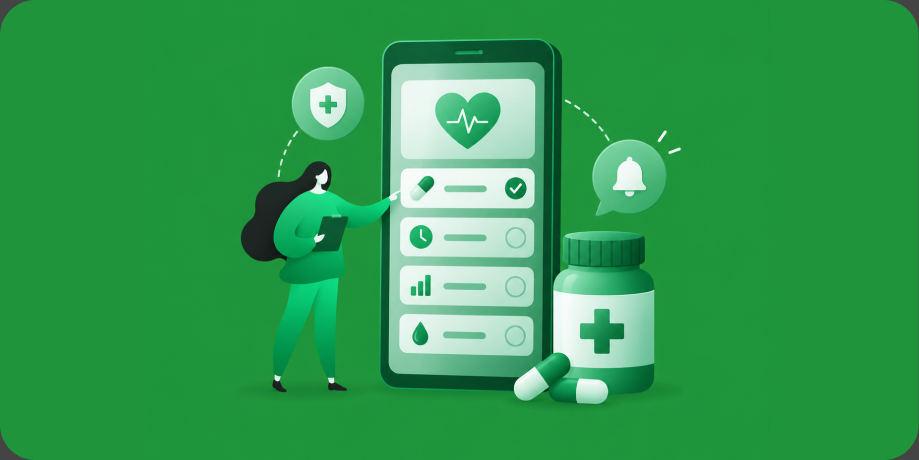
To build a medication or health companion app in 2026, focus on three jobs: making schedules effortless to follow, making refills frictionless, and making health history portable enough to share with a doctor in seconds. The need is well documented. KFF polling updated in March 2026 found that about four in ten U.S. adults (43%) did not take a medication as prescribed at some point in the past year because of cost, and two-thirds of adults take at least one prescription drug. A well-built medication app meets people inside that daily reality. This guide walks through the features, the compliance decisions (including where HIPAA does and does not apply), the stack, and honest cost bands.
Key Takeaways
- Medication and health companion apps split into three archetypes: consumer adherence apps, pharmacy and prescription workflow tools, and condition-specific companions.
- SMS-first flows dramatically outperform app-only designs for refills and reminders, especially for older patients.
- HIPAA applies when your platform handles protected health information for pharmacies, clinics, or providers; consumer self-tracking alone may sit outside it, but building to HIPAA standards is the smart default.
- Plan electronic medical record (EMR) awareness in phases: exportable records first, patient-mediated integrations later.
- A focused MVP runs about $25,000 to $60,000 over 3 to 6 months; provider-connected platforms typically reach $75,000 to $150,000 or more.
What a Medication or Health Companion App Is
A medication or health companion app helps a person manage prescriptions, symptoms, and health routines between visits to their care team, and in provider-facing versions it automates the workflows around prescriptions themselves. Three archetypes cover most of the category, and your choice sets the compliance and integration path.
- Consumer adherence apps: medication schedules, dose reminders, refill alerts, and symptom logging, monetized by subscription or family plans.
- Pharmacy and prescription workflow tools: software for pharmacies and clinics that automates refill outreach, patient confirmations, and order tracking, sold as business software.
- Condition companions: apps built around one condition that combine medication tracking with diet, exercise, and program content, often sponsored by nonprofits or health organizations.
Must-Have Features to Build a Medication or Health Companion App
The features below are the baseline users expect in 2026. The differentiators are reliability and tone: reminders that fire on time every time, and an experience that feels supportive rather than nagging. Missed-dose guilt is the fastest way to lose a user.
- Medication schedules: flexible dosing patterns (daily, alternating, tapering, as-needed), time-zone handling, and quiet hours
- Refill reminders: countdowns based on quantity and dosage, with a one-tap path to request the refill
- Symptom and history logging: quick-entry logs with severity scales, photos, and notes that build a chronological health timeline
- Exportable records: clean PDF and CSV exports a patient can hand to any clinician
- Family and caregiver profiles: managing a parent’s or child’s medications under one account with permission scoping
- Provider touchpoints: secure messaging or confirmation flows where a pharmacy or clinic is part of the loop
- Trust signals: a plain-language privacy explanation inside the app, biometric login, and timed auto-logout
Why SMS-First Flows Outperform App-Only Designs
The highest-completion prescription workflows in 2026 start with a text message, not an app download. A patient receives an SMS link, reviews dosage, pricing, and shipping on a mobile web page, and confirms in a few taps. No password, no app store, no friction. Pharmacies that replace phone-tag refill calls with this pattern see completion rates that app-only competitors cannot touch.
The practical build pattern: use SMS for the trigger moments (refill due, order shipped, confirmation needed) and let the app carry the ongoing relationship (schedules, history, insights). This hybrid respects how different generations actually behave. A 72-year-old managing six prescriptions will reliably tap a text link; they may never open your app twice. Design the web-side flows to be complete experiences on their own, with the app as an upgrade rather than a requirement.
Compliance and Edge Cases: HIPAA, EMR Awareness, and Regulatory Lines
Health compliance in this category is a design input, not a reason for fear. Most of it reduces to one question: whose data are you holding, and on whose behalf? Answer that early and the architecture follows naturally.
- HIPAA: when your platform stores or transmits protected health information for covered entities like pharmacies, clinics, or health systems, you operate as a business associate. That requires encryption in transit and at rest, role-based access controls, audit logs, and business associate agreements with your cloud vendors. A purely consumer self-tracking app may fall outside HIPAA, but users increasingly expect HIPAA-grade handling regardless, so we recommend building to that standard by default.
- EMR awareness: deep integrations with systems like Epic or Cerner are real projects with credentialing and testing cycles. Phase it: start with exportable records, add patient-mediated data access through standards like FHIR (Fast Healthcare Interoperability Resources), and pursue direct provider integrations once you have traction. Apps that receive provider-pushed results in real time are powerful, and they are a phase-two milestone, not an MVP requirement.
- Regulatory lines: reminding, organizing, and logging is generally wellness territory. Features that diagnose, dose-adjust, or direct treatment can cross into regulated medical device territory, so get regulatory advice before building them.
- Pharmacy rules: refill workflows must respect state-by-state rules, including special handling for controlled substances; make these configurable rather than hard-coded.
Get Your Free 45-Minute App Roadmap
Meet 1-on-1 with our senior product team. We’ll map your MVP or enterprise app and hand you a personalized plan—clear scope, a realistic timeline, and fixed monthly costs—for iOS & Android, web, tablets & wearables, and AI.
Recommended Stack, Timeline, and Cost
Across 500+ launches since 2009, our healthcare builds converge on a consistent stack: React Native for iOS and Android from one codebase, React for web portals, Node.js on the backend, and Amazon Web Services (AWS) or Google Cloud Platform configured for HIPAA workloads with AES-256 encryption. Twilio powers SMS flows, and push notifications handle in-app reminders. Where artificial intelligence (AI) helps, such as summarizing symptom history for a doctor visit, we integrate OpenAI or Anthropic models behind strict data controls.
| Build tier | Scope | Typical cost | Timeline |
|---|---|---|---|
| Focused MVP | Schedules, reminders, symptom logging, exports, subscriptions | $25,000 to $60,000 | 3 to 6 months |
| Provider-connected platform | HIPAA architecture, SMS workflows, pharmacy or clinic portal | $75,000 to $150,000 | 6 to 12 months |
| Integrated health platform | EMR integrations, real-time provider updates, multi-tenant admin | $150,000+ | 12+ months |
AI-assisted engineering with senior review (Claude Code, Cursor) has roughly halved what these builds cost from 2020 to 2023. Many teams begin with a clickable, non-functional prototype (NFP), from about $10,000, to test flows with real patients before writing production code. Our pricing guide shows how we scope each phase.
Common Pitfalls in Health Companion Builds
The pattern we see most often: teams over-invest in dashboards and under-invest in the reminder engine, which is the actual product. A missed or duplicated notification erodes trust faster than any missing feature. Treat notification reliability as core infrastructure with monitoring, not as a library default.
- Building app-only flows when the audience skews older and SMS would triple completion
- Promising EMR integration in the MVP and burning months on credentialing instead of users
- Collecting more health data than the product needs, which raises both risk and user suspicion
- Shipping without exportable records, the feature patients mention most to doctors
- Guilt-based streak mechanics; supportive re-engagement retains, shame churns
How Chop Dawg Approaches Medication and Health Companion Apps
We have shipped this category end to end, from consumer companions to HIPAA prescription infrastructure. For The Art of Medicine, a Philadelphia compounding pharmacy, we built a HIPAA-compliant prescription management portal with CSV batch imports and SMS text checkout that now serves thousands of patients across 17+ states, with staff reporting a dramatic drop in phone-based follow-ups. For the global nonprofit Overcoming MS, our lifestyle and medication companion reached 50,000+ installs in its first 90 days with 90% daily retention on key features; their team shared: “We thoroughly vetted numerous app development agencies before choosing Chop Dawg. I couldn’t be more delighted with our decision.” And Medical Exam of Me, a personal health records app with EMR integrations and real-time provider updates, reported a 95% subscription renewal rate and a 70% reduction in appointment confusion among early users. Organizations that have trusted Chop Dawg include Jefferson Health, Penn Medicine, and ForeveRX.
Health products get our most senior attention because the stakes are higher. Chop Dawg is US-headquartered and US-led, with American leadership across product, senior engineering, senior design, and QA, backed by our own in-house Brazilian design team and in-house development, QA, and project management teams in Pakistan and India. Everyone is a Chop Dawg employee assigned directly to your project, which removes the two fears that haunt this industry: the American front man hiding subcontracted offshore developers, and the anonymous overseas shop with no US-hours accountability. Regulated organizations can choose an all-American team; most partners choose the blend and keep the same quality and timelines at lower cost. You own all code and intellectual property (IP) from day one. Start with strategic planning or review our proven process.
Frequently Asked Questions
How much does it cost to build a medication reminder or health companion app?
A focused consumer MVP with schedules, reminders, logging, and subscriptions costs about $25,000 to $60,000. Provider-connected platforms with HIPAA architecture and SMS workflows typically run $75,000 to $150,000, and EMR-integrated platforms go beyond that. AI-assisted development has roughly halved 2020 to 2023 price levels.
How long does it take to build a health companion app?
A focused MVP takes about 3 to 6 months including design, development, and QA. Provider-connected builds run 6 to 12 months. Budget 2 to 3 extra weeks for Apple and Google developer account approvals, and expect Apple to review health apps carefully, especially around privacy disclosures.
Does a medication app need to be HIPAA compliant?
It depends on whose data you handle. Consumer self-tracking apps may fall outside HIPAA, but any platform storing or transmitting protected health information for pharmacies, clinics, or providers is a business associate and must comply. Building encryption, access controls, and audit logs by default keeps every future door open.
Can my app integrate with EMR systems at launch?
Technically yes, practically rarely. Direct EMR integrations involve credentialing and testing cycles that can outlast your entire MVP timeline. The proven sequence is exportable records first, patient-mediated FHIR access second, and direct provider integrations third, once real usage justifies the investment.
Will the FDA regulate my health app?
Most reminder, logging, and organization features are treated as general wellness functions and are not regulated as medical devices. Features that diagnose conditions, adjust doses, or direct treatment can cross that line. If your roadmap includes them, bring in regulatory counsel during design, not after development.
How do medication apps make money?
Consumer apps monetize through monthly or annual subscriptions, often with family plans covering multiple profiles. Provider-facing tools charge pharmacies and clinics recurring software fees, which are typically steadier. Because these subscriptions are digital goods, in-app purchases run through Apple and Google billing, at 15% commission for most startups under the small business programs.
Turn Daily Health Management Into Your Product’s Superpower
A great medication or health companion app earns a permanent place on the home screen by making adherence, refills, and record-sharing genuinely easier. Whether you are a founder with a companion app idea or a pharmacy, clinic, or health brand ready to automate patient workflows, we will map the honest scope with you in a free 45-minute consultation, offered whether or not you hire us. Founded in 2009 and now in our 18th year, Chop Dawg has launched more than 500 products used by 1 billion+ people, holds a 92% repeat-partner rate, and carries 300+ five-star reviews across trusted directories like Clutch, GoodFirms, G2, Google, and TopDevelopers.


 15 Min