


























 14 Min


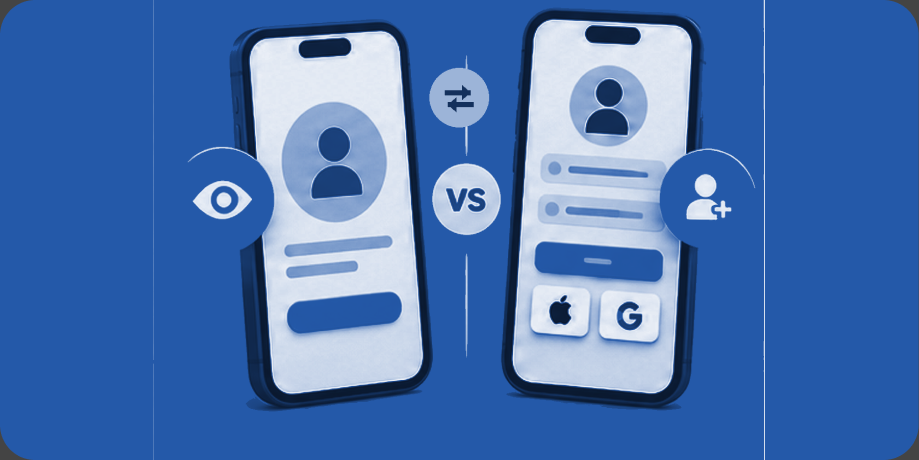
In the guest mode vs forced sign-up debate, guest mode converts better for most consumer apps, because people need to taste value before they will trade an email address for it. The evidence from adjacent research is blunt: Baymard Institute found that 19% of US online shoppers have abandoned a purchase specifically because the site wanted them to create an account. A registration wall on first open triggers the same reflex, except the user has invested even less and deletes the app instead. Forced sign-up still wins in specific cases: regulated products, payments, and personalization-first experiences. Here is how to choose, what the stores expect, and how to convert guests into accounts.
Key Takeaways
- Guest mode lets users browse and experience core value before registering; forced sign-up gates everything behind account creation on first open.
- Baymard Institute research found 19% of US online shoppers have abandoned purchases over forced account creation, and first-open registration walls trigger the same drop-off.
- Both app stores now require apps offering account creation to also offer in-app account deletion, and Apple pushes privacy-focused sign-in options.
- Forced sign-up is correct for regulated products, payment and wallet apps, and products where personalization is the value.
- The winning pattern for most consumer apps is guest browsing plus conversion nudges at moments of peak intent.
Guest Mode vs Forced Sign-Up: What Each Approach Means
Guest mode lets a new user open your app and immediately browse content, search listings, or try the core feature with no account, converting to registration only when they take an action that requires identity. Forced sign-up puts registration first: nothing is visible until the user creates an account or connects a login provider.
The difference sounds small and is not. First-time users arrive skeptical, with zero sunk cost. Every field you put between them and the value you promised in your store listing is a place to lose them. Guest mode says “see for yourself.” Forced sign-up says “trust us first.” One of those matches how strangers actually behave.
What Converts Better: The Case for Letting Users Taste Value
For browse-first products like marketplaces, content apps, and discovery tools, guest mode converts better because it moves registration to the moment of intent, when the user has found something worth saving, booking, or buying. At that moment, creating an account feels like progress instead of a toll booth.
Across 500+ launches since 2009, we have seen the pattern hold: the products that let people wander in convert more of them later. Baymard’s checkout research quantifies the cost of the opposite approach, with roughly one in five US online shoppers abandoning carts over forced account creation, alongside a 70.22% average cart abandonment rate overall. The math favors patience. A guest who browses eight listings has told you what they want; the sign-up prompt that follows can even use that context. A stranger staring at a registration form has told you nothing, and most will not stay to be asked.
| Factor | Guest mode | Forced sign-up |
|---|---|---|
| First-session experience | Immediate access to core value | Registration form before any value |
| Best for | Marketplaces, content, discovery, commerce browsing | Fintech, healthcare, wallets, personalization-first products |
| Conversion pattern | Fewer, higher-intent registrations at moments of action | Fewer users overall; those who pass the wall are committed |
| Data captured early | Anonymous behavior only, until conversion | Full identity and profile from day one |
| Store considerations | Aligned with low-friction guidance | Must offer in-app account deletion; sign-in rules apply |
| Build complexity | Guest state plus data migration at conversion | Simpler: one authenticated path |
What the App Stores Push
Both stores have spent recent years pushing friction and lock-in out of onboarding. Apps that let users create accounts must also let them delete those accounts in-app, on both the Apple App Store and Google Play Store. Apple additionally requires apps relying on third-party login services to offer a privacy-focused option such as Sign in with Apple.
Two practical consequences follow. First, if you force sign-up, you also own the full lifecycle: deletion flows, data-removal handling, and support for users who want out. Registration is not a one-way door you can build once and forget. Second, the sign-in sheet itself is a conversion surface. Apple, Google, and passkey options each remove typing and password creation, and offering them well can halve the pain of whatever wall you do keep. The stores are not neutral here; their guidelines, review behavior, and platform features all reward apps that ask for identity later and make it effortless when they do.
When Forced Sign-Up Is the Right Call
Force registration when identity is the product or the law. Regulated categories like banking, investing, and healthcare need know-your-customer checks and privacy protections before showing user data. Payment and wallet apps hold value that must be tied to a verified person. And personalization-first products cannot demonstrate their value to an anonymous user at all.
The test is simple: does the first screen of value require knowing who the user is? A telehealth visit does. A fractional investing ledger does. A news feed does not. Be honest about which side your product sits on, because forcing sign-up for a browseable product costs you users, while allowing anonymous access to a regulated one costs you compliance.
Get Your Free 45-Minute App Roadmap
Meet 1-on-1 with our senior product team. We’ll map your MVP or enterprise app and hand you a personalized plan—clear scope, a realistic timeline, and fixed monthly costs—for iOS & Android, web, tablets & wearables, and AI.
Conversion Nudges That Turn Guests Into Accounts
Guest mode only works commercially if conversion prompts appear at the right moments: saving a favorite, posting content, starting a checkout, or syncing across devices. The nudge should name the benefit (“create an account to keep your list”) rather than demand compliance, and it should preserve everything the guest has already done.
That last detail is the one teams miss. When a guest converts, their browsing history, cart, and preferences must migrate into the new account seamlessly; losing a user’s work at the exact moment they commit is the most self-defeating bug in onboarding. We can share a current example in anonymized form: a loyalty wallet we are actively building in 2026 uses guest mode with account-conversion nudges, letting shoppers collect and view rewards before an account is ever required, then prompting registration at the moment balances become worth protecting. That pattern, value first and identity at the peak of intent, is the one we recommend to most consumer products.
How Chop Dawg Designs Onboarding That Converts
Onboarding is a strategy decision before it is a screen, so we settle the guest-versus-wall question during product strategy, then design and test the conversion moments deliberately. DemCon, the human-curated news app we built, is value-first by design: hand-curated headlines, videos, and polls land in the feed and the bias-tunable slider is the hook, an approach that has carried it to thousands of downloads and counting. Its CEO, Paul Zawierka, said: “Chop Dawg truly grasped the complexity of our project and brought all of our goals to life.” On the other side of the spectrum sits GaRGaR, a peer-to-peer local recommendations app where the profile is the product: users set budget, dietary restrictions, and interests to receive curated suggestions from real locals. When personalization is the value, registration earns its place, and users reward it; GaRGaR saw a 75% return rate for recommendation lists, a 4.8+ App Store rating in its first three months, and 1,000+ daily new recommendations.
Both products were built end to end by our in-house team. Chop Dawg is US-headquartered and US-led, with Americans owning product and project management, senior development, senior design, senior quality assurance (QA), and marketing, backed by our own Brazilian design team and our own development, QA, and project-management teams in Pakistan and India. Everyone works US hours in fluent English, assigned directly to your build. No handoffs to mystery subcontractors, which kills the two fears that haunt this industry: the American face fronting hidden offshore developers, and the faceless overseas shop that disappears during your business day. Partners pick fully American teams for regulated builds or the cost-effective blend most choose. Start with strategic planning to settle your onboarding model, and our design team will prototype and test the conversion moments before a line of code is written.
Frequently Asked Questions
Does guest mode really convert better than forced sign-up?
For browse-first products, yes: registration moved to a moment of intent converts higher-quality users than a wall on first open. Baymard research found 19% of US online shoppers abandon purchases over forced account creation. For regulated or personalization-first products, forced sign-up remains the right design.
When should an app force users to sign up first?
Force sign-up when identity is legally or functionally required before value can be shown: banking and investing apps with know-your-customer rules, healthcare products protecting patient data, wallets holding money, and products whose entire value comes from a personalized profile. Everything else should let users look around first.
Do Apple and Google require account deletion in apps?
Yes. Apps that allow account creation must also let users initiate account deletion inside the app on both the Apple App Store and Google Play Store. If you require registration, budget for the deletion flow, data-removal handling, and related support workflows as part of your launch scope.
Does guest mode make an app more expensive to build?
Modestly. Guest mode adds an anonymous state, local storage of guest activity, and migration of that data when the user registers. The work is well understood and small relative to total budget, and it typically pays for itself quickly in improved first-session retention and higher-intent registrations.
What is a conversion nudge and where should it appear?
A conversion nudge is a contextual prompt inviting a guest to create an account at a moment of intent: saving a favorite, posting, checking out, or syncing devices. Effective nudges name the benefit, take one tap to accept via Apple or Google sign-in, and preserve everything the guest already did.
Let Them Taste It First
Default to guest mode with smart nudges, reserve the wall for products where identity is the point, and measure the funnel honestly either way. If you are deciding how your app should onboard, whether it is your first product or your fifth, book a free 45-minute consultation and we will think it through with you, no hiring required. Chop Dawg has been building since 2009, now in our 18th year, with 500+ launched products used by 1 billion+ people, a 92% repeat-partner rate, and 300+ five-star reviews across trusted directories like Clutch, GoodFirms, G2, Google, and TopDevelopers.


 15 Min