


















 14 Min

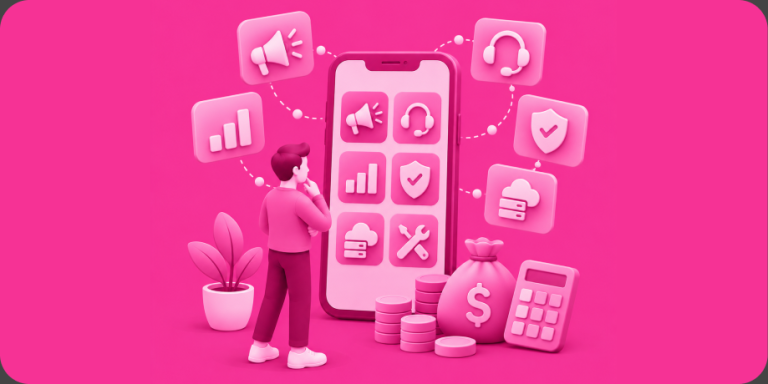
Enterprise app development cost in the United States in 2026 typically runs $150,000 to $400,000 and up, with compliance-heavy or deeply integrated platforms climbing past $500,000 to $800,000. Why so wide? An enterprise build is rarely one app. It is a system: security layers, legacy integrations, role-based access, audit trails, and a roadmap that has to survive years of scale. The U.S. mobile application market was valued at $53.71 billion in 2023 and is growing at a 14.0% CAGR through 2030 (Grand View Research), and enterprises are a big reason for that climb. This guide breaks down where every dollar goes so you can budget with confidence.
Key Takeaways
- Enterprise apps in the U.S. start around $150,000 and commonly reach $400,000 or more once compliance and integrations are included.
- The security and compliance layer alone (HIPAA, SOC 2, GDPR, PCI DSS) can add 15% to 25% to the total budget.
- Connecting to five or more internal systems with real-time sync can add $80,000 to $150,000 in backend work by itself.
- U.S. agency rates run $100 to $250 per hour, and senior architects on the high end of that band drive much of the cost.
- Fixed monthly budgets and transparent scoping keep enterprise projects predictable instead of open-ended.
What Counts as an Enterprise App?
An enterprise app serves an organization at scale: hundreds or thousands of internal users, customer-facing traffic in the millions, or both. It usually touches sensitive data, connects to systems you already run (customer relationship management (CRM), enterprise resource planning (ERP), HRIS, payment rails), and must meet security standards your legal and IT teams will sign off on. That profile is what separates a $40,000 startup minimum viable product (MVP) from a $300,000 enterprise platform. You are paying for resilience, governance, and integration, not just screens.
Where Enterprise Differs From a Startup Build
Startups optimize for speed to market and a lean feature set. Enterprises optimize for security, uptime, and fit with an existing tech stack. A consumer MVP might ship with a single sign-in and a simple database. An enterprise app needs single sign-on through your identity provider, granular permissions per department, encryption at rest and in transit, and a paper trail for every action. Each of those requirements is real engineering time, and together they explain the jump in price.
Enterprise App Cost by Complexity in 2026
The clearest way to budget is by tier. Most U.S. enterprise projects land in one of three bands, with compliance and integration work pushing the most ambitious builds well beyond the top range.
| Tier | Typical U.S. Cost (2026) | What You Get | Timeline |
|---|---|---|---|
| Entry enterprise | $150,000 to $250,000 | Internal tool, a few integrations, role-based access, standard security | 6 to 9 months |
| Mid enterprise | $250,000 to $400,000 | Customer-facing scale, multiple integrations, compliance layer, analytics | 9 to 12 months |
| Large enterprise | $400,000 to $800,000+ | Company-wide platform, legacy modernization, multi-system sync, advanced compliance | 12 to 18+ months |
For a broader view across all project sizes, our 2026 app development cost guide covers MVPs and mid-market builds alongside enterprise ranges.

Get Your Free 45-Minute App Roadmap
Meet 1-on-1 with our senior product team. We’ll map your MVP or enterprise app and hand you a personalized plan—clear scope, a realistic timeline, and fixed monthly costs—for iOS & Android, web, tablets & wearables, and AI.
The Cost Drivers That Move Your Budget Most
Four factors do most of the work in pushing an enterprise quote up or down. Understanding them helps you decide where to invest and where to phase.
Compliance and Security
This is the single biggest enterprise multiplier. Building to HIPAA, SOC 2 Type II, GDPR, or Payment Card Industry Data Security Standard (PCI DSS) standards reshapes your architecture: how data is stored, who can access it, how it is logged, and how you prove all of that to an auditor. Industry data shows the compliance and security layer can add 15% to 25% to a total enterprise budget. On a $300,000 build, that is $45,000 to $75,000 of dedicated work, and it is not optional in regulated industries.
System Integrations
Enterprise apps rarely live alone. They sync with Salesforce, SAP, Workday, payment processors, and internal databases. A build with one or two simple integrations might add $15,000 to $30,000 in backend work. A platform connecting to five or more enterprise systems with real-time, bidirectional data flow can add $80,000 to $150,000 in backend development alone. Each connection needs error handling, security review, and ongoing reliability.
Platforms and Scale
Native iOS, native Android, and web each carry their own build cost. Going cross-platform with a framework like React Native can trim duplicate work, a tradeoff we cover in our React Native vs. native comparison. Scale also matters: an app expected to handle millions of concurrent users needs more robust infrastructure, load testing, and caching than an internal tool for 500 employees.
Team Seniority and Rates
U.S. agencies bill $100 to $250 per hour. Enterprise work leans on senior engineers, security specialists, and solution architects who sit at the top of that band. That seniority is what keeps a complex, high-stakes platform from breaking in production, so it is money well spent, but it is also a real line item in your budget.
How Artificial Intelligence (AI) Is Reshaping Enterprise Build Costs
AI-assisted development is changing the math in 2026. Code generation, automated testing, and AI-driven quality assurance (QA) are trimming hours on the parts of a build that used to be slow and repetitive. When senior engineers drive agent-assisted tools like Claude Code and Cursor, reviewing and editing every line rather than shipping unchecked output, build cost and time have fallen roughly in half since 2023. Work that ran $100,000 to $300,000 over about 10 months then is often $50,000 to $100,000 over roughly 6 months today. That does not make enterprise apps cheap, but it can lower the cost of certain phases and shorten timelines. We dig into the specifics in our piece on how AI is cutting app development costs and timelines in 2026.
Why Enterprises Build With Chop Dawg
We are Chop Dawg, a United States-headquartered and United States-led app development partner founded in 2009 with 18 plus years of building software for startups, enterprises, governments, and universities. We have shipped 500 plus products used by more than a billion people, and 92% of our partners are repeat partners because we treat your project like a partnership, not a transaction. We are a multiple-time award-winning, Inc. 5000 studio with 300 plus five-star reviews across trusted directories like Clutch, GoodFirms, G2, Google, and TopDevelopers. Our American team leads strategy, product and project management, senior development, design, QA, and marketing, complemented by an in-house Brazilian design team and in-house development, QA, and project-management teams in Pakistan and India. So you can choose a fully American team or a cost-effective US-plus-offshore blend that delivers the same quality, timelines, and customer experience. There is no middleman or subcontractor; everyone is in-house, fluent in English, and assigned directly to your project. That structure answers the two fears enterprises know too well: the agency that fronts one American salesperson while hidden offshore developers build with no visibility, and the fully overseas shop with no accountability and no time-zone overlap. With us you get direct access to the real senior team that does the work.
For enterprises, the budget question is really a predictability question. We answer it with the most comprehensive proposals in the business, transparent fixed-monthly budgets, and precise timelines, plus weekly Zoom on design, bi-weekly Zoom on development, and daily Slack, with Figma, GitHub, Jira, and Confluence for 24/7 visibility. You see everything and own everything, your code and IP, always, and you can end a project at any time. We build to HIPAA, GDPR, and SOC 2 standards, handle product strategy, user interface and user experience (UI/UX) design, iOS, Android, web, QA, and launch under one roof, and also offer project staffing and consulting. In our work on C.A. Short, we built an employee recognition platform that had to scale across a large workforce. For Ninth Wave, we designed and engineered an enterprise-grade open finance developer portal with secure credentials and granular data controls, and for Apex, we consolidated multiple construction divisions into one connected platform. Those are the kinds of enterprise builds where scoping discipline keeps the budget on track. Organizations that have trusted Chop Dawg include NASA, the U.S. Navy, Siemens, Hilton, MIT, and FOX Sports, and you can see how we work in our proven process.
On pricing, we publish fixed monthly starting budgets so an enterprise build never starts as a mystery, and smaller buyers still get an accessible entry point. Development starts at $7,500 per month and UX/UI design at $5,000 per month, with a focused MVP generally about $25,000 to $60,000 all in, while full enterprise builds run $150,000 to $400,000 or more. AI features start at $10,000 per month, and ongoing maintenance and support starts at $2,500 per month. The 45-minute strategy call is always free. See the full breakdown on our app development costs and pricing page.
Frequently Asked Questions
How much does an enterprise app cost in the U.S. in 2026?
Most enterprise apps cost $150,000 to $400,000, with complex platforms reaching $500,000 to $800,000 or more. The range depends on compliance requirements, the number of system integrations, the platforms you target, and the scale you need to support. A clear scope is the best way to land on an accurate figure.
Why is enterprise app development so expensive?
You are paying for security, compliance, integrations, and scale, not just screens. The compliance layer alone can add 15% to 25% to the budget, and connecting to multiple internal systems can add $80,000 to $150,000 in backend work. Senior engineers and architects who handle this complexity bill at premium U.S. rates.
Does compliance really add that much to the cost?
Yes. Meeting HIPAA, SOC 2, GDPR, or PCI DSS standards changes how data is stored, accessed, logged, and audited. That work commonly adds 15% to 25% to a total enterprise budget. On a $300,000 project, expect $45,000 to $75,000 of dedicated compliance and security engineering that is non-negotiable in regulated fields.
Can I lower my enterprise app budget without cutting quality?
You can phase the build, launch a focused first release, and add integrations over time rather than all at once. AI-assisted development is also trimming hours on testing and code generation in 2026. The key is scoping with a partner who tells you what to prioritize and what can wait.
How long does an enterprise app take to build?
Entry enterprise builds take 6 to 9 months, mid-range projects run 9 to 12 months, and large company-wide platforms with legacy modernization can take 12 to 18 months or more. Compliance reviews and integration complexity are the most common reasons timelines extend.
Is the build cost the only cost I should budget for?
No. Build cost is separate from run cost. Once your app is live, the big-three clouds (Google Cloud Platform, Amazon Web Services (AWS), Microsoft Azure) bill elastically like an electric bill, often a few hundred dollars a month at modest scale and cheaper per user as you grow, plus third-party APIs and merchant fees of roughly 2.9% plus 30 cents per transaction. Budget for both the one-time build and the ongoing run cost.
Ready to Scope Your Enterprise Build?
Get a clear, transparent estimate from a team that has delivered software on time and on budget for 18+ years, whether you are an established organization modernizing or scaling an existing platform or a newer venture building your first enterprise-grade product. Book your free 45-minute consultation and we will help you map scope, compliance, and budget with no surprises.


 15 Min