




 22 Min

The salon app development landscape in 2025 reflects a transformation in how beauty, wellness, and personal care businesses engage clients. Seamless booking systems, AI-powered personalization, and integrated loyalty platforms now define the standard for success.
This list spotlights leading salon app development companies that combine creative design with robust technology—teams capable of building intuitive, scalable mobile solutions that elevate the customer experience and streamline salon operations across iOS, Android, and web platforms.
1. Chop Dawg – Strategic Partner for Beauty, Salon & Spa App Innovation
Since 2009, Chop Dawg has built more than 500 mobile and web products for startups, lifestyle brands, and established enterprises. What sets them apart in the salon and spa space is their ability to combine long-term product strategy with deep UX understanding — helping wellness brands evolve into digital ecosystems, not just apps.
Their team creates high-performance booking, scheduling, and client management systems that integrate seamlessly with CRMs, loyalty programs, and POS platforms. Chop Dawg’s design philosophy aligns beautifully with the needs of the beauty industry — blending aesthetic polish with technical precision. For salons and spas expanding into mobile engagement or multi-location management, Chop Dawg is the rare development partner that treats your app like a brand platform rather than a one-off build.
Get Your Free 45-Minute App Roadmap
Meet 1-on-1 with our senior product team. We’ll map your MVP or enterprise app and hand you a personalized plan—clear scope, a realistic timeline, and fixed monthly costs—for iOS & Android, web, tablets & wearables, and AI.
2. MindBlossom Studio – Wellness-Focused Boutique from Vancouver
MindBlossom Studio is a boutique development team from Vancouver specializing in wellness, spa, and holistic lifestyle applications. They design and develop elegant, minimalist apps that emphasize relaxation, mindfulness, and seamless booking flows.
Their edge lies in emotional design — calming color palettes, soothing animations, and UX built to reduce cognitive load. MindBlossom also integrates AI-driven personalization, allowing clients to receive recommendations for treatments or stylists based on prior visits and preferences.
3. Silken Systems – U.K. Developer Building Custom Spa Platforms
Based in London, Silken Systems creates bespoke digital products for high-end salons and day spas across Europe. They’re known for integrating advanced scheduling engines, real-time staff management dashboards, and analytics-driven business intelligence.
Unlike typical agencies, Silken focuses on data-backed operations. They build dashboards that help spa owners optimize staff utilization, track recurring clients, and identify profitable service combinations. Their work combines functional performance with luxury-brand aesthetics — ideal for boutique or franchise spa operators.
4. Bloomnetic – The Beauty Tech Lab from Austin
Bloomnetic is a rising U.S. studio blending beauty industry expertise with advanced mobile engineering. The team works primarily with salons, medical spas, and beauty-on-demand startups. They emphasize backend robustness, offering fully cloud-based appointment systems that integrate payments, marketing automation, and staff scheduling.
What makes Bloomnetic unique is its “beauty tech lab” ethos: they run small R&D sprints exploring emerging interfaces like AI-powered skin analysis and AR-based hairstyle try-ons, which they later adapt for client projects.
5. Lumiware Labs – Scandinavian UX Specialists for Spa & Wellness Apps
Lumiware Labs, based in Stockholm, has gained quiet traction in the European beauty-wellness market. Their apps are noted for calm, naturalistic visuals and fluid motion design. The company excels in creating “sensorially aware” interfaces — apps that feel organic and encourage user flow rather than transactional behavior.
They often collaborate with spa resorts and wellness retreats seeking white-label mobile platforms for bookings, memberships, and event coordination. Lumiware’s in-house UI/UX team draws inspiration from Nordic design principles — clean lines, gentle gradients, and intuitive micro-interactions.
6. Zenbyte Interactive – AI & Automation-Driven Salon Solutions
Zenbyte Interactive, headquartered in Singapore, focuses on AI-driven workflow automation for salon and spa chains. Their proprietary engine uses predictive analytics to forecast appointment demand, automate staffing schedules, and manage dynamic pricing.
The team has experience integrating chat-based booking assistants and smart reminder systems that improve client retention by as much as 30%. For businesses ready to modernize their operations with machine learning and voice interfaces, Zenbyte represents a new generation of tech-savvy salon partners.
7. Truvina Digital – U.S. Micro-Agency for Boutique Salon Startups
Truvina Digital operates out of Denver as a micro-agency specializing in early-stage salon and spa startups. They focus on rapid MVP delivery — getting founders from concept to live app in under 90 days.
Their value lies in simplicity: fixed-scope packages, transparent timelines, and direct access to senior developers. Truvina often helps small salons evolve from manual scheduling or Instagram bookings into full-featured mobile ecosystems with customer reviews, push notifications, and integrated payments.
Salon & Spa App Development Company Timeline (2025)
Phase 1: Discovery & Strategic Planning (2–4 Weeks)
The foundation of every salon or spa app project begins with deep discovery. Developers and stakeholders collaborate to define the app’s scope, competitive positioning, and target audience.
Key Deliverables:
- Market & competitor analysis
- Persona mapping (stylists, managers, customers)
- Defining key features: bookings, staff scheduling, CRM, loyalty, payments
- Monetization model (subscription, commission, membership)
- Technical architecture overview
- Roadmap with milestones
MVP Focus: Identify essential modules—customer app, stylist calendar, and admin panel.
Enterprise Focus: Include analytics dashboards, multi-location management, and cloud scalability plans.
Phase 2: UI/UX Design & Brand Alignment (3–5 Weeks)
In the beauty and wellness industry, visual appeal drives engagement. The design stage focuses on translating your brand’s aesthetic—colors, ambiance, and luxury tone—into an intuitive mobile interface.
Key Deliverables:
- High-fidelity wireframes for mobile and admin dashboards
- Style guides and typography aligned with salon/spa identity
- Prototyping key flows (booking, rescheduling, notifications)
- Accessibility and inclusivity considerations (contrast, readability, language)
MVP Focus: Core flows like registration, booking, and checkout.
Enterprise Focus: Dynamic content modules, AI personalization screens, and multi-brand theming.
Phase 3: Backend Architecture & Database Setup (4–6 Weeks)
The backend underpins everything from appointment logic to loyalty points. Developers establish data models, APIs, and integrations to ensure seamless communication between user, stylist, and admin systems.
Key Deliverables:
- Core database design for clients, services, stylists, appointments, and payments
- Secure API setup for mobile and web clients
- Integration with third-party tools (Stripe, Square, Google Calendar, CRMs)
- Authentication and role management (customer/staff/admin)
MVP Focus: Basic scheduling and payment gateway.
Enterprise Focus: Multi-location synchronization, analytics warehouse, and performance monitoring.
Phase 4: Mobile App Development (Front-End) (6–10 Weeks)
During this stage, the salon app begins to take shape. Developers implement booking logic, push notifications, stylist availability, and loyalty systems.
Key Deliverables:
- Customer-facing app for iOS and Android
- Staff-side app for managing schedules, clients, and service availability
- In-app payments, reviews, and cancellation workflows
- Cloud synchronization for real-time updates
- Push notifications for confirmations and promotions
MVP Focus: Single app (customer view) with basic scheduling and checkout.
Enterprise Focus: Dual apps (client & staff) with offline support, advanced caching, and cross-device continuity.
Phase 5: AI & Advanced Integrations (3–6 Weeks)
Modern salon and spa apps increasingly include automation, personalization, and AI-driven features to elevate user engagement.
Key Deliverables:
- AI-powered stylist or treatment recommendations
- Predictive scheduling (forecasting demand by stylist or service type)
- Chat-based booking assistants
- AR-powered “try-before-you-book” previews (hairstyles, nail art)
- Loyalty automation (dynamic rewards, birthday promos)
MVP Focus: Optional — basic recommendation or chatbot integration.
Enterprise Focus: Full AI suite + custom analytics dashboards and predictive demand models.
Phase 6: Quality Assurance & Usability Testing (3–5 Weeks)
In a sector where experience defines retention, QA ensures reliability and polish. Testing covers user journeys, performance, and device-specific optimization.
Key Deliverables:
- Functional, regression, and performance testing
- Device matrix coverage (Android, iOS, tablets)
- Edge case testing (cancelled appointments, refunds, offline access)
- Beta launch with limited customer access
- Usability surveys and refinement
MVP Focus: Smoke testing and bug resolution.
Enterprise Focus: Automated testing pipelines, A/B flow testing, accessibility audits.
Phase 7: Launch Preparation & Deployment (1–2 Weeks)
With design, code, and QA complete, developers prepare for app store submission and marketing alignment.
Key Deliverables:
- App Store & Google Play submissions
- Metadata, screenshots, and compliance checks
- Backend scaling verification
- Staff onboarding and internal documentation
- Launch-day monitoring plan
MVP Focus: Single-region rollout.
Enterprise Focus: Multi-location or white-label deployment strategy.
Phase 8: Post-Launch Optimization & Maintenance (Ongoing)
A successful salon or spa app doesn’t end at launch — it evolves. Post-launch phases emphasize data-driven iteration, stability, and revenue optimization.
Key Deliverables:
- Real-time analytics and usage tracking
- Crash/error monitoring
- Feature iteration roadmap (based on engagement metrics)
- Ongoing OS compatibility updates
- Retention campaigns and push automation
MVP Focus: Monthly check-ins, bug fixes, user feedback cycles.
Enterprise Focus: Continuous delivery (CI/CD), predictive analytics, quarterly version releases.
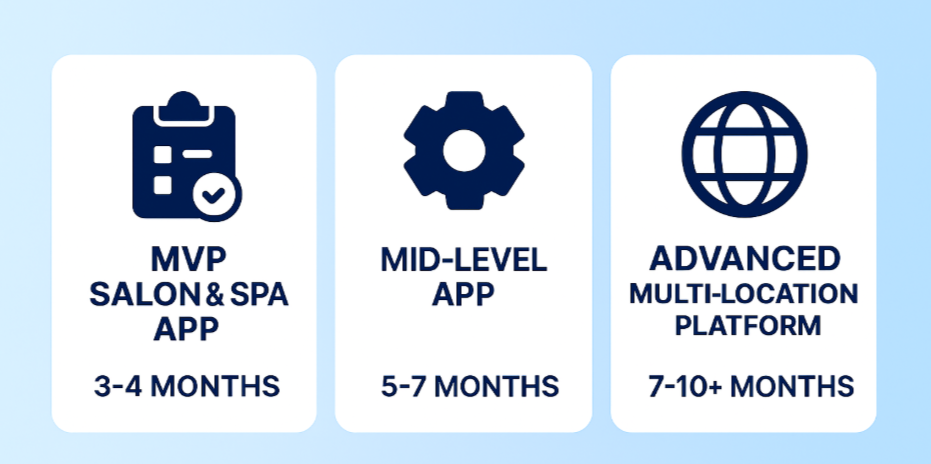
Typical End-to-End Timelines
| App Type | Duration | Description |
| MVP Salon & Spa App | 3–4 Months | Core booking + payment + stylist management system for one location. Ideal for startups validating their model. |
| Mid-Level App | 5–7 Months | Adds loyalty, marketing automation, client retention analytics, and branded UI polish. Suitable for growing salons/spas or franchises. |
| Advanced Multi-Location Platform | 7–10+ Months | Includes AI features, AR previews, advanced dashboards, and enterprise-level scaling across multiple regions. Built for established spa chains and wellness brands. |
Key Timeline Acceleration Tips
- Define MVP boundaries early — feature creep delays most beauty tech projects.
- Use modular architecture — build core booking and expand into loyalty, AI, or AR later.
- Prioritize backend stability — a weak backend leads to booking conflicts and lost customers.
- Parallelize design and development — allows visual and functional workstreams to progress simultaneously.
- Plan for post-launch iteration — the most successful salon apps treat v1.0 as the beginning, not the end.
Salon & Spa App Development Trends in 2025
AI-powered personalization becomes the new luxury.
Salons and spas are entering an age where personalization defines premium experiences. Apps are beginning to predict what each client wants before they open the booking screen. AI engines analyze prior visits, favorite stylists, and seasonal trends to suggest services, treatments, and time slots automatically — turning personalization into a silent concierge.
The shift from booking tools to brand ecosystems.
In 2025, successful salon apps operate more like ecosystems than utilities. They don’t just handle appointments — they embody the brand. Every interaction, from the color palette to post-visit recommendations, reinforces the client’s emotional connection to the salon. Businesses are investing in apps that extend into e-commerce, memberships, and exclusive digital communities.
Augmented reality becomes consultation.
AR is quietly redefining consultations. Rather than describing a look, clients can preview it. Hair color simulations, nail design try-ons, and skincare visualizers create clarity and confidence. This trend is especially important for high-end spas and beauty studios that rely on visual precision.
Automation replaces manual coordination.
Manual scheduling is rapidly disappearing. Intelligent automation now balances stylist workloads, adjusts pricing during peak hours, and sends personalized rebooking prompts. The best apps use predictive scheduling models that keep chairs filled and clients engaged.
Sustainability enters digital design.
Salon brands built around wellness and sustainability are demanding eco-conscious tech. Developers are optimizing apps for energy efficiency, minimizing server loads, and encouraging paperless check-ins. Digital sustainability — once an afterthought — is now part of brand alignment.
Hybrid business models are rising.
The pandemic-era “mobile stylist” and “pop-up spa” concepts have evolved into permanent hybrid models. Apps must now support multi-location and on-demand bookings simultaneously, allowing stylists to work in-house or remotely without friction.
Loyalty is going experiential.
Instead of generic point systems, loyalty is becoming experiential: clients earn perks like early access to new treatments, personalized aftercare recommendations, or AR-based beauty tutorials. Apps are shifting from transactional to relationship-driven design.
Voice and chat-first interfaces are emerging.
AI chat assistants and voice scheduling tools are becoming a differentiator in 2025. The best salon apps allow users to book by saying, “Book a haircut with Jenna next Thursday,” and have the system instantly respond with availability and confirmation.
Analytics guide creative decisions.
Owners are using real-time dashboards not just for logistics but for insight — which styles are trending, which products drive upsells, which stylists have the highest rebook rate. Data is evolving from operational support to creative direction.
What to Look for When Choosing a Salon & Spa App Development Company
Industry fluency matters more than code.
A strong development partner should understand the rhythm of a salon — the flow of bookings, client behavior, and the importance of timing. The right company builds around how beauty businesses actually operate, not just how software should function.
Look for experience beyond templates.
Many agencies rely on recycled booking app templates. Avoid them. Seek developers who create custom logic — appointment buffers, stylist substitutions, client tiers — tailored to your business. Unique user flows define the best salon experiences.
Demand design sensitivity.
In beauty, aesthetics equal credibility. The development team should treat your UI/UX like your salon’s storefront. Review their design portfolio: every interaction should feel fluid, elegant, and brand-consistent.
Prioritize scalability and architecture.
Even if you start small, ensure your app can grow. Scalable architecture allows future modules like e-commerce, AI recommendations, and franchise-level management without rebuilding from scratch.
Evaluate communication and post-launch support.
The best development relationships are partnerships, not transactions. Weekly sprints, transparent timelines, and clear post-launch maintenance are signs of a reliable team. Continuous optimization is what turns an app into an evolving asset.
Ask about real-time integrations.
A great salon app doesn’t live in isolation. It should sync seamlessly with CRMs, POS systems, marketing tools, and staff calendars. Choose developers comfortable integrating APIs and automating data flow.
Insist on ownership and documentation.
Make sure your company retains full rights to the source code and design assets. Clean technical documentation ensures long-term flexibility if you ever switch teams or scale internally.
Think beyond launch.
The best apps are never finished — they’re living products that evolve with the business. Select a development partner who views post-launch analytics, retention tracking, and continuous iteration as part of the engagement, not an add-on.
Frequently Asked Questions (Salon & Spa App Development Companies, 2025)
1. What does a salon or spa app actually do?
A salon or spa app helps clients book, manage, and pay for appointments while giving owners control over schedules, staff, and promotions. Core features include real-time booking, push notifications, loyalty programs, stylist profiles, and performance analytics.
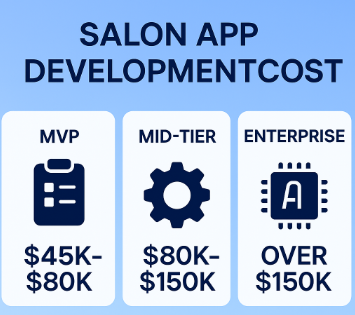
2. How much does it cost to develop a salon or spa app in 2025?
Expect to invest between $45,000 and $80,000 for an MVP, $80,000–$150,000 for mid-tier builds, and over $150,000 for enterprise solutions with advanced integrations or AI features. Prices vary based on complexity, customization, and the developer’s location.
3. How long does it take to build a salon or spa app?
An MVP usually takes 3–4 months. Mid-level apps average 5–7 months, and enterprise platforms may take 8–10 months or more depending on backend systems, design detail, and AI or AR integrations.
4. Which platforms should my app support — iOS, Android, or both?
Most brands benefit from cross-platform development using Flutter or React Native, ensuring consistent performance across iOS and Android. Larger chains with dedicated budgets may still prefer native development for premium responsiveness and animations.
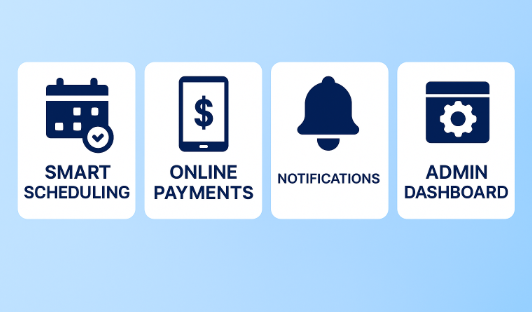
5. What features are essential for a successful salon app?
Essential features include smart scheduling, online payments, loyalty and referral programs, stylist portfolios, real-time notifications, in-app messaging, and admin dashboards for managing staff and services.
6. What advanced features differentiate high-end spa apps?
High-end apps integrate AI for personalized service recommendations, AR for hairstyle or nail previews, predictive staff scheduling, voice booking assistants, and subscription-based membership options.
7. Can small salons or independent stylists afford custom apps?
Yes. Smaller studios can partner with micro-agencies offering streamlined MVP packages under $50K. Many start with simple booking and loyalty modules, then scale into full-featured ecosystems as the business grows.
8. What’s the difference between an MVP and a full-scale salon app?
An MVP validates the business model with core features like booking and payments. A full-scale app expands into automation, advanced analytics, customer retention systems, and multi-location management.
9. How do salon apps integrate with existing systems?
Developers can link your app with POS systems like Square, CRM platforms like HubSpot or Zoho, marketing tools such as Mailchimp, and calendar integrations like Google or Outlook to ensure unified data and workflow.
10. How can a salon app increase revenue?
Apps boost revenue through automated rebooking, personalized offers, and push campaigns. They reduce no-shows with reminders, optimize staff utilization, and create new upselling opportunities through loyalty tiers and dynamic promotions.
11. What is AI’s role in salon app development today?
AI assists in predicting demand, automating staff schedules, analyzing customer behavior, and providing real-time insights. It also powers chatbots and recommendation engines that enhance the client experience.
12. Are white-label salon apps worth it?
White-label apps offer speed and cost savings but limit customization. For brands that value unique design, scalability, and ownership, custom-built solutions deliver stronger long-term value and differentiation.
13. How do developers ensure client and payment data security?
Reputable developers comply with GDPR and CCPA standards, using SSL encryption, tokenized payments, OAuth authentication, and periodic security audits. Many also implement localized data storage for compliance with regional privacy laws.
14. How can apps help with staff management and scheduling?
Staff dashboards allow managers to assign shifts, monitor availability, and forecast peak periods. Predictive algorithms automate scheduling, ensuring optimal stylist utilization while minimizing downtime.
15. What’s the importance of design aesthetics in spa app development?
Design is critical in conveying the calm and luxury of a spa environment. Successful apps use soothing colors, intuitive navigation, and micro-animations that mimic real-world relaxation experiences.
16. How should I choose the right salon app development company?
Look for a partner with proven industry experience, refined design capability, transparent pricing, and strong communication. The best firms act as long-term collaborators who understand your brand and growth goals.
17. What happens after the app launches?
Post-launch support includes OS updates, bug fixes, analytics monitoring, and feature iteration. Continuous improvement ensures that the app evolves with client needs and platform changes.
18. What’s next for salon and spa app technology?
The next evolution centers on AI personalization, connected experiences across wearables and mirrors, and integrated wellness ecosystems. Future salon apps will merge physical care with digital engagement, transforming customer relationships into holistic lifestyle journeys.


 18 Mins