


























 23 Mins


The mobile gaming market stands at a pivotal moment. With global revenue reaching approximately $92 billion in 2024 and projected growth continuing through 2025, selecting the right development partner determines whether your game captures audience attention or disappears among millions of competing titles.
For niche gaming founders, this challenge intensifies. Gaming requires specialized expertise: understanding player psychology, implementing sophisticated monetization systems, optimizing performance across thousands of device configurations, and building live-ops infrastructure enabling ongoing engagement.
This analysis examines what distinguishes exceptional game developers, evaluates their technical capabilities, and provides the decision framework needed to select partners aligned with your gaming vision.
Ready to transform your game concept into a market-ready application? Explore how Chop Dawg‘s developers bring proven gaming expertise, player-centric design, and transparent development processes to launch successful games.
1. Abdullah Khan — Developer
Abdullah specializes in building interactive and high-performance game apps. He focuses on smooth gameplay mechanics, responsive interfaces, and integrating game engines while ensuring apps perform reliably across devices.
Get Your Free 45-Minute App Roadmap
Meet 1-on-1 with our senior product team. We’ll map your MVP or enterprise app and hand you a personalized plan—clear scope, a realistic timeline, and fixed monthly costs—for iOS & Android, web, tablets & wearables, and AI.
2. Faisal Hameed — Developer
Faisal brings full-stack expertise to game development, implementing features like in-app purchases, real-time multiplayer functionality, and backend logic for scoring, leaderboards, and player progression. His work ensures engaging, responsive, and stable gaming experiences.
3. Christopher Curtin — Developer
Christopher focuses on creating dynamic game app systems that combine robust backend architecture with seamless frontend experiences. He works on features like animation handling, real-time updates, and integration with analytics to enhance player engagement and retention.
The Current State of Mobile Game Development
Market Reality and Technical Complexity
Mobile gaming evolved from simple puzzle mechanics into sophisticated entertainment experiences rivaling console quality. The industry generated approximately $92 billion in revenue during 2024, with emerging markets like Turkey, Mexico, and India experiencing double-digit growth.
Technical complexity increased dramatically. Modern mobile games incorporate real-time multiplayer synchronization, sophisticated monetization systems, and performance optimization across thousands of device configurations. Cross-platform frameworks like Unity and Unreal Engine enable simultaneous iOS and Android development while maintaining visual fidelity unthinkable on mobile devices five years earlier.
Modern Gaming Architecture Requirements
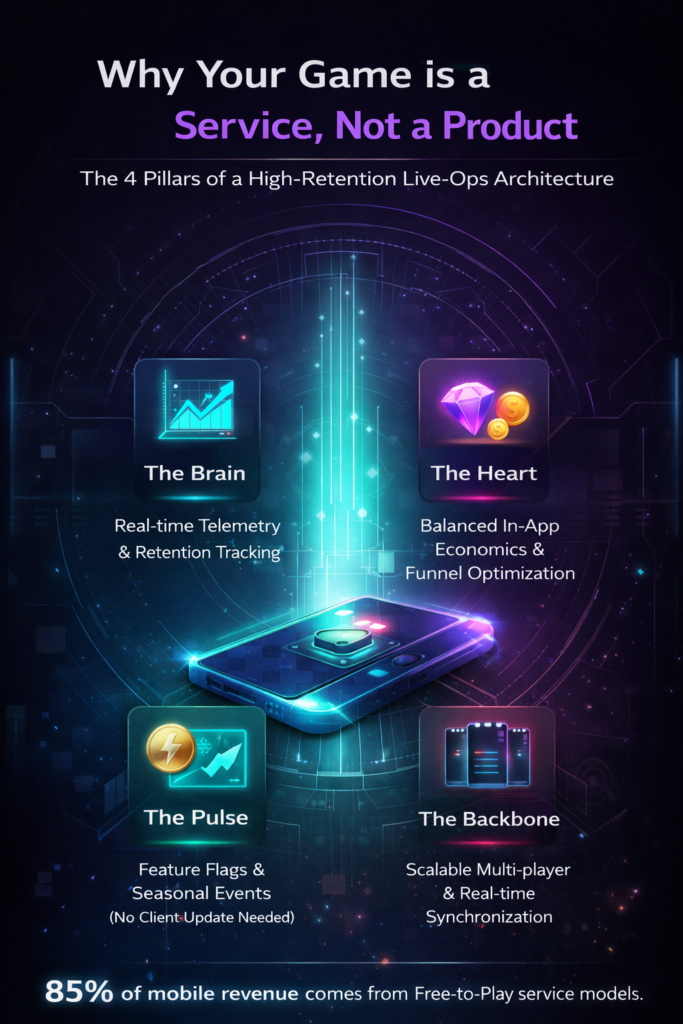
In 2025, successful games operate as live-service platforms—games supporting ongoing content updates, event systems, and real-time analytics rather than one-time releases. A substantial majority of in-app-purchase revenue derives from titles adopting live-ops approaches and multiplayer infrastructure.
When selecting developers, prioritize teams demonstrating:
- Live-ops architecture capability: Backend systems supporting seasonal events, leaderboard updates, telemetry, feature flags
- Cross-platform infrastructure: Performance optimization across iOS and Android hardware tiers
- Post-launch analytics & monetization: Player engagement tracking, conversion funnels, retention analysis, live-ops impact measurement
Meet Chop Dawg’s Game Development Specialists
Iqbal Shezada: Backend Architecture & Live-Ops Infrastructure
With 25+ years of senior engineering leadership, Iqbal brings the backend expertise essential for modern gaming platforms. Games appearing simple on surfaces require sophisticated backend systems handling millions of concurrent players, real-time synchronization, and persistent state management.
For Gaming Specifically:
- Live-ops backend architecture: Node.js systems supporting seasonal events, leaderboard updates, telemetry, and feature flags enabling rapid content iteration without client updates
- Real-time multiplayer infrastructure: WebSocket architectures, matchmaking systems, and state synchronization ensuring seamless multiplayer experiences
- Analytics pipelines: Comprehensive telemetry capturing session behavior, conversion funnels, retention cohorts, and monetization performance
- Scalable monetization systems: Backend infrastructure supporting free-to-play economics, in-app purchases, and live-ops driven revenue optimization
Why game studios need this: Most developers handle basic multiplayer. Iqbal architects systems handling millions of concurrent players, real-time state synchronization, and live-ops infrastructure enabling competitive games to evolve continuously. His monetization systems generate the revenue supporting ongoing development.
Moeed Farooq: Performance-First UI/UX and Cross-Platform Excellence
As a core developer at Chop Dawg, Moeed specializes in the experience layer where games succeed or fail: responsive, beautiful interfaces paired with rock-solid performance. Gaming is uniquely demanding—players expect 60fps frame rates, instant responsiveness, and beautiful visuals on diverse hardware.
For Gaming Specifically:
- Performance-optimized UI: React Native and native development delivering 60fps interfaces across iOS and Android hardware tiers
- Cross-platform consistency: Identical gameplay experience whether players use flagship devices or budget hardware, with intelligent level-of-detail systems and dynamic resolution scaling
- Player feedback implementation: Haptic feedback, sound design integration, and visual polish differentiating great games from adequate ones
- Analytics-ready interfaces: Seamless integration with analytics systems tracking player progression, monetization funnels, and engagement metrics
Why game studios need this: Gameplay mechanics matter. Execution matters infinitely more. Players abandon games with poor performance, confusing interfaces, or inadequate feedback. Moeed builds interfaces and experiences that retain players.
Wikram Das: Full-Stack Gaming Infrastructure
Wikram brings rare full-stack capability—frontend, backend, infrastructure—enabling complete gaming systems without handoffs. For game studios, this consolidation dramatically accelerates iteration and enables rapid monetization adjustments based on player behavior.
For Gaming Specifically:
- Unity and Unreal Engine integration: Backend systems connecting game engines to monetization, analytics, and live-ops infrastructure
- Cloud infrastructure optimization: AWS and Google Cloud deployments providing automatic scaling during player spikes without manual intervention
- Content delivery networks: Efficient asset delivery minimizing download times and supporting large player populations globally
- DevOps and deployment automation: Continuous deployment enabling rapid content updates and balance adjustments based on player analytics
Why game studios need this: Full-stack developers accelerate decision-making. Content balancing requests don’t get blocked by frontend-backend coordination. Analytics reveal player behavior; developers respond within days, not weeks. For games competing on engaging mechanics, this velocity advantage is existential.
Kainat Sabir: Quality Assurance for Gaming Excellence
Gaming QA is fundamentally different from standard app testing. A functional bug is merely annoying. A gameplay bug—unbalanced difficulty, exploitable mechanics, unfair monetization—destroys player retention and reputation. Kainat Sabir‘s QA expertise ensures games launch polished and remain competitive post-launch.
For Gaming Specifically:
- Gameplay iteration validation: Testing diverse difficulty curves, reward pacing, progression systems, and monetization mechanics through extensive playtesting
- Performance across device tiers: Rigorous testing ensuring consistent frame rates, smooth controls, and responsive UI across budget and flagship devices
- Multiplayer stress testing: Validating real-time synchronization, matchmaking fairness, and leaderboard integrity under peak player loads
- Monetization funnel testing: Confirming conversion paths, price point testing, and ensuring pay-to-win perception doesn’t alienate players
- App store optimization: Testing approaches maximizing visibility in Apple App Store and Google Play Store
Why game studios need this: Developers build mechanics. Kainat ensures they feel right. Through playtesting and iteration, she identifies difficulty spikes, confusing progression systems, and monetization friction before players experience them. Her work directly drives retention and revenue.
Modern Game Development Requirements (2025)
Essential Features for Competitive Games
Modern gaming applications compete in mature markets where players expect comprehensive functionality:
Performance Optimization: Players expect smooth frame rates regardless of device tier. This requires level-of-detail systems, dynamic resolution scaling, efficient asset loading, and battery optimization.
Engaging Core Gameplay Loop: All successful games establish compelling core loops players repeat throughout experiences. Loops require extensive iteration and playtesting, as minor adjustments to timing, feedback, or reward pacing dramatically impact engagement.
Balanced Monetization: Monetization must generate revenue without compromising experience or creating pay-to-win perception. Implementation requires analytics tracking conversion funnels, cohort analysis, continuous A/B testing, and responsive adjustment.
Social and Community Features: Friend systems, clan mechanics, chat functionality, cooperative gameplay, and competitive leaderboards extend player lifetimes significantly compared to purely solo experiences.
Analytics Integration: Comprehensive analytics track player progression identifying difficulty spikes, monetization funnel performance, session patterns, and retention cohort analysis.
Live-Ops Architecture Fundamentals
Successful modern games operate as services requiring:
- Backend systems supporting seasonal events and content updates without client rebuilds
- Leaderboard infrastructure enabling competitive player engagement
- Feature flags allowing rapid mechanic adjustments based on player behavior
- Telemetry pipelines capturing detailed engagement data guiding monetization and content decisions
- Version management enabling live updates while maintaining player progression
Evaluating Game Developers
Technical Stack Alignment
Verify expertise matches your requirements. Unity dominates mobile gaming, powering approximately 71% of top mobile games. Unreal Engine offers advantages for visually intensive 3D experiences. Native development sometimes proves optimal for specific mechanics.
Inquire about approach to performance optimization across device tiers, battery efficiency strategies, poor network condition handling, and offline functionality implementation.
Monetization Strategy Understanding
Leading developers demonstrate understanding of mobile gaming economics beyond basic implementation. Free-to-play monetization generated approximately 85% of mobile gaming revenue in 2024, requiring sophisticated approaches.
Evaluate whether partners understand player psychology, regulatory considerations affecting loot boxes, analytics implementation measuring funnel performance, and ongoing optimization approaches testing pricing strategies.
Player Psychology and Game Feel
Games competing on mechanics require developers understanding psychological principles: variable reward schedules, progression systems balancing challenge with accessibility, social proof mechanics, and difficulty curves preventing frustration or boredom.
Ask how they approach gameplay iteration, playtesting methodology, and data-driven balance adjustments based on player behavior.
Live-Ops Experience
Evaluate partners demonstrating understanding of content pipeline requirements, analytics integration, version management, and operational monitoring. Ask about post-launch support structures, content update processes, and how they scale games as player bases grow.
Communication Infrastructure
Gaming development involves subjective decisions around feel, difficulty, and reward pacing. Companies offering daily Slack communication, regular video meetings, and transparent task tracking through Jira demonstrate commitment to collaborative partnerships.
Game Development Economics in 2025
Development Cost Ranges
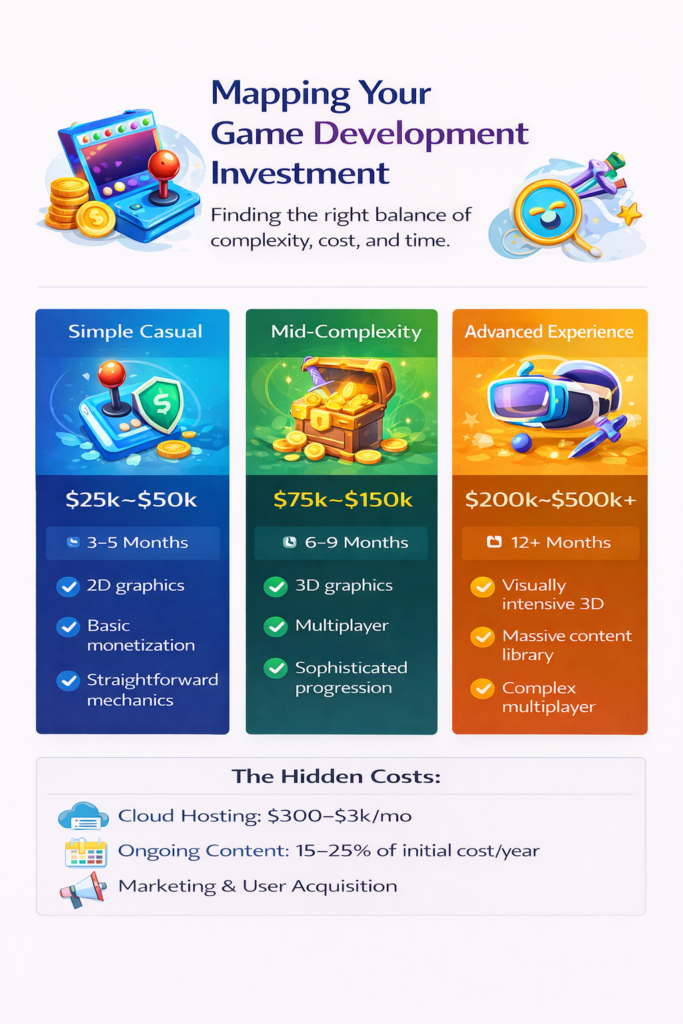
Simple Casual Games ($25,000-$50,000): Straightforward mechanics, 2D graphics, basic monetization, 3-5 months development.
Mid-Complexity Gaming ($75,000-$150,000): Multiplayer functionality, 3D graphics, progression systems, sophisticated monetization, 6-9 months development.
Advanced Gaming Experiences ($200,000-$500,000+): Sophisticated multiplayer, visually intensive 3D environments, extensive content libraries, 12+ months development.
Cost Optimization Strategies
Start with focused minimum viable products validating core gameplay mechanics. Consider cross-platform frameworks sharing codebases between iOS and Android, reducing costs by 30-40% versus separate native development.
Ongoing Investment
Plan for:
- Cloud infrastructure hosting: $300-$3,000 monthly depending on player scale
- Third-party services: $200-$2,000 monthly (analytics, crash reporting, authentication)
- Content development: 15-25% of initial development annually maintaining engagement
- Marketing and user acquisition: Additional ongoing expenses
Making Your Final Decision
Evaluate potential partners systematically. Request proposals from multiple developers, conduct reference calls with past gaming clients specifically, assess cultural fit alongside technical capabilities, and verify their understanding of your gaming genre.
Strong game developers ask probing questions about your target audience, player psychology assumptions, and monetization philosophy. They discuss playtesting methodology, how they iterate based on player behavior, and how they’d approach balance adjustments post-launch.
Trust communication quality and gaming-specific experience. Technical capabilities matter, but numerous developers possess adequate skills. The differentiating factor lies in how effectively partners understand gaming business models, player psychology, monetization strategies, and live-ops requirements.
Frequently Asked Questions
How long does game app development typically take?
Development timelines vary based on gameplay complexity. Simple casual games typically require 3-5 months from initiation through launch. Mid-complexity games incorporating multiplayer features often need 6-9 months. Complex games with extensive content and advanced graphics may extend 10-14 months or longer.
Should I build native apps or use cross-platform development?
The decision depends on specific game requirements and budget constraints. Native development delivers optimal performance but requires separate iOS and Android codebases, effectively doubling costs. Cross-platform frameworks like Unity enable code sharing, reducing costs by 30-40% while delivering performance suitable for most gaming applications.
What ongoing costs should I budget beyond initial development?
Cloud infrastructure hosting typically costs $300-$3,000 monthly depending on player scale. Third-party service subscriptions for analytics, crash reporting, and authentication range from $200-$2,000 monthly. Ongoing content development maintaining engagement generally costs 15-25% of initial development annually. Marketing and user acquisition represent additional ongoing expenses.
How important is the development company’s location?
Location matters primarily for communication coordination and cost considerations. North American companies typically charge $100-$150 hourly but offer timezone alignment. Eastern European developers ($40-$60 hourly) deliver exceptional quality at reduced costs with manageable timezone differences. South Asian teams ($20-$40 hourly) offer maximum cost savings but may require asynchronous communication.
What’s the most important factor when choosing a game developer?
Communication quality and gaming-specific experience prove consistently critical. Differentiating factors include understanding gaming business models, player psychology principles, monetization strategies, and live-ops requirements. Developers treating games as standard mobile applications miss nuances essential for competitive success.
Should I start with an MVP or build a comprehensive game?
Start with focused minimum viable products, validating core gameplay mechanics before expanding feature sets. This enables faster market entry, earlier player feedback, and preserved capital for marketing once core mechanics prove engaging. Most successful games evolved through iterative enhancement based on actual player behavior.
How do I protect my game concept intellectual property?
Ensure development agreements explicitly transfer complete intellectual property ownership to your company from project inception. Reputable partners provide comprehensive code repositories, design documentation, and architectural materials, enabling future development independent of ongoing partnership. Request regular code deliveries throughout development.
What questions should I ask potential gaming developers?
Request specific examples of gaming applications they’ve developed, including technical challenges and solutions. Ask about approach to gameplay iteration, performance optimization strategies, monetization implementation, and live-ops support structures. Inquire about bug resolution timeframes, content update processes, and performance monitoring systems.



 15 Min