










 16 Min

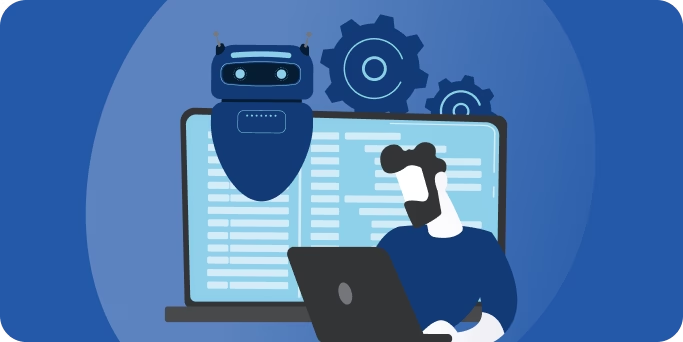
You’re starting a company. You have an idea for an app. Your friend says: “Just use ChatGPT. Vibe code it. You’ll have an MVP in a week.”
Meanwhile, your colleague says: “Hire a professional development team. It’ll cost money, but you won’t regret it.”
Both are partly right. But the gap between a prototype and a product is where most founders get stuck.
TL;DR
Vibe coding works great for prototypes and MVPs when you understand its limits. It’s fast (3-5x faster for routine tasks) and cheap. But AI-generated code has 1.7x higher bug density, 45% contains security flaws, and it breaks down completely for complex systems, scalability, compliance, and security. Hire professionals when you’re launching something users depend on, handling sensitive data, or scaling beyond a prototype. The best founders use both: validate with vibe coding, build real products with professionals.
What Is Vibe Coding, Actually
Vibe coding is using AI to generate code in response to natural language prompts. You describe what you want (“build a login system with email verification”), and an AI generates the code.
It’s not magic. It’s pattern matching on a scale humans can’t achieve. Large language models trained on millions of open-source repositories can predict what code likely solves a given problem.
In 2026, vibe coding has matured. Tools like Lovable app builder, Replit, and Cursor make rapid prototyping accessible. It’s not “write nothing and hope.” Professional developers use AI tools daily. 84% of developers say they use or plan to use AI tools. 51% use them daily.
But vibe coding as a complete development methodology, replacing hiring professionals, is different from using AI as a productivity tool. That distinction matters.
The Productivity Case: Where Vibe Coding Wins
AI code generation is fast. The data backs this up.
Developers using AI coding tools merge approximately 60% more pull requests than lighter users. A single developer saves roughly 3.6 hours per week using AI tools. For routine tasks like boilerplate code, form validation, simple API integrations, and repetitive patterns, AI accelerates work significantly.
If your team has actual developers, vibe coding tools supercharge their productivity. A developer who used to spend 2 hours on form validation now spends 20 minutes. That’s real.
For prototyping, the speed is transformative. Building a quick proof of concept in a week is genuinely possible with AI-assisted code generation.
The Bug Problem: 1.7x Higher Defect Rate
Here’s where vibe coding becomes a liability.
A December 2025 analysis examined 470 GitHub pull requests where code was co-authored by generative AI, revealing critical quality issues. Result: AI-co-authored code had 1.7x more major issues compared to human-written code.
The bugs aren’t random crashes. They include logic errors (incorrect dependencies, flawed control flow), misconfigurations (75% more common), and security vulnerabilities (2.74x higher).
Think about that number. Logic errors 75% more common. Security issues nearly 3x more frequent.
These aren’t typos. These are architectural problems that a human reviewer would catch by reading the code, but only if someone reviews it. And vibe coders don’t typically have code reviews.
The Security Nightmare: 45% Contains Vulnerabilities
The security data is worse.
Roughly 24.7-45% of AI-generated code contains security flaws. For comparison, that’s dramatically higher than professional code. Developers trained in security practices, code review, and threat modeling aim for zero known vulnerabilities. AI generates code with a 1 in 2 chance of a security issue.
Now imagine that code handles user authentication, payment processing, or medical data. This is why security best practices matter. A vulnerability isn’t an inconvenience. It’s a breach. It’s a lawsuit. It’s your company’s reputation vanishing.
Vibe coding for anything handling sensitive data or payments is reckless.
The Scope Problem: Where Vibe Coding Breaks
AI generates code within context windows (usually 8K-128K tokens). For a simple feature, that’s plenty. For complex systems, it’s a prison.
Your app needs to:
- Handle 100K concurrent users without crashing
- Ensure the payment system never loses a transaction
- Keep user data secure even if the database is compromised
- Scale from 1K to 1M users without rewriting the architecture
Vibe coding handles none of this. These problems require understanding how systems interact, anticipating failure modes, and designing for scale. AI doesn’t have a context window big enough to hold all that.
A professional team understands system design. They know databases, caching, message queues, load balancing, and architectural patterns that make systems reliable. Vibe coding generates working code for features, not systems.
The Compliance Trap: You’re on Your Own
If your app needs to comply with regulations (HIPAA, GDPR, PCI-DSS, SOC 2), vibe coding is a liability, not a shortcut.
Regulatory compliance requires precise control over data storage, encryption, access logs, audit trails, and retention policies. It requires security practices built in from day one, not bolted on after launch.
When an auditor asks about your security practices, your answer can’t be “an AI wrote this code.” Compliance requires demonstrating that you’ve thoughtfully designed your system to meet specific requirements.
Vibe coding generates code. It doesn’t generate compliance documentation, audit trails, or security documentation that regulators need.
Get Your Free 45-Minute App Roadmap
Meet 1-on-1 with our senior product team. We’ll map your MVP or enterprise app and hand you a personalized plan—clear scope, a realistic timeline, and fixed monthly costs—for iOS & Android, web, tablets & wearables, and AI.
The Hidden Cost: Technical Debt and Rewrites
Here’s what founders don’t think about.
You vibe code an MVP in 2 weeks. It works. You get users. Now you need to add features, fix bugs, and scale.
The codebase is messy. Each vibe-coded feature has its own patterns. No consistency. No architecture. Testing was skipped. Documentation is nonexistent.
Adding a new feature now requires refactoring five other features. Scaling requires rewriting the database layer. Security gets audited and you discover vulnerabilities in 40 different places.
You end up hiring a team to rewrite what you thought was done. The 2 weeks of vibe coding becomes 3 months of rewrites. The cost is higher than hiring professionals to build it right the first time.
This is the pattern with vibe coding. It feels cheap upfront. It’s expensive in the long run.
The Trust Problem: Only 33% Trust AI Code
Developers don’t trust AI-generated code.
51% of professional developers use AI tools daily. But only 33% say they trust AI results. 46% don’t fully trust them.
Why? Because they’ve debugged AI code. They’ve seen the 1.7x bug rate. They know AI can confidently generate incorrect code that looks right on the surface.
This matters because shipping code requires trust. If your team doesn’t trust the code, they spend time verifying every line. The speed advantage disappears.
When Vibe Coding Actually Works
Vibe coding is excellent in specific contexts. Know what they are and don’t stretch beyond them.
Prototypes and throwaway code. If you’re proving a concept and will rewrite it, vibe coding is perfect. Fast, cheap, good enough. You’re not shipping this code; you’re learning from it.
Non-critical features. A feature that doesn’t affect revenue, security, or data integrity. An “About Us” page. A blog display. Marketing site features. These are low-risk places for AI-generated code.
Boilerplate and routine patterns. Code that follows standard patterns. Form validation, API request boilerplate, common algorithms. AI is excellent at these because they’re patterns it saw in training data.
Accelerating experienced developers. If your development team uses AI tools to move faster, productivity jumps. This is different from vibe coding replacing developers.
Proof of concepts for potential clients. Show what’s possible without building the final product. Vibe code a demo. Use it to win consulting contracts. Then build properly.
Outside these contexts, vibe coding creates more problems than it solves.
When You Need to Hire Professionals
Hire a development agency when the app handles real user data, processes payments, requires security compliance, or needs to scale.
Hire when you’re building something users depend on for business operations. Hire when bugs cost money. Hire when the app handles sensitive information.
The cost of hiring professionals (typically $50K-$150K for a solid MVP) is a fraction of the cost of rewrites, security breaches, or lost users due to poor reliability.
Professional teams bring:
- Architectural thinking (not just features, but systems)
- Security practices built into development, not bolted on after
- Code reviews and quality gates
- Testing and reliability engineering
- Documentation and maintainability
- Scalability planning
These aren’t nice-to-haves. They’re the difference between a prototype and a product.
The Honest Comparison
Vibe coding vs. hiring professionals isn’t a binary choice in 2026. It’s a sequencing decision.
Startup strategy: Validate with vibe coding, build with professionals. Spend 2 weeks proving your idea works with a vibe-coded prototype. If it gains traction, hire a team to build the real thing. You’ve spent $1K on vibe coding instead of $100K on a product nobody wanted.
This is faster and cheaper than either extreme. It’s faster than hiring a team to build the MVP you’re unsure will find customers. It’s more reliable than vibe coding the final product and discovering security vulnerabilities after launch.
The 2026 Reality
AI code generation is real and useful. But it’s not a substitute for experienced development teams. It’s a tool that accelerates their work.
The teams winning in 2026 use AI to move faster, but they still prioritize architecture, security, testing, and code quality. They don’t vibe code and hope. They review, test, refactor, and ship products they’d stake their reputation on.
If you’re evaluating whether to vibe code or hire: your answer depends on what you’re building and whether you can afford to fail.
Building a prototype or proof of concept? Vibe code it. Building something users depend on for their business? Hire professionals. Building something that handles payments or sensitive data? Hire professionals, no question.
Your Next Step
The best founders don’t choose between vibe coding and hiring professional developers. They use both strategically.
Validate your idea fast with AI tools. Then, when you know the market wants what you’re building, invest in a team that builds it right.
If you’ve vibe coded a prototype and now need to build the real product, a professional development team can assess what can be salvaged and what should be rebuilt. Many startups transition from prototype to product successfully when they have experienced guidance.
Schedule a free consultation to discuss how to move from prototype to product, including what parts of your vibe-coded MVP can accelerate the professional build.
Frequently Asked Questions
Can AI really generate production-ready code?
AI can generate working code for specific features and non-critical parts of your app. But production-ready requires testing, security review, scalability planning, and documentation. AI generates code patterns; professionals build systems. For non-critical features, yes. For core functionality, no.
What’s the 1.7x bug rate actually mean?
AI-co-authored code had 1.7 times more major issues (logic errors, incorrect dependencies, flawed control flow) in a study of 470 GitHub pull requests. It doesn’t mean 70% more bugs overall. It means serious bugs are significantly more common in AI-generated code than human code.
How many AI-generated code has security vulnerabilities?
Studies show 24.7-45% of AI-generated code contains security flaws. This is drastically higher than professional code standards. If you’re handling payments, user data, or sensitive information, this rate is unacceptable.
Is it cheaper to vibe code an MVP?
Yes, initially. Vibe coding costs almost nothing. But the total cost depends on rewriting. If your MVP works and you scale it professionally, you often rewrite the architecture. Total cost (vibe code + rewrite) often exceeds building right from the start.
Should I use AI tools if I hire a development team?
Absolutely. Professional developers use AI tools daily to move faster. 51% use them daily. The difference is they review, test, and refactor the output. AI is a productivity tool, not a replacement for expertise.
What percentage of developers use AI tools daily?
51% of professional developers report using AI tools daily. 84% say they use or plan to use AI tools. But only 33% fully trust AI results. Trust gap is the limiting factor.
Can vibe coding work for payment processing?
No. Payment systems require security compliance (PCI-DSS), precise control over data handling, and zero tolerance for vulnerabilities. 45% of AI code has security flaws. This is incompatible with handling payments. Hire professionals for financial functionality.
When should I hire a development agency instead of vibe coding?
Hire professionals when building for real users, handling sensitive data, processing payments, needing security compliance, or planning to scale. Vibe code for prototypes, non-critical features, and proof of concepts. When the app matters, hire professionals.


 19 Min