























 19 Mins


The freelance app development market presents niche founders with attractive options: lower costs, flexible engagement, and access to specialized expertise. Yet distinguishing capable developers from those who overpromise requires systematic evaluation beyond platform ratings and hourly rates.
This analysis examines freelance platform realities, hidden costs, and explains when dedicated specialized developers deliver superior outcomes for market-ready applications.
Considering whether freelancers or dedicated specialists better serve your app? Explore how Chop Dawg‘s developers combine specialized expertise with transparent pricing and accountability for niche founders.
1. Iqbal Shezada — Senior Developer
Iqbal brings deep engineering leadership to freelance projects, with a strong skill set in building scalable, maintainable applications. His experience spans complex systems, backend logic, and polished frontend experiences, making him a go‑to developer for high‑impact freelance builds.
Get Your Free 45-Minute App Roadmap
Meet 1-on-1 with our senior product team. We’ll map your MVP or enterprise app and hand you a personalized plan—clear scope, a realistic timeline, and fixed monthly costs—for iOS & Android, web, tablets & wearables, and AI.
2. Hameed Ullah — Developer
Hameed excels at taking project requirements and turning them into clean, efficient code. He’s adept at full‑stack tasks, strong on problem solving, and works comfortably across a range of technologies — a reliable choice for freelance engagements that need quality and speed.
3. Mooed Farooq — Developer
Mooed is known for translating design into responsive, high‑performing interfaces. His work emphasizes clarity and usability, making him excellent for freelance work where user experience and thoughtful implementation matter most.
4. Abdullah Khan — Developer
Abdullah brings solid technical versatility to freelance projects, able to handle frontend interactions and backend integration with ease. His strength lies in delivering dependable, scalable application features on tight timelines.
5. Farhan Jameel — Developer
Farhan is a versatile full‑stack developer ideal for freelance roles that require both frontend polish and solid backend foundations. He’s effective at fast iterations and delivering clean builds that align with client goals and product requirements.
Understanding the Freelance Development Market in 2025
Market Growth and Hidden Complexity
The freelance platform market will surpass $14 billion by 2029, growing at 17% annually. Over 30% of Fortune 500 companies utilize freelance networks for technology projects. This growth creates both opportunity and complexity: while talented developers exist across platforms, identifying them requires navigating inconsistent vetting, variable quality, and communication challenges.
Freelance Developer Rates by Experience and Region
By Experience:
- Junior developers: $25-$50/hour
- Mid-level developers: $50-$100/hour
- Senior developers: $100-$150+/hour
By Region:
- North America: $75-$150/hour
- Eastern Europe: $30-$75/hour
- South Asia: $15-$60/hour
The average U.S. freelance mobile developer charges approximately $61 hourly. Platform rates like Upwork skew lower around $27 due to international talent. Complete projects range from $5,000-$25,000 for simple apps to $25,000-$75,000 for mid-range applications.
Popular Freelance Platforms (and Their Limitations)
Upwork: Volume and Variety
Upwork hosts over 12 million active freelancers across software development, design, and testing. The platform offers detailed profiles, portfolios, client reviews, and escrow payment protection. However, quality varies significantly in this open marketplace. Platform fees add 20% to rates, and vetting responsibility falls entirely on founders.
Toptal: Premium Vetting
Toptal accepts only the top 3% of applicants through technical assessments and communication reviews. This selectivity delivers higher quality but at premium pricing comparable to specialized development teams.
Freelancer.com: Competitive Bidding
Freelancer.com‘s bidding system creates price competition but introduces evaluation complexity. The model can incentivize unrealistic low-ball estimates.
Arc: Vetted Matching
Arc provides multi-stage vetting and matching services for mid to senior developers. The platform publishes transparent rate data by technology, experience, and location, though the pool remains smaller than broad platforms.
Gun.io: Curated Connections
Gun.io emphasizes careful vetting and cultural fit for longer engagements. 70% of clients report increased satisfaction from rigorous selection. Projects typically start at $75/hour.
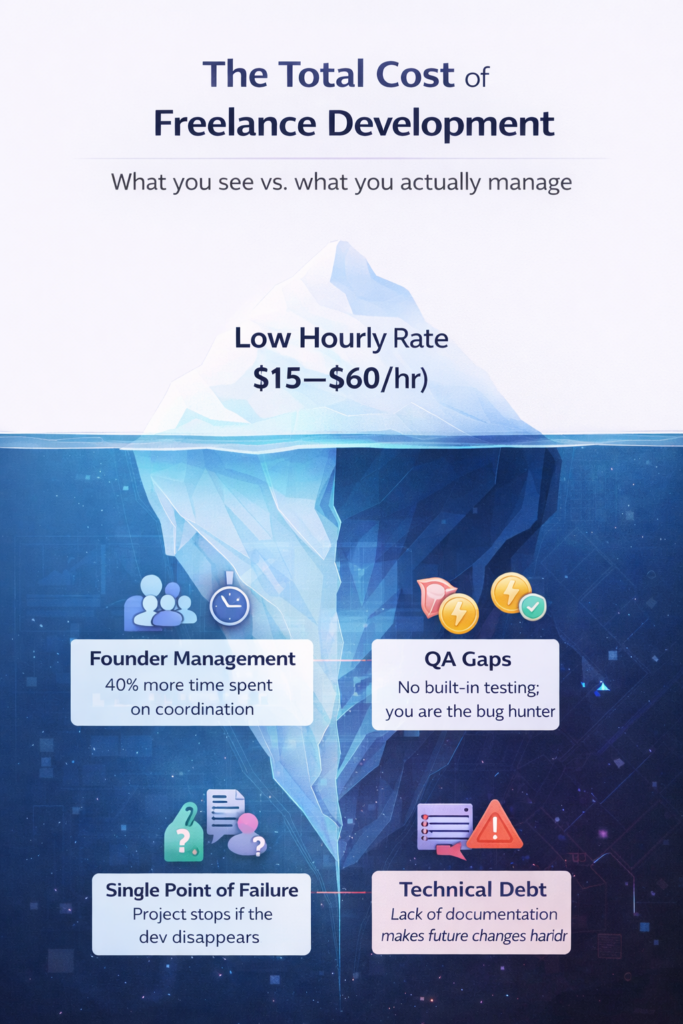
Hidden Costs of Freelance Development
Lower hourly rates attract founders initially, but hidden costs often offset apparent savings:
Project Management Overhead: Freelancers work independently, meaning founders handle all coordination, tracking, scope management, and integration. Research shows 40-50% of software projects finish late, while 78% experience scope creep leading to failure.
Single Point of Failure: If freelancers become unavailable through illness, competing commitments, or disappearance, projects face immediate disruption. Replacement developers must understand existing work, causing delays and potential rebuilding.
Quality Assurance Gaps: Freelancers rarely include systematic QA testing. Founders must test themselves or hire separate specialists, adding unexpected costs.
Limited Accountability: While platforms offer dispute resolution, enforcing accountability with individuals proves challenging. Freelancers juggling multiple projects may deprioritize your delivery.
Communication Overhead: Coordinating across time zones, managing expectations, handling scope changes, and resolving misunderstandings consume significant founder time.
Knowledge Dependency: Freelancers often lack documentation discipline, creating dependency on their availability for future changes or troubleshooting.
Meet Chop Dawg’s Specialized Developers
Rather than hiring freelancers across platforms, Chop Dawg offers dedicated specialists eliminating freelance coordination overhead while providing accountability freelancers can’t deliver.
Iqbal Shezada: Senior Architecture & Strategic Oversight
With 25+ years of engineering leadership, Iqbal provides the architectural vision and strategic guidance that transforms app concepts into scalable, maintainable systems. He doesn’t just write code—he designs systems architecture, making critical decisions about technology stack, scalability, security, and long-term sustainability.
Why This Matters vs. Freelancers:
- Strategic technical decisions preventing costly architectural rewrites
- Mentorship transferring knowledge to your team (freelancers rarely do this)
- Backend systems scaling from MVP through enterprise adoption
- Third-party integrations handled expertly rather than causing friction
- Post-launch guidance supporting sustainable growth
Freelancers rarely provide this level of strategic oversight; most focus on task execution rather than foundational architecture.
Moeed Farooq: User Experience & Cross-Platform Excellence
Moeed specializes in the interface layer where apps succeed or fail: responsive, beautiful experiences paired with rock-solid performance. He understands both React and React Native, enabling consistent experiences across iOS, Android, and web from launch.
Why This Matters vs. Freelancers:
- User experiences that drive adoption and retention
- Cross-platform consistency without separate native codebases
- Performance optimization preventing slowdown as users grow
- Implementation of complex UI patterns typically requiring expensive specialists
- Handling offline functionality and poor network conditions seamlessly
Freelancers with UI expertise are available; those combining UI, performance, and cross-platform mastery are exceptionally rare.
Wikram Das: Full-Stack Infrastructure & Deployment
Wikram brings rare full-stack capability spanning frontend, backend, and infrastructure. He owns complete systems from user interface through cloud deployment, eliminating coordination overhead between specialists.
Why This Matters vs. Freelancers:
- Rapid feature iteration without frontend-backend coordination bottlenecks
- Cost-optimized AWS and Firebase infrastructure
- Deployment automation enabling continuous delivery
- Scalable systems growing with your user base
- DevOps and infrastructure knowledge most freelancers lack
Finding individual freelancers with true full-stack mastery—frontend, Node.js backend, and DevOps—is exceptionally difficult.
When Specialized Developers Outperform Freelancers
Specific project characteristics make specialized developers substantially more effective:
Complex Features: Applications requiring sophisticated backend architecture, advanced UI/UX, multiple platforms, and third-party integrations exceed individual freelancer capabilities. Specialized developers provide complete expertise with complementary skills.
Compressed Timelines: Specialized teams scale resources by assigning multiple developers simultaneously. Solo freelancers cannot match this capacity for time-sensitive launches.
Ongoing Support: Post-launch maintenance, updates, and additions require sustained support. Specialized developers offer structured agreements with guaranteed response times. Freelancers may become unavailable or deprioritize your project.
Accountability: Specialized developers operate under formal contracts with legal accountability. Their reputation depends on successful outcomes, creating stronger delivery incentives than individual freelance arrangements.
Knowledge Transfer: Specialized teams maintain comprehensive documentation, architectural knowledge, and project continuity. Freelancers often lack documentation discipline, creating dependency.
Comparison Framework: Freelancers vs. Specialized Developers
| Factor | Freelancers | Specialized Developers |
| Team Composition | Individual contributors working independently | Full multidisciplinary team (design, development, PM, QA) |
| Management Responsibility | Founder must manage scope, tasks, timelines | Developer handles coordination and project management |
| Scalability & Timeline | Limited to individual capacity; slower for parallel work | Can scale resources and timelines quickly |
| Quality Assurance | Typically requires separate hires or founder testing | Built-in QA and systematic testing processes |
| Risk & Continuity | Higher risk from single point of failure | Stable team continuity and redundancy |
| Accountability Structure | Individual accountability (difficult to enforce) | Contractual accountability with delivery frameworks |
| Cost Structure | Lowest initial cost; variable long-term | Higher upfront but more predictable and structured |
| Post-Launch Support | Uncertain availability and support | Guaranteed support with SLAs |
| Documentation | Often minimal | Comprehensive technical documentation |
| IP Ownership | Requires explicit verification | Clear immediate IP transfer |
| Strategic Guidance | Limited | Included as part of engagement |
Chop Dawg’s Model: Better Than Both Freelancers and Traditional Agencies
Chop Dawg operates distinctly from both freelance engagements and conventional agencies. Since 2009, the Philadelphia company has delivered over 500 applications for startups, Fortune 500s, nonprofits, and government agencies.
Fixed-Rate Monthly Pricing
Unlike hourly billing creating budget uncertainty, Chop Dawg employs fixed-rate monthly pricing. This provides budget predictability crucial for startups while eliminating concerns about rate variations, inflated invoices, or scope creep surprises.
Embedded Team Integration
Rather than functioning as external vendors, Chop Dawg embeds specialized developers directly into client teams. This integration provides freelancer-like collaboration flexibility while maintaining professional-level accountability, expertise, and resource depth.
Complete Specialist Coverage
Every project includes dedicated specialists: project managers ensuring milestones, UI/UX designers creating interfaces, platform developers, and quality assurance engineers. This eliminates the founder burden of sourcing and coordinating multiple specialists independently.
Immediate IP Ownership
Chop Dawg transfers complete intellectual property ownership immediately. All development occurs on client servers with comprehensive documentation throughout—contrasting some freelance arrangements requiring explicit IP verification and negotiation.
Hybrid Team Flexibility
Hybrid teams combine U.S.-based leadership with international resources in Brazil and Pakistan. Founders choose all-U.S. teams for timezone alignment or hybrid models for budget efficiency—flexibility unavailable through pure freelance platforms or traditional agencies.
Transparent Communication
Daily Slack communication, weekly video demos, and clear escalation processes ensure you remain informed throughout development. This transparency prevents the communication voids plaguing some freelance engagements.
Making the Right Decision
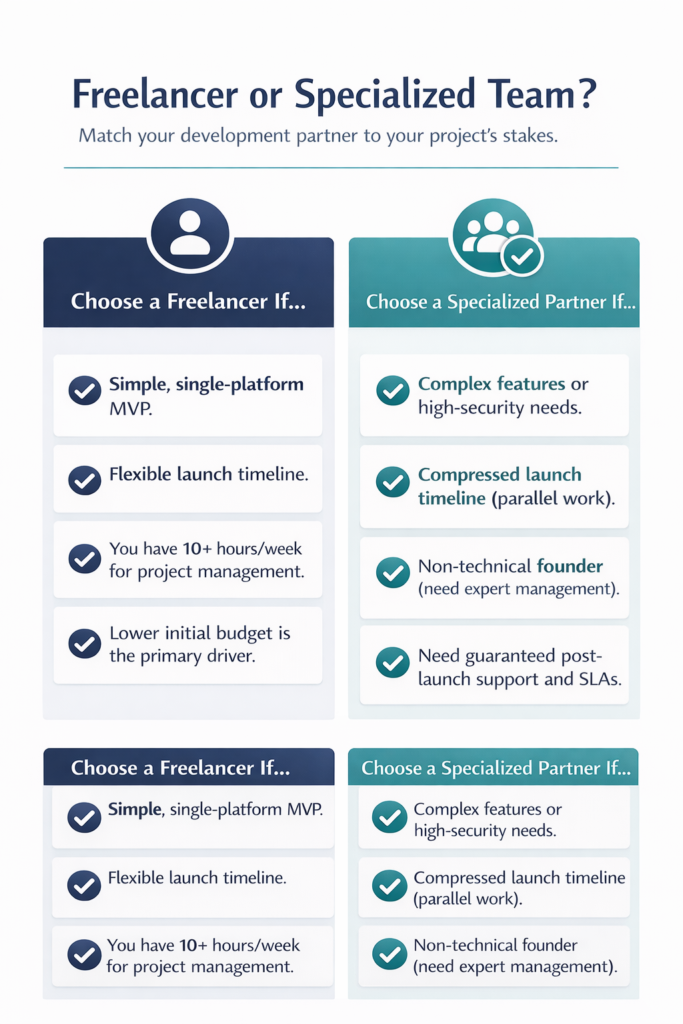
Selecting between freelancers and specialized developers requires honest assessment:
Technical Complexity: Simple applications may succeed with capable freelancers. Sophisticated architecture, integrations, or specialized capabilities benefit from dedicated specialists.
Management Bandwidth: Technical founders with available time can utilize freelancers effectively. Non-technical founders or those focused on business development benefit from specialists handling technical management.
Timeline Urgency: Compressed launches require specialist resource scalability. Flexible timelines accommodate freelance development’s slower individual capacity.
Budget Realities: Limited budgets make freelancers attractive initially. However, consider total cost including management time, potential rework, delays, and knowledge transfer. Specialist predictability sometimes proves more economical despite higher upfront rates.
Risk Tolerance: Freelance arrangements carry higher disruption, quality variation, and accountability risks. Risk-averse founders or those building mission-critical applications benefit from specialist accountability.
Development Timeline Realities
Understanding typical timeframes aids planning:
Simple MVP: 2-4 months for basic functionality with specialized developers; 4-6 months with freelancers due to coordination overhead.
Mid-Range MVP: 4-8 months for custom UI, API integrations, and moderate features with specialists; 6-12 months with freelancers. Most niche apps fall here.
Complex Applications: 8-12+ months for AI, real-time processing, extensive integrations, or compliance requirements with either approach, though specialized teams often compress timelines through parallel work.
Research indicates MVP development typically spans two to six months including discovery. Simple apps launch within four to eight weeks with lean scopes, while complex applications require six to twelve months.
Freelance development often extends these timelines through coordination overhead and capacity constraints, whereas specialized developers with team redundancy sometimes compress schedules.
Essential Evaluation Questions
Whether considering freelancers or specialized developers, ask these questions:
Portfolio Verification: Request detailed case studies with goals, implementation, and outcomes. Contact referenced clients directly. Examine code through GitHub repositories.
Communication: Establish response timeframes, channels (Slack, email, video), meeting frequency, and progress reporting mechanisms.
Technical Capabilities: Confirm technology stack expertise, performance optimization approaches, and handling of offline functionality and poor network conditions.
Project Management: Determine who tracks tasks, manages timelines, and coordinates changes. Clarify scope change handling and escalation processes.
Post-Launch Support: Define maintenance, bug fixes, and updates. Establish response guarantees for critical issues and understand ongoing costs.
Team Redundancy: For specialized developers, confirm team depth ensuring project continuity if someone becomes unavailable.
Frequently Asked Questions
Should I hire freelance developers or specialized development partners?
The choice depends on project complexity, timeline urgency, management capacity, and risk tolerance. Freelancers suit simple projects with flexible timelines when you possess technical management skills. Specialized developers excel for complex applications, compressed timelines, non-technical founders, or situations requiring accountability and support.
How do I verify a freelance developer’s experience?
Request detailed case studies with verifiable client references. Contact clients directly confirming quality, communication, and timeline adherence. Review code samples or GitHub repositories. Conduct technical interviews covering your application’s specific challenges.
What hourly rates should I expect?
U.S. developers typically charge $50-$150 hourly, Eastern European developers $30-$75, and South Asian developers $15-$60. However, lower rates don’t guarantee value—evaluate total cost including management overhead and potential rework rather than optimizing solely for lowest rates.
How long does MVP development take with freelancers?
Simple MVPs require 2-4 months with specialized developers, 4-6 months with freelancers. Mid-range applications need 4-8 months with specialists, 6-12 months with freelancers. Complex apps require 8-12+ months with either approach.
What are the biggest freelance developer risks?
Major risks include single points of failure if developers become unavailable, inconsistent quality without oversight, scope creep without formalized management, limited accountability for deliverables, and communication challenges with international developers. Successful engagements require founders actively managing these risks.
Should my app be native or cross-platform?
Native delivers optimal performance and platform-specific features but requires separate iOS and Android codebases, essentially doubling time and cost. Cross-platform frameworks like React Native and Flutter enable code sharing, reducing costs by 30-40% while delivering suitable performance for most applications.
How do I protect my app idea with freelancers?
Execute comprehensive NDAs (non-disclosure agreements) before sharing details. Ensure contracts explicitly transfer complete IP ownership from project inception. Require work on your infrastructure rather than developer systems. Consider legal counsel reviewing contracts. Reputable developers respect IP protections—those resistant should be avoided.
Can I transition from freelancer to specialized developer later?
Yes, though transitions introduce complexity. Ensure comprehensive documentation, organized code repositories, and clear architectural documentation from freelance work enabling specialist continuation. Budget for specialist time understanding existing code. Starting with specialists often proves more efficient despite potentially higher initial costs.
What if a freelance developer disappears mid-project?
Platform engagements provide some dispute resolution, though recovering funds or forcing completion proves difficult. Mitigate through reputable platforms with payment protection, structuring payments around verified milestones, maintaining continuous code access, and identifying backup contacts. Specialized partnerships eliminate this risk through team redundancy.
How much should I budget for post-launch maintenance?
Plan for 15-20% of initial development costs annually covering hosting infrastructure (AWS, Firebase), third-party subscriptions, bug fixes, OS updates, and minor enhancements. Complex applications or those requiring frequent updates need larger budgets. Establish maintenance agreements before launch rather than scrambling when issues arise.



 20 Min