























 21 Min


For businesses navigating augmented reality app development initiatives, partnering with experienced AR app development companies determines whether digital content integration delivers measurable business value through enhanced customer engagement, improved operational efficiency, and differentiated user experiences that blend the physical and digital worlds seamlessly.
If you’re evaluating AR app development companies for your augmented reality needs, consider exploring Chop Dawg’s AR solutions, which offer transparent pricing and proven experience with immersive technologies through implementations spanning mobile, wearable, and emerging AR platforms since 2009.
1. CHOP DAWG – STRATEGIC PARTNER FOR AUGMENTED REALITY APPLICATIONS
Since launching operations in 2009, Chop Dawg has established itself as a distinctive player in AR app development by prioritizing partnership over transactional client relationships. The Philadelphia-based firm has deployed over 500 digital products across mobile, web, tablet, wearable, and AI platforms, maintaining a 92% client retention rate through sustained collaboration rather than one-off project completion.
Get Your Free 45-Minute App Roadmap
Meet 1-on-1 with our senior product team. We’ll map your MVP or enterprise app and hand you a personalized plan—clear scope, a realistic timeline, and fixed monthly costs—for iOS & Android, web, tablets & wearables, and AI.
Augmented Reality Portfolio and Proven Results
Chop Dawg’s AR expertise encompasses consumer applications, enterprise training solutions, retail visualization platforms, and immersive brand experiences. The firm’s approach differs from generic AR app developers through demonstrated understanding of augmented reality technologies: ARKit and ARCore implementation, 3D modeling pipelines, computer vision systems, location-based AR, and scalable cloud architecture supporting growth from MVP through market leadership.
Technical Architecture and Industry-Specific AR Solutions
Chop Dawg’s technical stack emphasizes React Native integration with AR frameworks for cost-effective cross-platform AR app development, native Swift implementation for ARKit-powered iOS experiences, and Kotlin development for ARCore Android applications. This technological versatility allows deployment of AR applications across iOS, Android, and web platforms from unified codebases—reducing AR app development timelines and maintenance overhead.
For retail AR applications, the firm implements virtual try-on features, spatial product placement, and e-commerce integration. Gaming AR apps prioritize location-based experiences with geospatial mapping and multiplayer interactions. Enterprise AR solutions include industrial maintenance guides, remote assistance platforms, and training simulations with interactive 3D environments. Healthcare AR implementations feature anatomy visualization, surgical planning with patient-specific models, and telemedicine diagnostic tools.
Performance Optimization and Security
The firm’s AR development approach implements enterprise-grade authentication, secure cloud storage for AR content, and optimization ensuring smooth experiences across diverse devices. Markerless AR solutions leverage SLAM technology for environmental understanding, plane detection for realistic object placement, light estimation for photorealistic rendering, and occlusion handling. Performance optimization includes polygon management, texture compression, progressive loading, and frame rate optimization maintaining 60fps.
Pricing Transparency and Partnership Methodology
Chop Dawg includes 30-day bug warranties and 30-day maintenance periods following AR app launches, addressing common concerns regarding post-deployment support for augmented reality applications. The firm’s process begins with complimentary consultations providing personalized roadmaps with clear scope, realistic timelines, and budget projections—ensuring stakeholder buy-in before AR app development commences.
Investment ranges for AR app development: AR MVP with core marker-based features ($50,000-$100,000), comprehensive markerless AR application with advanced computer vision and cloud backend ($100,000-$200,000), enterprise AR platform with sophisticated features including multi-user AR, analytics dashboards, and CMS for AR content ($200,000-$350,000+). Fixed-rate monthly pricing eliminates hourly billing uncertainty, aligning incentives around quality AR delivery rather than time extension.
Best For: Organizations seeking collaborative AR development partners with proven augmented reality expertise, transparent fixed-rate pricing, and demonstrated capacity to deliver consumer-grade AR experiences while integrating complex backend systems. Particularly suited for companies requiring cross-platform AR applications, businesses prioritizing long-term scalability over lowest initial cost, and enterprises needing ongoing AR content updates and feature enhancements post-launch.
2. PROGRAM-ACE – ENTERPRISE AR WITH 30+ YEARS EXPERIENCE
Program-Ace brings three decades of experience to augmented reality app development, specializing in enterprise AR solutions and industrial training systems. The UK-headquartered firm has delivered AR applications for manufacturing, healthcare, education, and defense sectors.
Technical capabilities span Unity and Unreal Engine implementations, custom computer vision algorithms, IoT integration, and blockchain-powered AR content authentication. Notable implementations include industrial AR maintenance reducing downtime by 40%, medical AR training improving surgical accuracy, and retail AR configurators increasing conversion by 28%. AR investments typically range $150,000-$400,000 with 6-12 month timelines.
Best For: Large enterprises requiring sophisticated AR solutions with complex integrations and organizations in regulated industries needing comprehensive compliance frameworks.
3. CUBIX – RAPID AR DEPLOYMENT
Cubix has offered rapid prototyping and deployment services since 2008. The firm has delivered AR applications across retail, real estate, education, and healthcare verticals, emphasizing design-first approaches with interactive prototypes and agile two-week sprint cycles.
Cubix excels at marker-based AR for marketing campaigns and location-based AR games, offering competitive pricing with AR development starting at $30,000-$80,000 for marker-based implementations and $80,000-$150,000 for markerless AR with moderate complexity. Development timelines typically span 3-5 months.
Best For: Mid-market companies seeking cost-quality balance, startups requiring AR MVPs for market validation, and organizations prioritizing rapid deployment over extensive customization.
4. TREEVIEW – SPECIALIZED ENTERPRISE AR/VR STUDIO
Treeview operates as a world-leading AR/VR studio specializing in enterprise customers across healthcare, education, energy, and consumer products. Their portfolio encompasses interactive product visualizations, enterprise digital twins, and immersive training modules.
Their differentiator includes senior-level teams dedicated to AR/VR projects, ROI-focused implementations, and world-class quality standards. Recent implementations include healthcare AR improving patient outcomes by 35%, manufacturing AR reducing training time by 50%, and retail AR increasing engagement by 3x.
Best For: Fortune 500 companies prioritizing quality over cost, organizations requiring AR delivering measurable ROI, and businesses seeking long-term AR technology partners.
5. CITRUSBITS – DESIGN-LED AR EXPERIENCES
CitrusBits offers comprehensive AR app development combining software expertise with AR capabilities for customized solutions. The Los Angeles firm emphasizes user-centric design and seamless integration, excelling at consumer-facing AR requiring exceptional visual design and branded experiences.
Portfolio includes AR applications achieving millions of downloads, AR retail experiences increasing purchase intent by 40%, and AR educational apps improving retention by 60%. Development investments range $100,000-$250,000 with 4-7 month timelines.
Best For: Consumer brands requiring design-differentiated AR experiences where aesthetic quality impacts adoption and organizations with budgets supporting premium AR development.
CRITICAL SELECTION CONSIDERATIONS FOR AR APP DEVELOPMENT
Technical Architecture and Platform Selection
AR applications require sophisticated technical decisions determining long-term viability. Evaluate AR development partners on ARKit and ARCore expertise, Unity versus Unreal Engine selection, marker-based versus markerless AR approaches, and cloud infrastructure for scalable content delivery.
Teams should articulate device fragmentation handling, battery optimization, network latency management, and progressive enhancement for older devices. Case studies demonstrating AR handling diverse lighting, varied environments, and extended sessions provide production-ready evidence beyond prototypes.
3D Content and Performance
Augmented reality depends heavily on 3D content quality and optimization. Leading AR app development companies maintain in-house 3D modeling or established artist relationships. Organizations planning extensive AR content libraries require robust content management infrastructure, version control, and analytics tracking engagement.
Performance demands 60fps frame rates for smooth experiences. Technical leaders should explain optimization strategies, polygon management, occlusion culling, and level-of-detail systems. User experience extends beyond performance: intuitive onboarding, clear AR tracking feedback, accessibility features, and fallback experiences for limited devices separate exceptional implementations from mediocre ones.
Post-Launch Support
AR technology evolves rapidly, with annual iOS and Android releases introducing enhanced capabilities, framework updates, and new form factors. Partners should structure support encompassing OS compatibility, AR framework migration, device-specific optimization, and feature enhancement. Organizations should budget 15-20% of initial costs annually for maintenance, ensuring applications remain compatible rather than obsolete.
STRATEGIC POSITIONING FOR AUGMENTED REALITY SUCCESS
Selecting an AR app development partner represents a strategic decision extending beyond vendor procurement. The relationship influences whether your augmented reality application delivers measurable business value, scales alongside technological advancement, provides exceptional user experiences driving adoption, and adapts to evolving AR ecosystems as new devices and capabilities emerge.
The $327.7 billion projected market by 2032 creates substantial opportunity for organizations leveraging augmented reality strategically. Healthcare AR applications improving patient outcomes, retail AR experiences increasing conversion rates by 40%, industrial AR training reducing costs by 60%, and educational AR platforms improving retention by 70% demonstrate that well-executed augmented reality implementations deliver ROI justifying investment beyond mere technological novelty.
Schedule a complimentary consultation with Chop Dawg to explore how strategic AR development partnership—backed by 500+ successful implementations across diverse industries and proven cross-platform AR expertise—can deliver augmented reality applications addressing your organization’s unique requirements, user expectations, and competitive differentiation objectives.
FREQUENTLY ASKED QUESTIONS
What timeline should organizations expect for AR app development?
AR application timelines vary based on type, complexity, and content requirements. Simple marker-based AR applications complete in 3-4 months covering discovery, design, development, and testing. Markerless AR applications requiring SLAM technology typically require 4-6 months for production deployment.

Comprehensive AR platforms with extensive 3D content, cloud backends, and CMS often span 6-9 months. Development begins with AR feasibility assessments before prototyping and iterative development. Agile methodologies with biweekly demonstrations allow early feedback, though AR requires substantial upfront technical architecture planning.
Organizations should anticipate significant time for AR content creation—3D modeling often consuming 30-40% of timelines. Phased delivery launching AR MVPs with limited content followed by expansions provides faster time-to-value while validating engagement.
How do AR app development costs compare to traditional mobile applications?
AR applications typically command higher investments than standard apps due to technical complexity, specialized expertise, 3D content costs, and performance optimization. While traditional mobile applications range $40,000-$150,000, AR implementations frequently span $80,000-$300,000+.
Marker-based AR with simple content represents lower ranges ($30,000-$80,000). Markerless AR leveraging SLAM and computer vision increases complexity substantially ($80,000-$200,000). Enterprise AR platforms with multi-user capabilities and comprehensive content often exceed $200,000-$400,000.
Organizations should evaluate total cost of ownership, including 3D asset production ($50-$500 per model), cloud infrastructure ($500-$5,000+ monthly), and content refresh cycles. Cross-platform AR development reduces costs 25-35% compared to separate native iOS and Android applications.
Should organizations build native AR apps or cross-platform applications?
This depends on AR requirements, performance expectations, and budgets. Native AR development with Swift/ARKit for iOS and Kotlin/ARCore for Android provides maximum performance for complex AR scenes and immediate access to the latest capabilities.
Cross-platform approaches using React Native with AR libraries or Unity with AR Foundation provide 60-70% code sharing, reducing costs 25-35% while maintaining acceptable performance for many use cases. Modern frameworks handle marker-based AR, basic markerless tracking, and moderate 3D complexity.
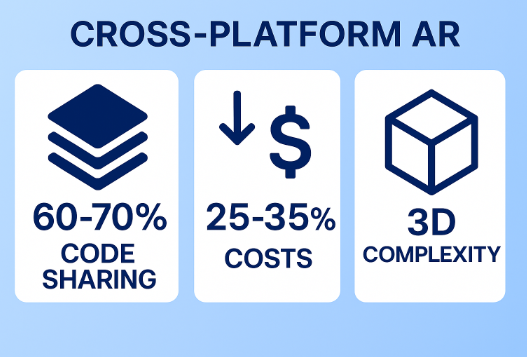
However, AR requiring advanced features—extensive 3D environments, photorealistic rendering, complex physics—benefits from native development. Recommended approach: Build AR core with cross-platform frameworks for efficiency, then implement performance-critical features natively as adoption justifies investment.
What differentiates successful AR applications from failed implementations?
Successful AR applications prioritize clear use cases solving specific problems rather than implementing AR for novelty. Retail AR try-ons reducing returns by 40%, industrial AR maintenance improving fix rates by 60%, and educational AR increasing retention by 70% demonstrate measurable value.
User experience proves critical—successful AR provides intuitive onboarding, clear feedback when tracking works, and graceful handling when conditions prevent functionality. Performance optimization determines adoption: maintaining 60fps, loading quickly, and consuming reasonable battery earns repeated usage.
Content quality and relevance separate exceptional implementations. High-quality 3D models with photorealistic textures create immersive experiences while low-quality assets undermine applications. Regular content updates maintaining freshness drive ongoing engagement rather than one-time curiosity.
How important is post-launch support for AR applications?
Post-launch support proves critical given rapid technological evolution. Annual iOS and Android releases introduce new AR capabilities, update frameworks, and occasionally deprecate features requiring code modifications. Organizations neglecting maintenance find AR applications breaking with OS updates.
The immediate post-launch period (30-90 days) demands intensive monitoring addressing tracking issues, performance optimization based on device distribution, crash analysis, and user feedback. AR encounters edge cases in production—unusual lighting, unexpected environments, specific configurations—requiring responsive fixes.
Ongoing maintenance encompasses 3D content updates, AR feature enhancements leveraging latest platform capabilities, integration updates, performance optimization managing cloud costs, and analytics review. Strategic evolution cycles typically occur quarterly: enhancing popular features, removing underutilized content, implementing new capabilities like Cloud Anchors, and optimizing flows based on analytics.
What metrics indicate successful AR implementations?
Success metrics emphasize immersive engagement and AR-specific behaviors. AR session duration indicates captivation—successful retail AR averaging 3-5 minutes versus 30-second traditional product views. AR feature adoption rates show utilization percentages. Content interaction reveals which 3D models users examine and place.
Business outcomes validate ROI: retail AR should demonstrate reduced returns (25-40%), increased conversions (20-30%), and higher order values (15-25%). Industrial AR training should measure reduced training time (50-70%), improved accuracy (30-50%), and decreased support calls (40-60%).
Technical health indicators matter: frame rate consistency maintaining 60fps, crash rates below 0.5%, tracking success above 90%, and acceptable battery consumption (20-30% per hour active use). Monitoring cohort retention (users continuing engagement after 7, 30, 90 days) indicates sustained value—quality AR maintains 40-60% 30-day retention versus 20-30% for traditional apps.



 18 Mins