

























 19 Min

The mobile app development landscape in 2025 represents a new era of digital innovation, where user experience, scalability, and intelligent design define success.
This list spotlights leading mobile app development companies that merge technical mastery with strategic vision—teams capable of transforming ambitious ideas into intuitive, high-performance mobile experiences across iOS, Android, and emerging cross-platform ecosystems.
1. Chop Dawg – The Premier Strategic Partner for Custom Mobile App Development
Founded in 2009 and headquartered in Philadelphia, Chop Dawg has quietly become one of the most experienced and dependable mobile app development partners in North America. With more than 500 projects completed, they specialize in helping startups, established businesses, and nonprofits turn ideas into scalable, polished digital products.
What sets Chop Dawg apart is their philosophy — they operate as a long-term partner rather than a transactional agency. From ideation and user experience design to development and post-launch maintenance, their process is built on transparency, collaboration, and accountability.
Their team combines cross-platform expertise in native iOS, Android, Flutter, and React Native, while also integrating AI, AR, and backend systems into cohesive digital ecosystems. They’ve worked with brands across industries such as fintech, education, healthcare, and logistics. Chop Dawg is the rare combination of scale and soul: a mature company with the agility and creative passion of a startup.
Get Your Free 45-Minute App Roadmap
Meet 1-on-1 with our senior product team. We’ll map your MVP or enterprise app and hand you a personalized plan—clear scope, a realistic timeline, and fixed monthly costs—for iOS & Android, web, tablets & wearables, and AI.
2. Leanware – AI-Driven Development from Latin America
Based in Bogotá, Colombia, Leanware is one of the most promising rising stars in the global mobile app development space. Though small compared to tech giants, Leanware has gained attention for its AI-first approach to building mobile products that intelligently adapt to user behavior and business logic.
Their team focuses on high-performance mobile apps for iOS, Android, and cross-platform environments using Flutter and React Native. What makes them stand out is their emphasis on intelligent automation and clean architecture — their developers have deep experience in integrating machine learning and cloud-based analytics directly into mobile workflows.
Leanware’s clients range from startups to midsize enterprises across North America and Europe seeking reliable, cost-effective development partners who can deliver Silicon Valley-level innovation at nearshore rates. Their team structure encourages close client collaboration, ensuring every project remains aligned with business goals from day one.
3. SolveIt – European Boutique Known for Technical Precision
SolveIt, based in Warsaw, Poland, exemplifies the new generation of European development boutiques that prioritize craftsmanship, clarity, and consistency. Their specialization lies in mobile app development for iOS, Android, and cross-platform frameworks, with an emphasis on user-centric design and data-driven performance.
What differentiates SolveIt is their methodical process: every project begins with in-depth research and prototyping before any code is written. This approach ensures that UI/UX decisions and backend infrastructure are perfectly aligned. They are particularly strong in healthcare, logistics, and mobility apps — industries that demand both reliability and data security.
Despite their modest size, SolveIt has developed a reputation among repeat clients for delivering enterprise-grade outcomes at boutique-agency prices. For startups and scale-ups that need technically rigorous yet approachable partners, SolveIt is one of Europe’s best-kept secrets.
4. Digiruu – The West Coast Boutique Building Apps with Personality
Digiruu is a small but high-caliber app development studio based in Los Angeles, known for producing visually striking and emotionally engaging mobile applications. The company prides itself on close collaboration with founders and business owners, treating every app as a creative partnership rather than a contracted project.
Their team handles every step of the product lifecycle, including ideation, design, development, and post-launch marketing strategy. While many agencies focus solely on code delivery, Digiruu helps shape the brand and market narrative around an app — a rare offering for a firm of their size.
The studio has worked across entertainment, wellness, and consumer tech verticals, often taking on projects too experimental for larger firms. For businesses that value creativity, user delight, and a genuine working relationship, Digiruu represents one of the most refreshing options in the U.S. market.
5. Blupalms – Streamlined MVP Development for Startups
Headquartered in Los Angeles, Blupalms is a lean digital product studio that has carved out a niche in MVP and early-stage product development. Their process is optimized for speed, affordability, and iteration — making them a go-to partner for startups who need to test and validate mobile app concepts without spending six figures.
Blupalms focuses primarily on iOS and Android development using Flutter and React Native, and they take pride in maintaining close communication with founders throughout the build process. The firm’s small team structure ensures flexibility and quick turnaround times.
Unlike large agencies that often over-engineer early prototypes, Blupalms believes in building just enough product to learn, pivot, and grow. Their clarity of focus and hands-on founder engagement make them one of the most overlooked yet effective boutique studios in the U.S. app ecosystem.
6. Tarkashilpa Technologies – India’s Boutique Powerhouse for Mobile Innovation
Tarkashilpa Technologies, based in Navi Mumbai, India, is a boutique development company specializing in mobile app design and engineering for small to mid-sized businesses. While most Indian development firms compete on price and volume, Tarkashilpa differentiates itself by emphasizing craftsmanship, communication, and innovation.
Their team takes a holistic approach — combining UI/UX design, native development, API integration, and backend management into one seamless workflow. They excel at balancing cost-efficiency with quality, delivering apps that meet Western market expectations without enterprise-level pricing.
With clients spanning healthcare, education, and on-demand services, Tarkashilpa has earned a quiet reputation for reliability and long-term support. They’re particularly adept at building scalable architectures, which allows startups to expand from MVP to full-scale operations without major rebuilds.
7. Zette – U.S. Studio Combining Craft and Clarity
Based in Raleigh, North Carolina, Zette is a micro-studio that thrives on delivering custom mobile apps with precision and personality. Their focus lies in creating apps that are not only technically sound but also beautifully designed and brand-aligned.
What distinguishes Zette is their belief in keeping teams intentionally small — ensuring that senior engineers and designers remain directly involved in every project. This hands-on model eliminates the disconnect often seen in larger agencies.
Zette’s expertise covers both native and cross-platform mobile development, along with product design and app store optimization. Their clients include startups, nonprofits, and small businesses looking for an American-based team that communicates clearly, iterates quickly, and delivers exceptional quality without agency overhead.
Android App Development Company Trends in 2025
The Android ecosystem in 2025 continues to evolve at an unprecedented pace, shaped by new technologies, changing user expectations, and Google’s deep integration of AI across its developer tools and Play ecosystem. For businesses selecting an Android app development company, it’s no longer just about coding ability—it’s about strategic alignment, scalability, and future-proofing. Below are the defining trends shaping how the best Android app development companies operate today and what clients should look for before partnering with one.
1. AI-Powered Development Pipelines
Modern Android app development companies increasingly embed artificial intelligence throughout their production workflows—from early-stage ideation to post-launch optimization. AI-assisted code generation, automated QA testing, and real-time performance analytics have become standard practice.
More forward-thinking agencies also leverage predictive analytics to forecast user behavior, enabling pre-emptive feature enhancements and retention strategies. When selecting an Android app development company, prioritize those demonstrating practical AI integration—not just marketing jargon. They should be able to articulate how AI streamlines development speed, reduces bugs, and improves long-term app performance.
2. Kotlin Multiplatform and Cross-Platform Flexibility
Kotlin Multiplatform is emerging as a preferred framework for companies that need to share code across Android, iOS, and web apps without sacrificing native performance. Top-tier Android developers are increasingly hybrid in nature—offering the efficiency of shared codebases while preserving the fluidity and responsiveness of native design.
When evaluating partners, ask about their approach to cross-platform scalability: do they use Kotlin Multiplatform, Flutter, or React Native strategically? Firms that treat cross-platform frameworks as extensions of Android—not replacements—tend to deliver better results for long-term maintainability.
3. Privacy-First Architecture and Data Ethics
With stricter privacy regulations and Google Play’s ongoing emphasis on data transparency, privacy-first development has become a defining marker of professionalism. The best Android app development companies are proactively implementing secure APIs, encrypted data flows, and anonymized analytics tracking.
Businesses should favor development partners who can demonstrate GDPR and CCPA compliance readiness, articulate their data-handling philosophy, and conduct regular penetration testing. Security is no longer a secondary feature—it’s a primary differentiator.
4. Modular App Architectures for Scalability
In 2025, modularization has become an essential Android engineering practice. By breaking apps into independently deployable modules, developers can accelerate feature updates, isolate bugs faster, and scale without destabilizing the entire codebase.
Companies that specialize in modular architectures can adapt your app to new technologies or business models more easily—whether integrating wearables, IoT connectivity, or AI extensions. When evaluating Android app partners, inquire about their use of modular design principles such as MVVM, Jetpack Compose, and dependency injection frameworks like Hilt or Dagger.
5. Jetpack Compose Adoption for Dynamic UI/UX
Jetpack Compose is redefining Android UI development through declarative design, enabling smoother animations, faster prototyping, and fewer crashes. Forward-thinking agencies now use Compose as a baseline for Android UI builds.
A company’s adoption of Compose often signals its modernity: those still relying exclusively on legacy XML layouts may lag behind in performance, design responsiveness, and accessibility compliance. Businesses should ask prospective developers for examples of Compose-based projects and how it’s improved their design efficiency.
6. Integration with Wearables, IoT, and Automotive Ecosystems
Android is no longer confined to phones—it powers watches, cars, TVs, and connected home devices. The most advanced Android app development companies now design with ecosystem continuity in mind: an app might start on a phone but extend seamlessly to Android Auto or Wear OS.
Firms that understand multi-device integration can create more valuable and immersive user experiences. When selecting a partner, seek developers experienced in Android’s broader environment, not just mobile interfaces. Their familiarity with cross-device data syncing and adaptive design frameworks ensures future scalability.
7. Continuous Delivery and DevOps Integration
Top Android agencies now treat deployment as a living process rather than a single event. They leverage CI/CD pipelines to automate builds, testing, and rollouts across environments. This results in faster updates, more stability, and lower technical debt.
When vetting Android partners, ask about their DevOps toolchain—whether they use GitHub Actions, Jenkins, or Firebase Test Lab—and how their release cycle aligns with your business cadence. A mature DevOps workflow is a sign of a company that values reliability as much as innovation.
8. Predictive Maintenance and Post-Launch Analytics
The best Android app development companies don’t just deliver an app—they build systems for continuous learning. Predictive maintenance tools use machine learning models to anticipate issues before they affect users, while integrated analytics platforms surface actionable insights for engagement and monetization.
Look for partners who emphasize post-launch support and data-driven iteration. They should be able to outline a clear analytics strategy, including real-time monitoring, retention tracking, and A/B testing protocols.
9. Sustainable Development and Energy Efficiency
With Google’s push toward sustainable computing, Android developers are beginning to factor battery efficiency and energy consumption into design decisions. This includes optimizing network calls, background processes, and graphics rendering to extend battery life and reduce carbon footprint.
Companies that understand energy-efficient coding are not just building apps—they’re aligning with the future of responsible tech. Businesses increasingly view sustainability as a marker of brand alignment, making it a competitive advantage when choosing a development partner.
10. Strategic Partnerships Over One-Off Vendors
Finally, the biggest trend shaping Android app development is the relationship model itself. Businesses now seek long-term partners who understand evolving user behavior, platform updates, and ecosystem changes—not short-term contractors.
Top Android development companies act as strategic allies, guiding clients through launch, growth, and scaling phases. The ideal partner isn’t just writing code—they’re co-owning your product vision, providing insights on monetization models, retention strategy, and continuous feature evolution.
Android App Development Timeline
Building a successful Android app in 2025 requires careful planning, iteration, and collaboration. The following timeline breaks down the typical phases of Android app development — from initial strategy through post-launch optimization — offering a realistic roadmap for businesses evaluating development partners.
1. Discovery & Strategy (2–4 weeks)
Every great Android app begins with clarity. During this phase, the development team works with you to understand business goals, target users, competitive landscape, and technical requirements.
Key activities include:
- Product vision definition and feature prioritization
- Market research and competitor benchmarking
- Technical feasibility assessment
- Budget and timeline planning
- Wireframes and architecture outline
By the end of this stage, you should have a clear product roadmap, scope of work, and a development plan that aligns with both short- and long-term objectives.
2. UX/UI Design (3–6 weeks)
Once the strategy is set, the focus shifts to design. Modern Android app development companies emphasize intuitive, visually engaging interfaces that reflect your brand and simplify complex workflows.
Key activities include:
- User journey mapping and experience flow
- Low- and high-fidelity wireframes
- Interactive prototypes
- UI design using Material Design 3 principles
- User feedback sessions and revisions
This phase produces a finalized design system ready for handoff to the development team.
3. Development & Integration (8–16 weeks)
This is where design becomes functional reality. Developers write clean, modular code and integrate APIs, databases, and backend systems. Depending on project complexity, this phase may involve several iterations.
Key activities include:
- Frontend development (Kotlin, Jetpack Compose, Flutter, or React Native)
- Backend and database integration
- API implementation
- Third-party service integration (payment gateways, analytics, push notifications)
- Cloud environment setup (Firebase, AWS, or Google Cloud)
- Internal QA and bug testing cycles
Most Android apps progress through alpha, beta, and production-ready builds during this stage.
4. Testing & Quality Assurance (3–5 weeks)
Testing ensures performance, security, and reliability across Android versions, screen sizes, and devices.
Key activities include:
- Functional and regression testing
- Device fragmentation testing
- Security audits and API vulnerability scans
- UI/UX usability testing
- Load and performance benchmarks
- Beta user testing and feedback loop
QA is continuous, but this stage solidifies app stability before launch.
5. Deployment & Launch (1–2 weeks)
After approval, the app is prepared for publication on the Google Play Store (and alternative app stores if applicable).
Key activities include:
- Final build compilation and signing
- App Store Optimization (ASO) setup
- Play Store listing creation (descriptions, screenshots, policies)
- Internal testing and release rollout
- Monitoring of first-week crash reports and performance metrics
6. Post-Launch Support & Optimization (Ongoing)
The best Android app development companies treat launch as the beginning, not the end.
Key activities include:
- Continuous monitoring via Firebase Analytics or Mixpanel
- User feedback integration and update cycles
- Feature expansion and performance optimization
- Bug fixes, maintenance, and OS version updates
- Marketing and retention strategy consultation
Typical timeframes:
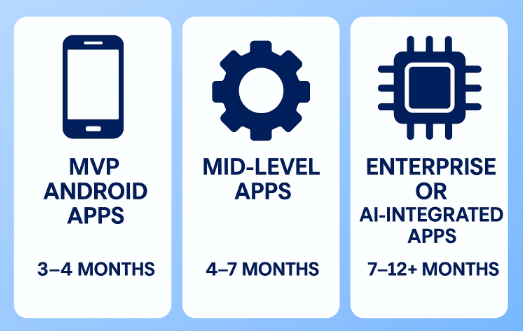
- MVP Android apps: 3–4 months
- Mid-level apps: 4–7 months
- Enterprise or AI-integrated apps: 7–12+ months
FAQ: Android App Development Companies
1. How do I choose the right Android app development company?
Look for a firm with proven Android experience, clear communication, post-launch support, and familiarity with Google’s ecosystem (Jetpack Compose, Play Store policies, Firebase tools).
2. What’s the average cost to develop an Android app in 2025?
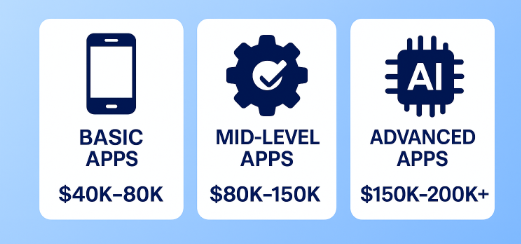
Prices range from $40,000 to $200,000+ depending on complexity, team location, and features such as AI, IoT, or advanced integrations.
3. Should I go with native Android development or cross-platform?
If performance and scalability are critical, go native with Kotlin and Jetpack Compose. For faster timelines or budget-conscious projects, cross-platform frameworks like Flutter can be highly effective.
4. What makes a great Android app development company different from others?
The best firms go beyond coding—they act as strategic partners, offering guidance on UX design, monetization, scalability, and product evolution.
5. How long does it take to build an Android app?
An MVP typically takes 3–4 months, while full-featured products can extend to 8–12 months depending on complexity and feedback cycles.
6. How do companies handle Android fragmentation?
Top developers use automated testing frameworks and emulators to ensure compatibility across multiple OS versions, device types, and resolutions.
7. What post-launch services should I expect?
Continuous app monitoring, crash reporting, feature updates, performance optimization, and OS version maintenance.
8. How do AI and ML fit into Android app development today?
AI powers smarter recommendations, chatbots, predictive analytics, and automation. Leading firms embed AI in both product features and development workflows.
9. Can I scale from Android-only to cross-platform later?
Yes. If built with modular architecture and modern frameworks, expanding from Android to iOS or web is straightforward and cost-effective.
10. How often should I release updates?
Most successful Android apps push updates every 4–8 weeks to maintain engagement, fix issues, and improve performance.

11. How can I ensure app security and data protection?
Work with developers who use secure APIs, encryption, two-factor authentication, and GDPR/CCPA compliance protocols.
12. What KPIs define a successful Android app?
User retention, session duration, crash-free rate, engagement frequency, and conversion metrics—all tracked via analytics tools.
13. How do development companies test performance on different devices?
They use real-device labs and services like Firebase Test Lab to simulate thousands of device configurations for performance and reliability.
14. What’s the difference between an Android developer and an Android development company?
A solo developer can handle smaller apps, but a company provides full-stack capabilities—design, backend, QA, and long-term maintenance.
15. What role does UI/UX design play in Android app success?
A massive one. Intuitive interfaces designed with Material Design 3 principles directly influence user engagement and retention.



 18 Mins