






























 18 Mins


The telemedicine industry stands at a transformative inflection point. Valued at approximately $105 billion in 2024, the global telemedicine market projects expansion to $335 billion by 2032, creating substantial opportunities for founders building specialized healthcare platforms. Yet market size alone doesn’t guarantee success—choosing the right development partner determines whether your telemedicine application delivers measurable patient outcomes or joins thousands of abandoned healthcare apps.
This analysis examines what distinguishes exceptional telemedicine developers, evaluates their technical capabilities against healthcare-specific requirements, and provides the decision framework needed to select a partner capable of navigating HIPAA compliance, EHR integration complexity, and the unique user experience challenges inherent to remote healthcare delivery.
Considering building a telemedicine platform that addresses genuine healthcare access barriers? Explore how Chop Dawg‘s HIPAA-compliant development expertise has helped healthcare organizations launch secure, user-focused applications with proven engagement results.
1. Iqbal Shezada — Senior Developer
Iqbal specializes in building secure and scalable telemedicine applications. He focuses on integrating video consultations, patient management systems, and HIPAA-compliant workflows while ensuring apps remain performant and reliable.
Get Your Free 45-Minute App Roadmap
Meet 1-on-1 with our senior product team. We’ll map your MVP or enterprise app and hand you a personalized plan—clear scope, a realistic timeline, and fixed monthly costs—for iOS & Android, web, tablets & wearables, and AI.
2. Hameed Ullah — Developer
Hameed brings full-stack expertise to telemedicine projects, handling features like appointment scheduling, electronic health records (EHR) integration, and real-time messaging. His work ensures smooth, user-friendly experiences for both patients and healthcare providers.
3. Abdullah Khan — Developer
Abdullah develops responsive interfaces and backend systems for telemedicine apps, supporting video streaming, patient dashboards, and notifications. He emphasizes reliability and data security while maintaining seamless user interactions.
4. Farhan Jameel — Developer
Farhan focuses on building robust telemedicine app functionality, including prescription management, analytics dashboards, and secure communication channels. His work helps healthcare providers deliver a secure and efficient digital experience to patients.
Market & Risk Snapshot (2024–2025)
Market Opportunity and Critical Challenges
The global telemedicine opportunity continues expanding, with multi-billion dollar potential driving substantial investment. Yet healthcare remains a high-risk sector: independent analyses of 2024 breach data document that over 276 million healthcare records were compromised across more than 700 reported incidents. Security lapses create immediate legal, reputational, and operational liabilities for telemedicine platforms.
Regulatory and standards landscapes also evolve rapidly. Interoperability expectations increasingly center on FHIR-based APIs, while state-level telemedicine regulations and federal enforcement priorities continue shifting in response to emerging threats.
Critical Requirements for Telemedicine Developers
Telemedicine founders must require vendor proposals to include:
- Documented, testable encryption and key-management approach – AES-256 encryption at rest, TLS 1.3 in transit
- FHIR-based EHR connectivity with queuing/retry semantics
- Production-grade video architecture and fallbacks for consultation reliability
- Incident response and post-launch security monitoring SLA with defined response times
Meet Chop Dawg’s Telemedicine-Specialized Developers
Iqbal Shezada: Healthcare Architecture & Security Leadership
With 25+ years of senior engineering leadership and specific healthcare experience, Iqbal brings the architectural vision essential for secure, compliant telemedicine platforms. He doesn’t just implement features—he designs systems architecture addressing healthcare’s unique requirements: regulatory compliance, security, reliability, and clinical workflow integration.
For Telemedicine Specifically:
HIPAA-Compliant Architecture: Iqbal designs systems implementing all five HIPAA components: Privacy Rule, Security Rule, Enforcement Rule, Breach Notification, and Omnibus Rule. His architectures incorporate:
- AES-256 encryption for data at rest and TLS 1.3 in transit
- Multi-factor authentication with biometric options
- Automatic session termination after inactivity
- Comprehensive audit trails logging all PHI access
- Role-based access control restricting data visibility
- Secure API development following OWASP guidelines
EHR Integration Expertise: Iqbal architects FHIR-compliant integrations with diverse healthcare systems (HL7, DICOM, SNOMED CT). His systems handle integration failures gracefully, maintaining application functionality when external healthcare systems experience downtime.
Scalable Infrastructure for Healthcare: Node.js and AWS systems handling high-traffic periods (patient check-ins, provider availability updates) without performance degradation.
Compliance Monitoring & Updates: Iqbal structures systems enabling rapid regulatory updates as state and federal telemedicine requirements evolve, preventing expensive rebuilds when rules change.
Why Telemedicine Needs This: Generic backend developers miss healthcare’s critical requirements. HIPAA isn’t bolted-on security—it’s foundational architecture. Iqbal designs systems where compliance is built-in, not added later.
Moeed Farooq: Clinical User Experience & Telehealth-Specific UI
Moeed specializes in the interface layer where telemedicine success happens: intuitive clinical workflows, accessible patient experiences, and reliable real-time video delivery. He understands healthcare users experience anxiety, urgency, or health concerns—interfaces must instill confidence and enable clear communication with providers.
For Telemedicine Specifically:
Clinical Workflow Optimization: Moeed designs interfaces following healthcare best practices: minimal clicks to reach providers, clear vitals/history display, seamless note-taking for clinicians, intuitive prescription workflows.
Video Consultation Excellence: Using React and React Native, he implements production-grade video architecture with fallbacks, ensuring consultations never drop due to poor connectivity. Automatic quality adaptation maintains video across poor networks.
Cross-Platform Accessibility: Telemedicine reaches patients on whatever devices they own—older phones, tablets, computers. Moeed’s experience ensures seamless experience across all platforms, with React Native enabling iOS/Android consistency from a single codebase.
Accessible Design for Healthcare: Color contrast, font sizes, and interaction patterns follow healthcare accessibility guidelines, ensuring elderly patients and those with visual/motor impairments can navigate easily.
Real-Time Communication Features: Seamless messaging, secure document sharing, appointment scheduling—all designed for healthcare contexts where clarity and trust matter.
Why Telemedicine Needs This: Patient experience drives adoption. Clinicians won’t use systems with awkward workflows. Moeed designs interfaces making clinical work easier and patient interactions reassuring.
Wikram Das: Full-Stack Telemedicine Infrastructure & DevOps
Wikram brings rare full-stack capability spanning frontend, backend, infrastructure, and DevOps—essential for telemedicine platforms where architectural decisions cascade from patient interface through secure cloud infrastructure.
For Telemedicine Specifically:
Secure Cloud Infrastructure: AWS deployment with HIPAA Business Associate Agreement (BAA), ensuring healthcare compliance throughout infrastructure.
Real-Time Data Synchronization: Node.js and NestJS backends synchronizing patient vitals, appointment status, consultation state across web and mobile without data loss.
FHIR-Based EHR Connectivity: Wikram implements FHIR APIs enabling seamless integration with diverse electronic health records systems. Queue/retry semantics ensure failed integrations retry automatically without losing data.
Video Infrastructure & Failover: Production-grade video servers with automatic quality adaptation and fallback mechanisms. If primary connection drops, patients maintain consultations through degraded quality rather than losing connection entirely.
Secure Storage & Key Management: AWS KMS for encryption key management, ensuring healthcare data remains encrypted with keys never exposed to application code.
Scalability for Traffic Spikes: Telemedicine platforms face usage spikes during evening hours and weekends. Wikram’s infrastructure scales automatically, preventing slowdowns when patient demand peaks.
Why Telemedicine Needs This: Full-stack expertise ensures clinical reliability. When video fails, patients can’t consult doctors. When EHR integration breaks, clinicians can’t access patient history. Wikram’s end-to-end ownership ensures these critical systems work reliably.
Critical Evaluation Factors for Telemedicine Development Partners
Healthcare Regulatory Expertise
HIPAA compliance applies to all healthcare providers qualifying as covered entities—those transmitting health information electronically. Development teams must demonstrate practical experience implementing Privacy Rule requirements, Security Rule safeguards, Breach Notification protocols, and Business Associate Agreement structures.
Request detailed examples of HIPAA implementation in past projects. Generic security capabilities don’t translate automatically to healthcare compliance—developers must understand encrypted data transmission requirements, access control protocols, comprehensive audit logging, automatic session termination, and role-based permission structures specific to medical contexts.
EHR Integration Experience
Seamless electronic health records integration separates functional telemedicine platforms from disconnected tools requiring duplicate data entry. Leading healthcare developers design applications adhering to HL7, FHIR, DICOM, and SNOMED CT interoperability standards.
Inquire about specific EHR integrations completed, data synchronization approaches implemented, and strategies for handling integration failures gracefully to maintain application functionality when external systems experience downtime.
Security Architecture and Compliance
HIPAA violations carry penalties reaching up to $1.9 million per violation category annually, making robust security architecture non-negotiable. Development partners should implement AES-256 encryption for data at rest and in transit, multi-factor authentication with biometric options, automatic session termination after inactivity periods, comprehensive audit trails logging all PHI access, role-based access control restricting data visibility, and secure API development following OWASP guidelines.
Post-Launch Support Structure
The telemedicine market faces significant challenges including data security concerns, with over 725 healthcare data breaches affecting more than 276 million individuals in 2024 in the United States. This threat landscape demands ongoing security monitoring, rapid vulnerability patching, and continuous compliance maintenance.
Clarify post-launch support offerings including security monitoring services, bug fix response timeframes, compliance update implementation as regulations evolve, performance optimization as user bases scale, and feature enhancement processes.
Telemedicine App Development Economics in 2025
Development Cost Ranges
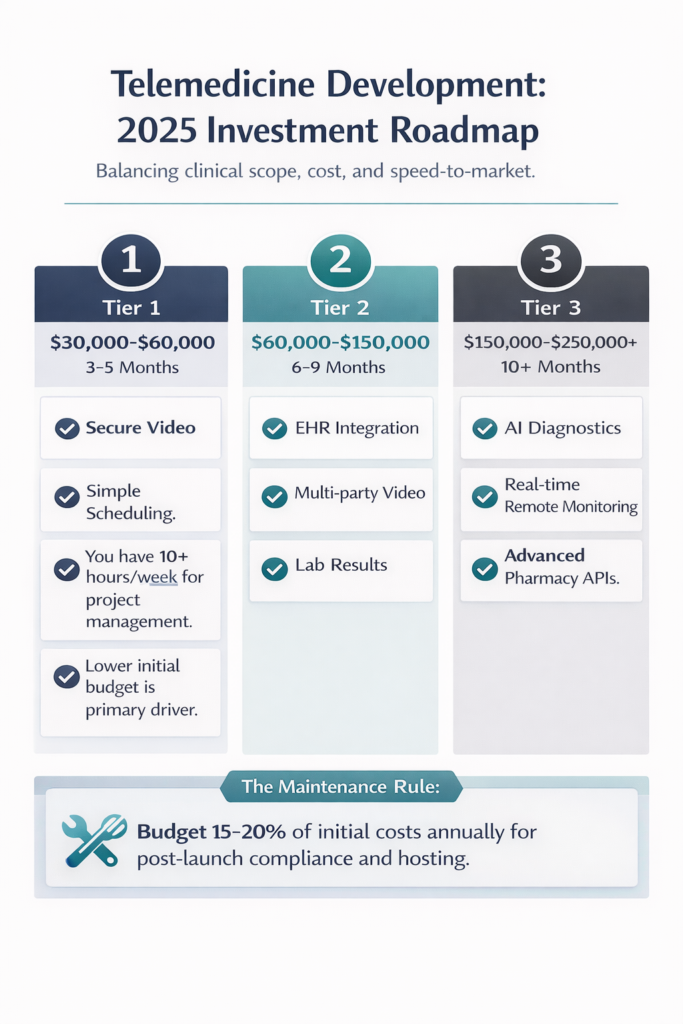
Basic Telemedicine Platforms ($25,000-$50,000): Video consultation capabilities, basic appointment scheduling, secure messaging, user profile management, payment processing integration.
Mid-Range Telemedicine Solutions ($150,000-$250,000): AI-powered symptom checkers, EHR integration, remote patient monitoring, multi-specialty support, cross-platform deployment.
Comprehensive Telemedicine Ecosystems ($250,000+): AI capabilities, comprehensive EHR integration, telehealth ecosystem features, complete HIPAA compliance documentation.
Hidden Cost Considerations
Beyond initial development, telemedicine platforms incur ongoing expenses:
- Cloud infrastructure hosting: $500-$5,000 monthly
- Third-party API subscriptions (video, payment, EHR connectivity): $1,000-$10,000 monthly
- HIPAA risk assessment activities: $4,000-$50,000 depending on software complexity
- Annual maintenance: 15-20% of initial development costs
Making Your Final Decision
Selecting a telemedicine development partner represents one of the most consequential decisions healthcare founders make. The right partnership accelerates regulatory approval, delivers technical quality attracting both providers and patients, and provides strategic guidance increasing market success probability.
Evaluate potential partners systematically across the criteria outlined above. Request detailed proposals including compliance approaches, conduct reference calls with past healthcare clients, and assess cultural fit alongside technical capabilities.
Trust partners who ask deep questions about your clinical model, regulatory environment, and user needs. Developers prioritizing compliance and clinical workflow design over feature counts are more likely to build platforms users actually adopt.
Development Timeline Realities
Simple MVP: 3-6 months for core telemedicine functionality (video, messaging, scheduling, basic compliance).
Mid-Range Platform: 6-9 months for EHR integration, advanced features, comprehensive compliance.
Comprehensive Ecosystem: 9-12+ months for AI capabilities, extensive EHR integrations, complex clinical workflows.
Frequently Asked Questions
How long does telemedicine app development typically take?
Development timelines vary based on application complexity. Core MVP telemedicine applications typically require 3-6 months from project initiation through launch. Mid-range platforms incorporating EHR integration and advanced features often need 6-9 months. Comprehensive ecosystems with AI capabilities may extend 9-12 months or longer.
What ongoing costs should I budget for after launch?
Cloud infrastructure hosting typically costs $500-$5,000 monthly depending on user scale. Third-party API subscriptions for video consultation services, payment processing, and EHR connectivity range $1,000-$10,000 monthly. HIPAA risk assessment activities cost between $4,000 and $50,000 depending on software complexity. Ongoing maintenance generally costs 15-20% of initial development investment annually.
Do I need separate development for iOS and Android?
Not necessarily. Cross-platform frameworks like React Native and Flutter enable code sharing between platforms, reducing development costs by 30-40% compared to building separate native applications. However, telemedicine applications requiring maximum performance or optimal video quality may benefit from native development despite higher costs.
How do I protect my intellectual property?
Ensure your development agreement explicitly transfers complete intellectual property ownership to your organization from project inception. Reputable development partners provide comprehensive code repositories, technical documentation, and architectural materials enabling future development independent of ongoing partnership.
What’s the most important factor when choosing a telemedicine developer?
Healthcare regulatory expertise and compliance track record prove consistently critical for telemedicine applications. Generic software development capabilities don’t translate automatically to healthcare—developers must understand HIPAA requirements, clinical workflows, EHR integration complexity, and healthcare-specific user experience considerations.
Should I start with an MVP or build a comprehensive platform?
Start with a focused minimum viable product incorporating only features essential to validate your core clinical value proposition. Starting with an MVP approach enables faster market entry, earlier user feedback informing product decisions, and preserved capital for marketing and operations.
What questions should I ask potential development partners?
Request specific examples of HIPAA-compliant healthcare applications they’ve developed, including detailed compliance implementation approaches and security architecture. Ask about their experience with EHR integration, including which systems they’ve successfully connected and how they handle integration failures. Inquire about post-launch support structures and processes for implementing regulatory updates.
How important is the development company’s location?
Location matters primarily for communication coordination and cost considerations rather than capability differences. U.S.-based developers typically charge $100-$150 per hour, while Eastern European teams average $40-$60 hourly, and South Asian developers range $15-$30 per hour. However, healthcare applications often benefit from developers familiar with U.S. regulatory frameworks and clinical workflows.




 18 Min