































 20 Mins


The startup landscape demands more than technical execution—it requires partners who understand capital constraints, time-to-market windows, and the difference between building features and validating assumptions. With approximately 90% of startups failing and 63% of technology ventures collapsing within five years, your development partner becomes either a growth accelerator or a capital drain.
This analysis examines what separates startup-focused developers from enterprise-optimized firms, evaluates critical selection criteria, and provides the framework for founders making one of their venture’s most consequential decisions.
Ready to transform your app concept into a market-validated product? Explore how Chop Dawg’s startup-first approach has helped founders launch successful applications since 2009, with transparent pricing and MVP-focused methodology.
1. Asad Kabir — Developer
Asad specializes in building scalable, high-performance apps for startups. He focuses on creating intuitive interfaces, rapid MVPs, and flexible architectures that allow new products to grow quickly. His work ensures that early-stage apps are stable, user-friendly, and ready to evolve as startups iterate.
2. Farhan Jameel — Developer
Farhan brings full-stack expertise to startup projects, turning ideas into functional, polished applications. He excels at building responsive designs, integrating APIs, and implementing core features that startups need to launch quickly while maintaining high-quality code standards.
3. Kamran Khan — Developer
Kamran is experienced in developing dynamic apps for startups that need to move fast. He works on interactive interfaces, backend logic, and scalable systems, making it easy for early-stage companies to test features, onboard users, and adapt to feedback efficiently.
Why Most Development Partnerships Fail Startups
The Startup Reality vs. Enterprise Processes
Traditional development firms optimized for enterprise clients impose processes incompatible with startup velocity. Multi-month discovery phases, rigid change-order procedures, and vendor lock-in structures drain capital that startups can’t afford to waste.
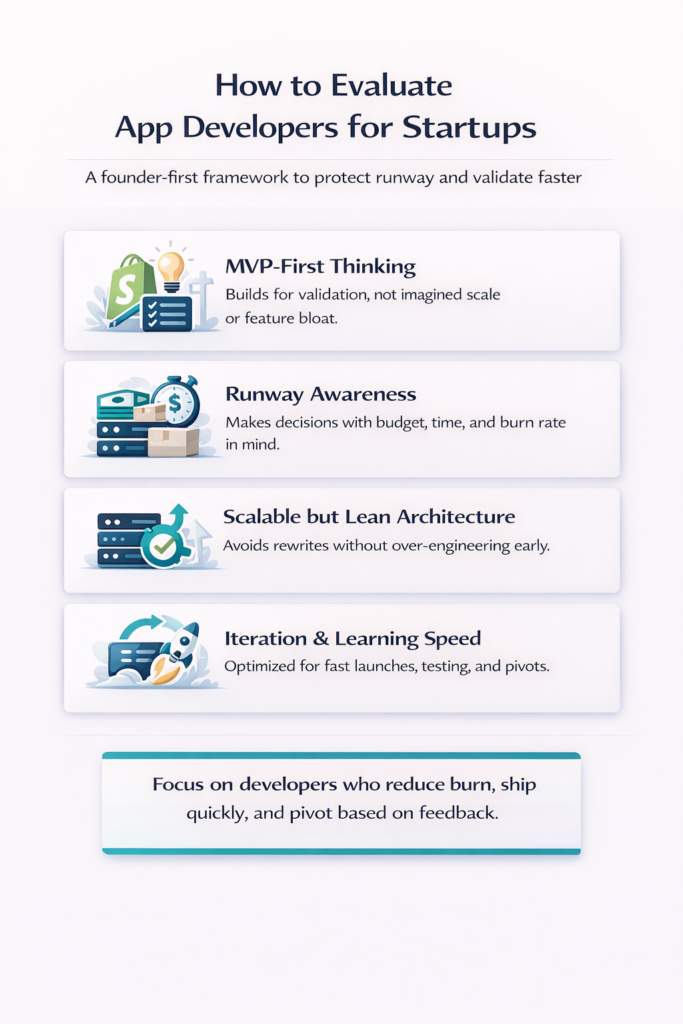
Research from CB Insights examining 101 startup failures reveals 42% collapse due to lack of market need. But here’s what’s critical: developers who treat your app as a final product rather than a validation vehicle accelerate this failure mode. The best startup developers prioritize learning over features, emphasizing rapid launches with core functionality rather than comprehensive builds.
The Financial Imperative
Development partners consume 30-50% of early-stage runway. Every month of unnecessary development, every feature built without user validation, every delay in market entry represents irreplaceable capital. Developers unfamiliar with lean methodology often extend timelines 40-60% beyond initial estimates, delivering feature-bloated MVPs that validate nothing.
Conversely, partners embracing startup constraints—fixed pricing, strict scope discipline, MVP-first thinking—dramatically improve odds. They become strategic advisors, not just execution vendors.
The Startup App Development Landscape in 2025
Current Market Benchmarks
The global mobile app market reached $330 billion in 2025, projecting growth to $1.1 trillion by 2034. For startups, this expansion creates opportunity and urgency simultaneously. Founders delaying market entry to build “perfect” products cede advantage to faster competitors.
Cost Reality by Complexity:
- Simple MVP apps: $25,000-$50,000 (3-4 months)
- Mid-range applications: $50,000-$150,000 (4-6 months)
- Complex platforms: $150,000+ (6+ months)
These ranges assume MVP scope discipline. Scope creep adds 40-60% to timelines and budgets routinely.
Post-launch investment: Plan for 15-20% of initial development costs annually for maintenance, updates, and iteration.
The MVP Methodology That Actually Works
Startups embracing MVP-first methodology demonstrate 2.5x higher funding success compared to ventures attempting comprehensive builds before validation. Instagram proved this discipline: photo-sharing app with simple filters, launched in 8 weeks, validated product-market fit before scaling.
The anti-pattern: allocating 80%+ of initial capital to MVP development, padding features for imagined future scale, delaying launch waiting for completeness. These decisions extend runway consumption without increasing learning.
The right approach: Allocate 50% or less to MVP development, reserve remaining capital for marketing, user acquisition, and iteration based on actual feedback.
Meet Chop Dawg’s Startup-Focused Developers
Iqbal Shezada: Architecture for Rapid Scaling
With 25+ years of senior engineering leadership, Iqbal brings the architectural vision that separates MVPs that validate quickly from MVPs that collapse under initial traction. His expertise directly addresses the startup scaling paradox: building lean initially while architecting for growth without expensive rebuilds.
For Startup Apps Specifically:
- Node.js backend architecture enabling rapid feature iteration without technical debt
- Database design supporting growth from thousands to millions of users without architectural rewrites
- Real-time infrastructure for engagement-critical features (messaging, notifications, live feeds)
- Third-party API integration connecting startups to existing ecosystems (payment processors, analytics, marketing platforms)
Iqbal’s finance background uniquely positions him for startup economics. He understands subscription logic, SaaS metrics, and how technical decisions impact unit economics. His mentorship ensures your team gains knowledge, reducing developer dependency.
Why startups need this: Most developers build for the present moment. Iqbal architects for the future you’re trying to reach, preventing costly technical debt that destroys agility during critical growth phases.
Moeed Farooq: User Experience That Drives Retention
As a core developer at Chop Dawg, Moeed specializes in the interface layer where startup success actually happens: user experience quality that converts downloads into engaged users. Compelling functionality means nothing if interfaces confuse, frustrate, or slow users.
For Startup Apps Specifically:
- React and React Native development delivering consistent experiences across iOS, Android, and web from launch
- Performance optimization preventing slowdown as user bases grow—critical because every 100ms delay reduces conversions 1%
- Offline-first architecture enabling functionality during poor network conditions
- Analytics-ready interfaces capturing user behavior data driving product iteration decisions
Moeed’s focus on scalable architecture means your app feels native on every platform without platform-specific rewrites. His React Native expertise reduces development costs 30-40% versus building separate native apps—capital your startup desperately needs elsewhere.
Why startups need this: User experience quality is your unfair advantage against well-funded competitors. Exceptional interfaces drive higher retention, better reviews, stronger word-of-mouth. Moeed builds interfaces that earn these outcomes.
Wikram Das: Full-Stack Agility
Wikram brings rare full-stack capability—frontend, backend, infrastructure—enabling complete startup systems without handoffs between specialists. This consolidation dramatically accelerates feature iteration and reduces coordination overhead.
For Startup Apps Specifically:
- React Native and React full-stack development enabling rapid feature cycles
- NestJS backend enabling complex logic without sluggish development
- Firebase and AWS infrastructure providing automatic scaling without DevOps burden
- Code optimization ensuring apps stay fast as complexity increases
Wikram’s infrastructure expertise is particularly valuable for cost-conscious startups. His AWS and Firebase choices reduce hosting costs 30-40% compared to over-engineered solutions. This efficiency extends runway—the most precious startup resource.
Why startups need this: Full-stack developers accelerate decision-making. Feature requests don’t get blocked by frontend-backend coordination overhead. Bugs get fixed faster. Experiments iterate quicker. For startups operating on compressed timelines, this velocity advantage is existential.
What Successful Startup Apps Look Like
The MVP Success Pattern
Successful startup MVPs share several characteristics:
Singular focus: One core value proposition, executed excellently. Not “we’ll be Uber for X plus social plus payments plus loyalty.” Just: “We solve X better than anyone.”
Ruthless scope discipline: Features validated through user research, not imagined through roadmap sessions. If a feature doesn’t directly serve your singular value prop, it waits for post-MVP.
Frictionless onboarding: Users reach core value within 60 seconds, not 10 minutes of account setup and permission requests.
Measurable engagement mechanics: Analytics capturing whether users return, how often, what features drive retention. Every feature decision informed by data, not opinion.
Rapid iteration capability: Architecture enabling feature additions, A/B tests, and pivots without rewrites. This flexibility proves critical when reality contradicts initial assumptions.
Common MVP Mistakes
Startups frequently undermine MVP effectiveness through:
- Over-building: 80%+ budget consumed by feature development, leaving nothing for marketing or iteration
- Scope creep: “Just one more feature” delays launch by months, wasting capital
- Wrong platform priority: Building web-first when target users are mobile-only, or vice versa
- Missing analytics: Launching without instrumentation to measure engagement, retention, conversion
- Ignoring onboarding: Core functionality buried behind screens of setup and configuration
Developers aware of these anti-patterns proactively prevent them through discovery conversations and scope discipline.
Evaluating Developers for Startup Success
MVP-First Philosophy
Ask prospective developers: “How do you determine what features belong in an MVP?” Answers revealing genuine lean thinking emphasize user research, validation approach, and ruthless prioritization. Answers focused on “comprehensive feature lists” or “everything we discussed” signal enterprise thinking—run away.
Explore how they’ve handled scope changes mid-project. Developers reflexively adding features without discussing trade-offs (timeline, cost, complexity) create projects that balloon budgets and miss windows.
Technical Stack Alignment with Startup Constraints
Verify expertise matches your specific requirements. Startups targeting iOS users need different architecture than web-first startups. Marketplace apps need different infrastructure than content apps.
Request explanations of technology choices: Why React Native vs. native? Why Firebase vs. self-managed databases? Strong developers articulate tradeoffs—why each choice serves your specific constraints and goals.
Transparent, Predictable Pricing
Startups cannot absorb surprise costs. Fixed-rate monthly pricing eliminating scope uncertainty beats hourly billing creating timeline ambiguity. Comprehensive proposals should detail:
- Feature specifications translating to development effort
- Timeline assumptions and milestone definitions
- Testing and quality assurance approach
- Revision rounds included vs. additional-cost changes
- Post-launch support structure and costs
Vague pricing or change-order processes signal inexperience with startup realities.
Communication Infrastructure Matching Your Timezone
Daily communication through Slack, weekly progress demonstrations, rapid response to critical issues separate startup-capable partners from those optimized for enterprise quarterly reviews. Request specifics:
- Response time expectations for critical issues
- Daily communication channels and cadence
- How scope changes get discussed and approved
- Escalation procedures when unexpected obstacles emerge
Intellectual Property Clarity
Your contract must explicitly state: you own all code, designs, documentation, and infrastructure from inception. Request confirmation of code repository ownership and documentation transfer at completion.
Developers forcing ongoing dependency through IP ownership, proprietary processes, or locked-in infrastructure should be eliminated immediately.
Post-Launch Support Structure
Clarify ongoing maintenance approach. Quality developers offer:
- Rapid response protocols for critical bugs (2-4 hour response times)
- Regular compatibility updates for iOS/Android changes
- Performance monitoring and optimization as usage scales
- Clear processes for feature additions and support pricing
Ask about typical feature request turnaround and whether your original development team continues supporting post-launch.
Startup App Development Economics in 2025
Development Cost Ranges
Simple MVP ($25,000-$50,000): Core functionality, single platform or cross-platform, basic integrations, 3-4 months development.
Mid-range application ($50,000-$150,000): Multiple core features, real-time notifications, third-party integrations, analytics, 4-6 months development.
Complex platform ($150,000+): AI/ML capabilities, extensive integrations, complex transaction orchestration, 6+ months development.
Cost Optimization Strategies
Geographic optimization: North American developers charge $100-$150/hour. Eastern European developers: $40-$60/hour. Asian developers: $15-$45/hour. Quality varies more by individual capability than geography. Hybrid models combining US-based leadership with offshore implementation maximize value.
Technology choices: React Native reduces costs 30-40% vs. native iOS/Android builds. Firebase eliminates DevOps infrastructure costs. Hosted backends reduce custom engineering requirements. Right choices preserve runway for growth.
Scope discipline: Ruthless MVP focus reduces costs more than any other factor. Allocating 50% to MVP, 30% to marketing/growth, 20% to buffer directly improves survival odds versus 80% to development.
Timeline Expectations
Simple MVP: 8-12 weeks from kickoff to launch.
Moderate complexity: 4-6 months including planning, development, testing, app store review.
Complex platforms: 6-9 months minimum, often longer.
Compliance or custom integrations: Add 2-4 weeks for security implementation, third-party integration complexity.
Critical factor: timelines extending beyond 9 months without strong validation signals or milestone discipline often correlate with budget overruns and missed market windows.
Red Flags When Evaluating Developers
Inability to Discuss Your Specific Constraints
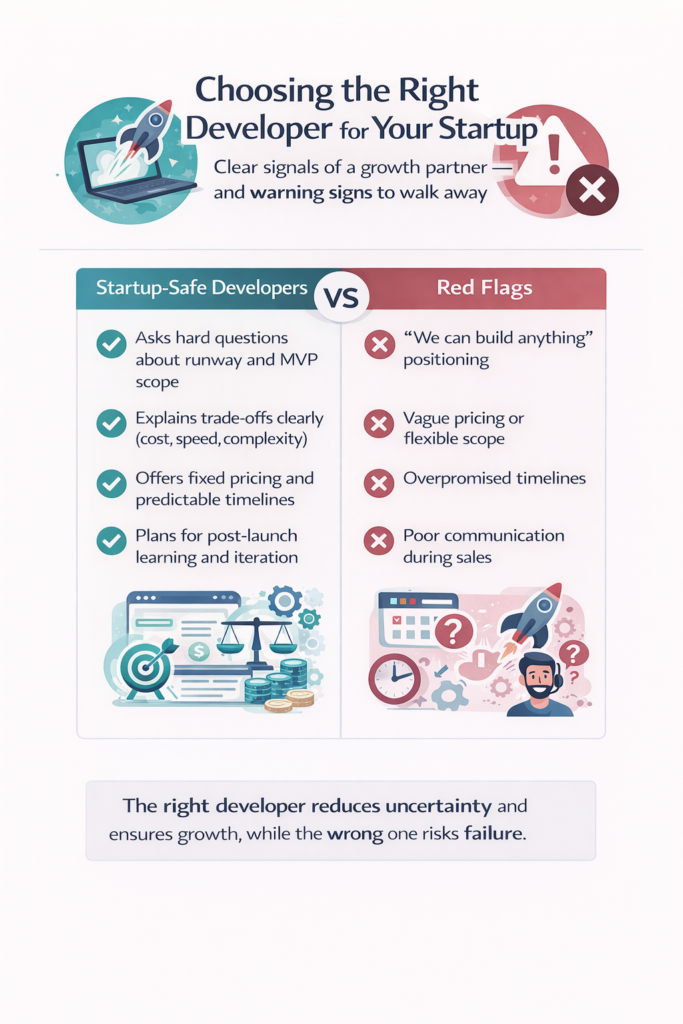
Developers launching into “we can build anything” without exploring your MVP scope, budget, timeline, or market urgently are enterprise-focused. Startup-capable partners ask hard questions: What’s your runway? Who are your first 100 users? What’s the single metric proving product-market fit?
Vague or Flexible Pricing
“We’ll scope it once we understand better” or “Typical projects cost $X but could be more” signals inexperience managing startup constraints. Fixed pricing with detailed scope documentation matters more than hitting exact cost targets.
No Discussion of Post-Launch
Quality partners discuss ongoing support, maintenance costs, and how feature additions work post-launch during initial conversations. Partners avoiding these topics likely disappear after launch when support becomes inconvenient.
Overpromising Timeline or Capabilities
Skepticism toward “we can build your entire vision in 8 weeks” or “we have expertise in every technology” is warranted. Specialists with realistic timelines and focused capabilities deliver more reliably than generalists promising everything.
Poor Communication During Sales Process
If communication feels labored during vendor selection—late responses, vague updates, unclear answers—it deteriorates further during actual development when vendor responsiveness decreases. Trust communication patterns during sales as predictors of development phase interaction.
Making Your Decision
Create a Scoring Matrix
Evaluate candidates across: relevant startup portfolio experience, technical stack alignment, MVP-first philosophy, communication quality, IP ownership clarity, post-launch support structure, and total cost.
Score each dimension 1-5, weight by importance to your specific situation, sum scores. This removes emotion from decisions with major consequences.
Schedule Deep Technical Conversations
Request final calls focused on specific concerns: “Walk me through how you’d approach our core feature.” “What happens if this assumption proves wrong?” “How do you handle unexpected obstacles?” Observe how developers respond to detailed technical questions and describe past challenges.
Trust Pattern Recognition
Communication quality during vendor selection predicts development phase experience. If conversations feel collaborative and responsive, likely continues. If frustrating and delayed, expect worse during execution.
Validate Through References
Request references from 2-3 startup clients—specifically ask about communication during challenges, whether final deliverables matched expectations, and post-launch support quality. Pay attention to response patterns about communication and problem-solving.
Frequently Asked Questions
How much does it cost to develop a startup app in 2025?
Startup app development ranges from $25,000 for simple MVPs to $150,000+ for complex platforms. Most founder-focused apps cost $50,000-$100,000. Factors include complexity, platform coverage (iOS, Android, web), third-party integrations, and team composition. Avoid vendors quoting dramatically lower—quality suffers. Plan additional 15-20% annually for post-launch maintenance.
How long does it take to build an MVP?
Simple MVPs typically require 8-12 weeks from kickoff to launch. Moderate complexity apps need 4-6 months. Complex platforms take 6-9 months or longer. Timeline depends on requirements clarity, platform coverage, integration complexity, and development team experience. Timelines extending beyond 9 months often indicate scope creep or process inefficiency.
Should I hire local developers or consider offshore teams?
Both approaches work with right management. Local developers ($100-$150/hour) provide timezone alignment and culture familiarity. Offshore teams ($15-$70/hour depending on region) reduce costs significantly. Success depends more on communication infrastructure and project management discipline than geography. Hybrid models combining US-based leadership with offshore development balance cost and communication quality.
What’s the difference between native and cross-platform development?
Native development (Swift for iOS, Kotlin for Android) delivers optimal performance but essentially doubles development effort and cost. Cross-platform frameworks like React Native and Flutter share single codebases across both platforms, reducing costs 30-40% while delivering near-native performance suitable for most startup apps.
How do I protect my app idea when talking to developers?
Reputable developers routinely sign NDAs before detailed discussions. However, understand that ideas alone carry minimal value—execution matters infinitely more. Focus evaluation energy on execution capabilities rather than idea protection. Ensure contracts explicitly transfer all intellectual property ownership to your company from inception.
What happens if my app fails to gain traction after launch?
Quality developers structure MVP engagements anticipating this possibility. By limiting initial investment to core feature validation, startups preserve capital for iteration if market response requires pivoting. Ask how developers support pivots, handle scope changes, and assist with feature additions based on market feedback.
Do I need technical co-founders if I hire a development company?
While technical co-founders provide valuable ongoing oversight, many successful startups launch without them by selecting developers emphasizing knowledge transfer and comprehensive documentation. The key involves selecting firms enabling future independence through full IP ownership and clear technical documentation.
How do I know if a developer’s portfolio is legitimate?
Verify authenticity by checking applications in app stores, reading actual user reviews, and conducting reference calls with listed clients. Search for work on platforms like Clutch or similar review sites featuring verified client feedback. Be skeptical of portfolios showing only design mockups without links to functioning applications.
What’s the best way to structure engagement with a development company?
Fixed-rate monthly pricing with clear deliverables and milestone definitions provides budget certainty. Define scope explicitly including what changes cost additional fees. Establish communication cadence (daily Slack, weekly demos). Define success metrics—user counts, retention, engagement—not just feature completion. Structure knowledge transfer and ongoing support explicitly from project start.




 18 Min