



























 19 Mins


Choosing the right React JS development partner determines whether your app scales smoothly or stalls under technical debt. With over 11 million websites globally relying on React and developers consistently ranking it among the most popular JavaScript frameworks, the technology’s value is proven—but finding a development company that delivers results, not just code, requires careful evaluation.
For founders building specialized applications, the stakes are particularly high. You’re creating a solution that demands both technical excellence and deep understanding of your unique market position. The development company you choose becomes an extension of your team, influencing everything from time-to-market to scalability potential.
This analysis examines the React development landscape in 2025, identifies what separates exceptional partners from average vendors, and highlights companies that consistently deliver measurable outcomes for specialized applications.
Considering a custom React app for your niche market? Explore how Chop Dawg’s custom app development services combine technical expertise with strategic guidance for founders building specialized solutions.
Why React JS Continues Dominating App Development in 2025
Understanding why React maintains its position helps founders evaluate development companies more effectively. Companies that articulate React’s strategic advantages—not just technical features—typically deliver better business outcomes.
The Current React Landscape
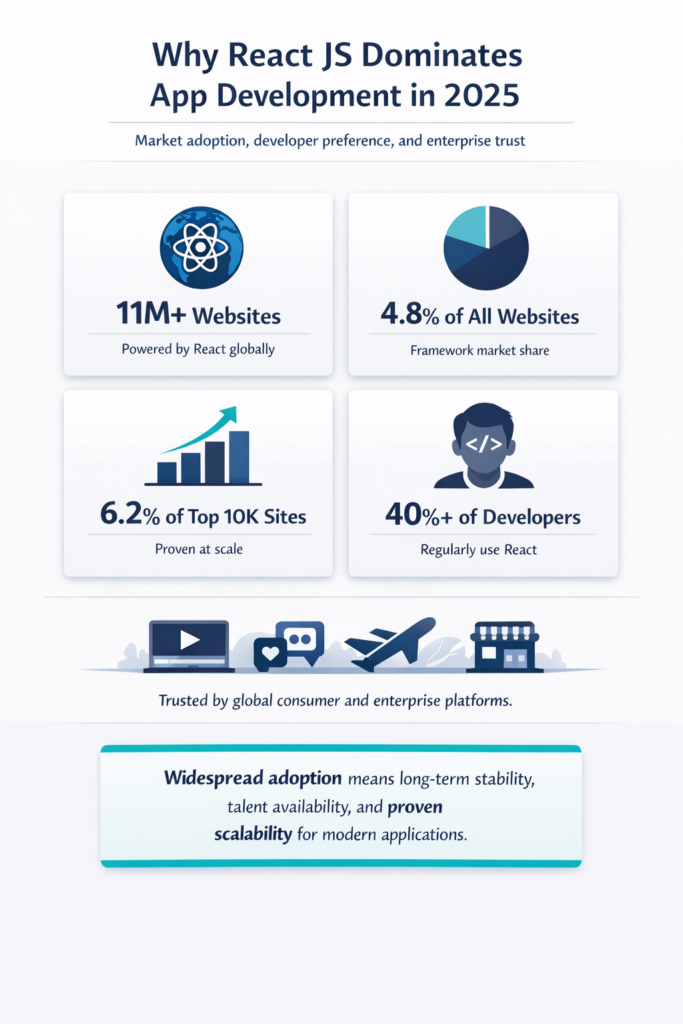
React runs approximately 4.8% of websites globally, with over 11 million sites utilizing the framework. Among the top 10,000 highest-traffic websites, React powers about 6.2%, demonstrating its reliability at scale. According to the Stack Overflow Developer Survey, React consistently ranks among developers’ most-used web frameworks, with over 40% of professional developers using it regularly.
Major platforms including Netflix, Instagram, Airbnb, and Facebook rely on React for their user interfaces, validating its enterprise-grade capabilities. This widespread adoption translates to better talent availability, extensive community resources, and proven scalability patterns.
Emerging Trends in React Development (2025)
React continues evolving beyond its role as a front-end framework—in 2025 it is central to new development paradigms driven by AI, server-side rendering, and enterprise scalability.
Usage of AI-assisted coding tools among development teams has grown substantially. According to Stack Overflow’s 2024 Developer Survey, 76% of developers are using or planning to use AI tools in their development process. Studies document productivity improvements ranging from 26% to 55% faster task completion when developers use tools like GitHub Copilot. This integration represents a fundamental shift in how development teams approach React projects, with AI tools handling routine code generation, testing scaffolds, and quality assurance checks.
React 19, officially released in December 2024, brought React Server Components to stable status. This architectural evolution enables significant performance gains in complex applications by reducing JavaScript bundle sizes and improving time-to-interactive metrics. Server Components render on the server and send only necessary HTML to clients, addressing React’s historical challenge of large bundle sizes.
What this means for you: Ask potential development partners how they integrate AI-assisted workflows, whether they’ve adopted Server Components and modern React 19 features, and how their architecture accounts for bundle size optimization and cross-platform code reuse.
Strategic Advantages for Specialized Applications
React offers specific benefits that matter for specialized applications:
Component-Based Architecture: Reusable components reduce development time by 30-40% for applications with consistent UI patterns. This modularity enables rapid iteration based on user feedback without rebuilding entire interfaces.
Virtual DOM Performance: React’s virtual DOM technology optimizes rendering by updating only changed elements rather than entire pages. This efficiency proves crucial for data-intensive applications handling real-time updates, complex dashboards, or frequent user interactions.
Cross-Platform Capabilities: React Native enables code sharing between web and mobile platforms, with up to 90% code reusability. You can reach users across multiple platforms without maintaining separate codebases, reducing both development costs and time-to-market.
SEO-Friendly Server-Side Rendering: For applications requiring organic discovery, React’s server-side rendering capabilities ensure search engines effectively index and rank content, driving visibility in specialized market segments.
Rich Ecosystem Integration: React integrates seamlessly with Redux for state management, GraphQL for data fetching, and numerous other modern technologies. This flexibility, supported by over 20 million weekly NPM downloads, enables development companies to build precisely the technology stack your specialized application requires.
What Separates Exceptional React Development Companies
Generic evaluation criteria miss the nuances that determine project success. Here’s what actually matters when building specialized applications.
Technical Depth Beyond Basic React Knowledge
Competent React development requires mastery extending well beyond the core framework. Exceptional companies demonstrate proficiency with state management solutions like Redux and MobX, advanced React patterns including Hooks and server components, performance optimization techniques, comprehensive testing frameworks, modern build tools like Webpack and Vite, and TypeScript integration for type-safe development.
Companies that discuss these topics naturally during discovery conversations typically possess the depth required for sophisticated applications.
Domain Understanding and Specialized Experience
Generic development shops struggle with specialized applications because they lack context. Look for companies that ask detailed questions about your market positioning, user workflows, and competitive differentiation before discussing technical implementation. Companies highlighting potential obstacles specific to your industry demonstrate thoughtful analysis rather than optimistic promises.
Project Management and Communication Infrastructure
Technical skills alone don’t ensure successful delivery. Every project requires a single point of contact managing tasks, timelines, and stakeholder communication. Transparent communication tools—daily updates through Slack, weekly video meetings, and centralized documentation platforms—enable real-time visibility. Agile practices with structured sprints keep projects aligned with evolving requirements.
Intellectual Property Protection and Security
For specialized applications, IP security proves non-negotiable. All team members should be covered under confidentiality agreements, with code, documentation, and assets developed on your servers and accounts from day one. Comprehensive documentation ensures no institutional knowledge disappears if you transition development resources.
Leading React JS Development Companies for 2025
These companies demonstrate consistent excellence across technical execution, communication, and business outcomes.
1. Chop Dawg: Full-Cycle Development for Specialized Applications
Chop Dawg stands out for founders building specialized applications requiring both technical excellence and strategic guidance. Since 2009, the company has designed, built, and launched over 500 digital products across iOS, Android, web, tablets, and emerging platforms.

Get Your Free 45-Minute App Roadmap
Meet 1-on-1 with our senior product team. We’ll map your MVP or enterprise app and hand you a personalized plan—clear scope, a realistic timeline, and fixed monthly costs—for iOS & Android, web, tablets & wearables, and AI.
Key Differentiators:
Strategy, design, development, and post-launch support under one roof eliminates coordination complexity. Monthly fixed-rate pricing with defined deliverables removes budget uncertainty. U.S.-based project management with full-time international development resources provides cost efficiency without sacrificing communication quality. All development occurs on client-owned infrastructure with comprehensive knowledge documentation. Portfolio spanning healthcare, hospitality, government, retail, and geolocation services demonstrates adaptability.
Chop Dawg provides dedicated project managers ensuring alignment at every milestone, with weekly status meetings and daily Slack communication maintaining real-time visibility. Featured case study: SparkCharge’s portable EV charging platform demonstrates complex, specialized applications with real-time geolocation, subscription management, and multi-user interfaces.
2. Bacancy Technology: Enterprise-Scale React Solutions
With over 12 years of experience and a team exceeding 1,050 developers, Bacancy Technology specializes in large-scale React implementations requiring robust architecture and extensive integration capabilities. Their extensive developer pool enables rapid scaling, though the scale may prove excessive for early-stage applications.
3. Netguru: Innovation-Driven Development
Netguru combines design thinking with development execution, focusing on transforming ideas into products through agile methodologies. Their blend of design thinking and technical execution produces polished user experiences, with strong rapid MVP capability and industry versatility across fintech, healthcare, and eCommerce.
4. The Frontend Company: React Specialization
As a specialized React development agency, The Frontend Company focuses exclusively on frontend engineering, bringing deep expertise to complex user interface challenges. Pure React focus enables mastery of ecosystem nuances, though frontend-only focus requires coordinating separate backend development.
5. Thoughtbot: Best Practices and Clean Code
Founded in 2003, Thoughtbot emphasizes clean, maintainable code and exceptional user experiences. Two decades of experience produces refined development processes, though premium positioning may exceed budgets for early-stage applications.
6. Cleveroad: Custom Application Development
Established in 2011, Cleveroad offers comprehensive services including mobile app development, cloud solutions, and staff augmentation alongside React development. Full-service capabilities simplify vendor management with flexible engagement models.
7. Toptal: Access to Top-Tier Independent Developers
Toptal maintains a vetted network of freelance React developers, offering flexibility for projects requiring specific expertise without long-term agency commitments. Rigorous vetting ensures quality, though the freelance model requires more hands-on management than full agencies.
Evaluating React Development Companies: A Decision Framework
Use this systematic approach to assess potential development partners.
Portfolio Review: Examine case studies for applications matching your technical requirements. Look for similar user interaction patterns, data complexity, and integration requirements. Exceptional companies quantify outcomes—load time improvements, user engagement increases—rather than just showcasing visual design.
Technical Assessment: Schedule calls with actual developers, not just sales teams. Request high-level technical architecture proposals addressing your specific requirements. Inquire about testing methodologies, continuous integration processes, and quality assurance protocols.
Operational Evaluation: Understand exactly how and when you’ll receive project updates. Identify your single point of contact and their authority to make decisions. Request examples of project documentation.
Business Terms Analysis: Ensure pricing structure aligns with your budget certainty requirements. Verify explicitly that all code, designs, and documentation transfer to you with no retained rights. Understand what’s included after launch and costs for ongoing maintenance.

Red Flags to Avoid When Selecting React Partners
Watch for these warning signs: guaranteed timelines without discovery suggest inadequate analysis; no access to code repositories creates dependencies; outdated portfolios may indicate lack of current expertise; shallow discovery questions reveal insufficient context; communication only through sales teams creates distortion; unwillingness to provide references suggests problematic client relationships.
Decision Stage Considerations
Budget Reality for Quality React Development
React development costs vary significantly based on team location, expertise, and project complexity. U.S.-based teams typically charge $100-$200+ per hour, hybrid models $75-$150 per hour, and offshore teams $25-$75 per hour. For specialized applications, prioritize value over lowest cost. Companies like Chop Dawg offer hybrid models combining U.S.-based project management with cost-effective international development.
Timeline Expectations
MVP development typically requires 3-4 months for basic functionality. Full-featured applications need 6-12 months depending on complexity. Enterprise-scale platforms require 12-24+ months with ongoing feature additions. Specialized applications often require longer discovery phases ensuring technical architecture aligns with unique business requirements.
Making Your Final Decision
Schedule discovery calls with your top three candidates. Present your vision, describe technical requirements, ask about similar projects, discuss challenges, and evaluate whether their communication style aligns with your working preferences.
The right partner combines technical excellence with genuine interest in your success. They ask probing questions, identify potential challenges, and propose thoughtful solutions rather than optimistic promises.
Ready to build your specialized React application? Schedule a consultation with Chop Dawg to discuss how their comprehensive development approach can bring your vision to life with transparency, expertise, and measurable results.
Frequently Asked Questions
What makes React JS suitable for specialized applications?
React’s component-based architecture enables rapid development of specialized user interfaces while maintaining code quality. The framework’s flexibility allows developers to create precisely the features your application requires without forcing generic patterns. React’s large ecosystem provides libraries for almost any functionality, and its extensive community ensures long-term viability and support.
How do I verify a React development company’s technical expertise?
Request to speak directly with developers who would work on your project. Ask specific questions about state management approaches, performance optimization strategies, and testing methodologies. Review their GitHub profiles for contributions to open-source React projects. Request detailed technical proposals addressing your application’s specific challenges.
Should I choose a specialized React agency or a full-service development company?
This depends on your project complexity and resource availability. Specialized React agencies offer deep frontend expertise but require separate backend coordination. Full-service companies like Chop Dawg provide integrated development across all layers, simplifying project management and ensuring cohesive architecture. For applications with complex business logic, integrated teams typically deliver better outcomes.
What’s a reasonable timeline for custom React app development?
MVPs typically require 3-4 months, while full-featured applications need 6-12 months depending on complexity. Specialized applications often require extended discovery phases (2-4 weeks) ensuring technical architecture aligns with unique business requirements. Companies promising significantly faster delivery often cut corners on architecture, testing, or documentation.
How much should I budget for professional React development?
Quality React development costs $50,000-$150,000 for MVPs and $150,000-$500,000+ for complex applications. Hybrid development models offer cost efficiency without sacrificing communication quality. Remember that inexpensive development creates technical debt requiring expensive fixes. Invest in quality architecture from the start for long-term savings.
What ongoing costs should I expect after launch?
Plan for 15-20% of initial development costs annually for maintenance, including bug fixes, security updates, performance optimization, and minor enhancements. Significant feature additions require separate budgets. Companies offering fixed-rate monthly maintenance provide budget predictability.
How do I protect my intellectual property when outsourcing development?
Require comprehensive NDAs before sharing any details. Ensure all development occurs on infrastructure you own. Contracts should explicitly transfer all IP rights to you with no retained licenses. Companies should provide complete code documentation ensuring you’re not dependent on their institutional knowledge. Chop Dawg structures all agreements to ensure complete client ownership from day one.
Can React apps scale to handle significant growth?
Yes, when architected properly. React powers platforms like Netflix and Instagram handling millions of concurrent users. Scalability depends more on backend architecture, database design, and infrastructure than frontend framework choice. During development partner selection, discuss their approach to scalability planning, including load balancing, caching strategies, and database optimization.
Should my application be built as a web app, mobile app, or both?
This depends on your users’ primary access patterns. React enables web development while React Native supports mobile. Many specialized applications benefit from web-first development for faster iteration, adding mobile apps once product-market fit is validated. Cross-platform approaches enable reaching users on all devices without maintaining separate codebases.
How do I evaluate if a development company understands my market?
Strong partners ask detailed questions about your users, their workflows, pain points, and decision-making processes before discussing technical solutions. They should identify unique challenges specific to your industry and reference analogous projects demonstrating relevant experience. Be cautious of companies that immediately jump to technical discussions without understanding your business context.



 18 Min