





















 22 Mins


Selecting the right development partner determines whether your app becomes a market leader or a costly learning experience. For niche app founders navigating technical decisions, Python offers compelling advantages: versatile frameworks, robust AI capabilities, and a developer ecosystem spanning rapid prototyping to enterprise deployments. The challenge lies in identifying which companies possess specialized expertise to transform your vision into market-ready applications.
This analysis examines leading Python app development companies, evaluation criteria that matter for decision-stage founders, and how partnership choices impact product success.
Considering a Python development partnership? Examine how Chop Dawg’s outcome-driven approach aligns technical execution with business objectives through transparent collaboration.
Leading Python Development Companies
1. Chop Dawg: Outcome-Driven Partnership
Chop Dawg emphasizes outcome-focused development extending beyond technical implementation. The company structures engagements around business objectives, providing dedicated project managers, specialized teams, and complete transparency through daily Slack communication, weekly Zoom sessions, and comprehensive Jira/Confluence management.
Critical differentiators include intellectual property protection and ownership clarity from day one. Development occurs on client servers with comprehensive documentation ensuring knowledge preservation. The team structure combining U.S.-based developers with international specialists offers cost flexibility without sacrificing quality. Fixed-budget monthly pricing eliminates development cost uncertainty.
Get Your Free 45-Minute App Roadmap
Meet 1-on-1 with our senior product team. We’ll map your MVP or enterprise app and hand you a personalized plan—clear scope, a realistic timeline, and fixed monthly costs—for iOS & Android, web, tablets & wearables, and AI.
2. Zazz: Enterprise-Scale Solutions
According to industry directories, Zazz brings 13+ years of Python experience with 763 completed projects serving clients across 12 industries. Their network encompasses 285+ Python experts, providing depth for complex implementations. Flexible engagement models include part-time and full-time arrangements, suiting founders needing specialized expertise without full-time commitments. Recognition includes INC 5000 placement and Clutch top developer designation. Minimum projects typically start at $50,000.
3. ScienceSoft: Three Decades of Expertise
ScienceSoft brings 30+ years of experience with 200+ completed Python projects, specializing in AI-based enterprise solutions. Their AI implementation helped an insurance company reduce manual tasks by 60%—demonstrating measurable business outcomes. For niche founders in regulated industries, this domain expertise accelerates development by reducing compliance learning curves.
4. Intellectsoft: AI-Driven Custom Development
Intellectsoft specializes in custom software with emphasis on AI-driven solutions and mobile applications. Serving 200+ clients globally, the company demonstrates capacity to scale solutions across diverse contexts. A Python mobile application for financial services increased operational efficiency by 30%, exemplifying outcome-focused development aligning with niche founder priorities.
5. Toptal: Elite Developer Network
Toptal connects businesses with freelance Python developers from the top 3% globally through rigorous screening. JPMorgan Chase and Airbnb utilize Toptal for accessing expertise. The platform suits short-term specialized projects and long-term needs, providing flexibility as requirements evolve. Hourly rates range from $20-30 offshore to $100+ for vetted experts, offering flexibility but requiring greater project management responsibility.
6. AnyforSoft: Specialized Framework Expertise
Florida-based AnyforSoft completed 150+ Python projects across media, sports, education, e-commerce, and fintech with 12+ years experience. The company offers web development, mobile applications, CMS platforms, and API development. Framework expertise spanning Django, Web2py, and Flask enables recommendations aligned with requirements rather than forcing single-framework approaches. Minimum projects typically begin at $50,000.
7. Rootstrap: Product Development Specialists
Rootstrap created 750+ products across education, medical, media, finance, and e-commerce with 10+ years experience. This extensive portfolio suggests accumulated knowledge about successful technical implementations. The product-centric focus—not merely software development—aligns with niche founder priorities around user adoption and market fit rather than feature completion.
Why Python Dominates App Development
According to Stack Overflow’s 2024 Developer Survey, Python ranks as the third most-used programming language, with over 51% of developers currently using it. This adoption stems from characteristics aligning with niche app requirements: flexibility across programming paradigms, dynamic typing accelerating development timelines, and extensive libraries streamlining complex processes.
The language’s interpretive nature enables real-time debugging and accelerated iteration—critical when building specialized applications requiring rapid market validation. Instagram, Spotify, Netflix, and Reddit built backend infrastructure on Python, demonstrating capacity to scale from MVP to millions of concurrent users.
For niche founders, Python’s versatility translates into business advantages: faster time-to-market, lower initial development costs, and easier pivoting when market feedback demands adjustments. Whether building fintech applications with security requirements, healthcare platforms needing compliance, or AI-powered systems leveraging machine learning, Python provides a technical foundation.
Ready to discuss your Python project? Explore Chop Dawg’s custom app development services to understand how strategic partnerships accelerate launches.
Python Usage & Ecosystem Trends for App Development in 2025
In 2025, Python continues to solidify its role as a leading language for application development—particularly in niche sectors such as AI-enabled apps, backend services, and data-driven platforms. Key facts:
- According to the Stack Overflow 2025 Developer Survey, Python usage among developers rose to 57.9%, representing a 7 percentage-point year-over-year increase.
- The Python Software Foundation / JetBrains 2025 “State of Python” report found that 86% of respondents using Python consider it their primary programming language for building apps, APIs and services.
- Job-market indicators show Python remains highly in-demand—one report notes more than 1.19 million job listings in 2025 requiring Python skills.
- In a survey of the Python developer ecosystem, 72% of respondents reported using Python professionally (vs. hobby/education use) and 50% had fewer than two years of professional coding experience, underlining how Python powers both rapid-iteration startups and broader developer onboarding.
What this means for app-founders evaluating Python development partners
- A large and growing base of Python developers gives you access to talent—but also means many providers claim “Python expertise,” so differentiating by depth (frameworks, architecture, scale) matters.
- The surge in Python use correlates with its dominance in AI/ML/analytics workflows—if your app involves data science, Python remains a strong strategic choice.
- Because many Python developers are relatively new (based on the “< 2 years experience” figure), evaluating partner company portfolios, senior-developer involvement, and architecture robustness becomes even more important.
Implication for your article’s vendor-selection context
When considering Python app development companies, use this trend data to inform your evaluation:
- Ask whether the team uses modern Python versions (3.11/3.12+), leveraging performance improvements.
- Ask how they support frameworks built for scale (e.g., asynchronous programming with FastAPI) vs. simpler apps.
- Ask for case studies demonstrating not just “Python was used” but “Python enabled rapid iteration, scale or data-driven features.”
Framework Selection: Technical Architecture Foundation
Python’s framework ecosystem shapes development speed, scalability, and maintenance requirements. Understanding framework differences helps founders make technical decisions aligned with business objectives.
Django: Full-Stack Power
Django represents the “batteries included” approach with built-in components for database operations, authentication, admin interfaces, and security. Instagram’s backend, Spotify’s internal tools, and The Washington Post’s systems run on Django. The framework excels for data-intensive applications requiring rapid development, with object-relational mapping simplifying database interactions and built-in security protecting against common vulnerabilities.
Trade-offs include architectural rigidity and steeper learning curves compared to minimal frameworks. For straightforward APIs, Django’s comprehensive structure may introduce unnecessary complexity.
Flask: Lightweight Flexibility
Flask provides minimal core functionality with extensibility through libraries. This micro-framework offers routing, request handling, and templating—leaving architecture decisions to teams. Netflix, Reddit, and Airbnb leverage Flask for use cases requiring flexibility.
Flask’s modular design enables precise tool selection. However, the framework provides minimal security protections—teams must implement safeguards independently. The absence of default components means evaluating third-party extensions, potentially creating maintenance complexity.
FastAPI: Modern API Performance
FastAPI, designed for high-performance APIs, leverages type hinting and asynchronous programming. According to GitHub statistics, the framework grew from minimal presence in 2020 to over 70,000 stars by 2025. FastAPI excels for maximum throughput and modern practices, with asynchronous support handling thousands of concurrent connections—critical for real-time applications or high-volume data processing.
Industry-Specific Development Costs
Fintech Applications
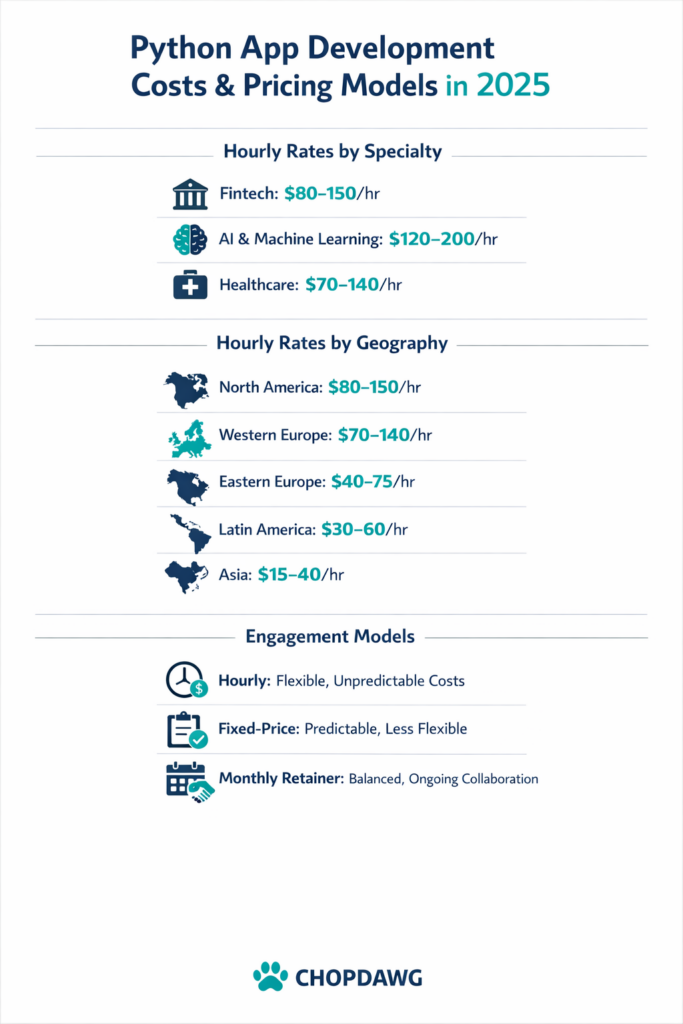
Python developers with fintech expertise command premium rates ($80-150 hourly in developed markets) due to security, compliance, and domain knowledge requirements. These specialists understand payment processing, blockchain integration, and regulatory compliance including PCI DSS standards. The cost of regulatory missteps far exceeds premiums for experienced fintech developers.
AI and Machine Learning
Python developers specializing in AI/ML represent the highest-paid segment at $120-200 hourly in developed markets. These specialists possess deep knowledge of TensorFlow, PyTorch, and scikit-learn, plus experience architecting data pipelines and deploying AI systems at scale. For applications leveraging predictive analytics or natural language processing, this expertise directly impacts product feasibility.
Healthcare and Life Sciences
Healthcare development demands HIPAA compliance, HL7 standards, and electronic health record integration knowledge. Healthcare-specialized Python developers typically charge $70-140 hourly depending on location. This specialized knowledge accelerates development by avoiding costly compliance retrofits.
Geographic Considerations: Cost-Quality Balance
Development rates vary dramatically by location, creating cost optimization opportunities without sacrificing quality.
North America: U.S.-based developers command $80-150 hourly (mid to senior level), with specialized roles occasionally exceeding $200 according to PayScale data. Premium rates reflect high living costs and strong demand, offering timezone alignment advantages.
Western Europe: Comparable quality at $70-140 hourly, offering modest savings with excellent English proficiency. Primary considerations involve timezone differences.
Eastern Europe: Poland, Ukraine, and Romania offer compelling cost-quality ratios at $40-75 hourly—representing 40-50% savings versus North America while maintaining high standards. Manageable timezone differences span 6-8 hours.
Latin America: Nearshore advantages for U.S. founders include minimal timezone differences and cultural alignment at $30-60 hourly. Timezone overlap enables real-time collaboration during business hours.
Asia: India, Pakistan, and Vietnam offer maximum savings at $15-40 hourly. Trade-offs include significant timezone differences and variable English proficiency requiring careful vetting.
Pricing Models: Understanding Engagement Types
Hourly Pricing
Suits projects with fluid requirements or low scope certainty. Founders pay for actual time, enabling flexibility as priorities shift. Risk involves cost unpredictability without careful scope management.
Fixed-Price Contracts
Establishes predetermined costs for specified deliverables, providing budget certainty. Development companies assume scope creep risk. However, fixed-price requires detailed upfront specifications, with mid-project changes triggering formal change orders.
Monthly Retainers
Provides dedicated team capacity on a recurring basis with consistent monthly fees. Combines budget predictability with reasonable flexibility for evolving priorities. Suits applications requiring ongoing development or continuous optimization.
Evaluation Criteria: Partner Selection
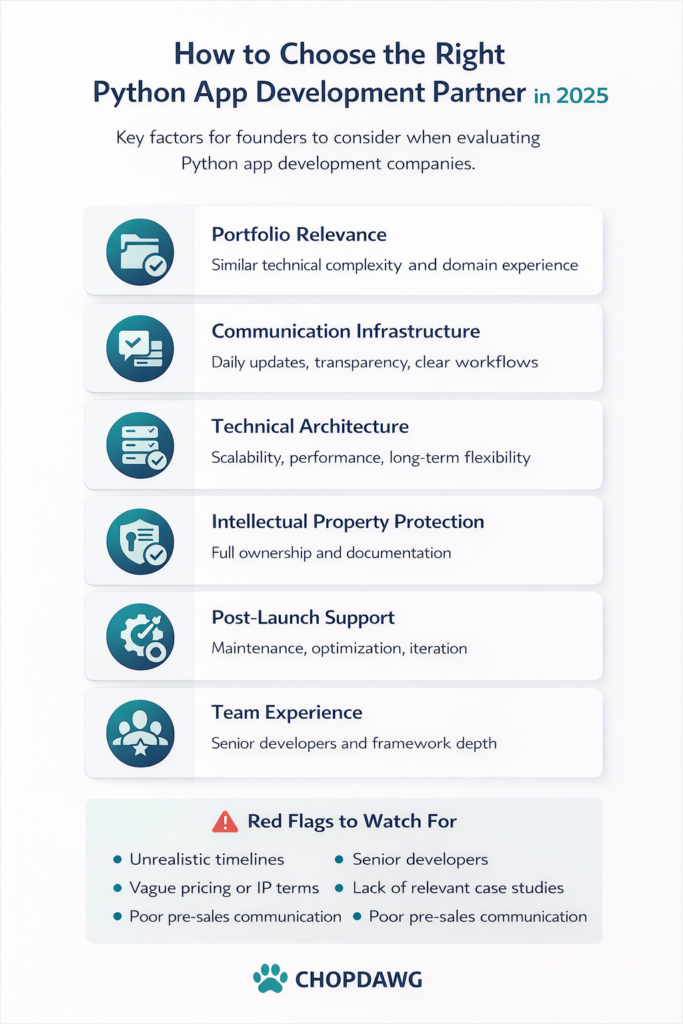
Portfolio Relevance
Examine portfolios for relevant technical complexity and domain expertise. Strong portfolios showcase diverse problem-solving, not merely polished interfaces. Case studies revealing challenges, technical decisions, and measurable outcomes provide more value than superficial descriptions.
Communication Infrastructure
Evaluate companies on communication protocols, tool utilization, and transparency practices. Companies providing daily updates, regular video meetings, and complete project visibility reduce coordination friction and accelerate feedback cycles.
Technical Architecture
Understand how partners approach technical architecture decisions. Ask about experience scaling applications, handling increased loads, and architecting for future features. Strong partners consider how initial decisions impact future development velocity and pivoting ability.
Intellectual Property Protection
Comprehensive NDAs should be standard. Verify contracts explicitly transfer all code, designs, and documentation to your ownership. Request development on your infrastructure rather than vendor systems for additional security.
Post-Launch Support
Applications require ongoing maintenance, bug fixes, and optimization after launch. Typical ongoing costs range 15-20% of initial investment annually. Companies offering comprehensive support provide continuity advantages.
Red Flags During Selection
Overpromising and Unrealistic Timelines: Vendors promising impossibly short timelines without understanding complexity raise concerns. Quality development requires proper planning, implementation, and testing.
Poor Pre-Sales Communication: Delayed responses, vague answers, and unclear pricing during sales typically worsen during engagement.
Lack of Relevant Experience: Inability to demonstrate relevant experience through portfolios or case studies may indicate insufficient expertise.
Unusually Low Pricing: Pricing significantly below market rates warrants scrutiny, potentially indicating junior developers or quality compromises.
Ready to transform your concept into market-ready reality? Connect with Chop Dawg’s expert team to discuss your requirements and explore how strategic partnership accelerates your launch.
Frequently Asked Questions
What makes Python good for custom app development? Python combines rapid development with extensive frameworks and libraries supporting web applications to AI integration. The language’s clear syntax reduces development time while versatility enables applications from simple MVPs to complex enterprise platforms. Instagram, Netflix, and Spotify built infrastructure on Python, demonstrating scalability.
How much does Python app development cost in 2025? Costs vary based on complexity, expertise, and location. Simple applications start around $5,000-35,000, while complex implementations involving AI or specialized compliance can exceed $100,000. Hourly rates range from $15-20 for junior developers in emerging markets to $150-200 for senior specialists.
Should I choose Django or Flask? Django suits complex, data-intensive applications requiring rapid development with built-in features. Flask works better for lightweight APIs or applications requiring architectural flexibility. FastAPI represents the best choice for modern, high-performance API development. Partners should recommend frameworks based on your specific requirements.
What’s the difference between hiring freelancers versus companies? Freelancers offer lower rates ($20-100+) with flexibility for specialized tasks. However, founders assume greater responsibility for project management and quality assurance. Companies provide comprehensive services including project management, QA, and team redundancy, typically charging higher rates but reducing founder involvement and project risk.
How long does Python app development take? Timelines vary by complexity. Simple MVPs may launch in 2-3 months, while comprehensive applications require 6-12 months or longer. Agile methodologies enable phased releases, allowing founders to launch with essential features and add capabilities iteratively.
What ongoing costs should I expect after launch? Post-launch maintenance typically costs 15-20% of initial investment annually, covering bug fixes, security updates, performance optimization, and infrastructure. Major new features require additional investment beyond maintenance budgets.
How do I protect intellectual property? Comprehensive NDAs should be standard. Verify contracts explicitly transfer all code, designs, and documentation to your ownership. Request development on your infrastructure rather than vendor systems. Maintain regular code backups and ensure you receive complete documentation.
What questions should I ask during consultations? Ask about experience with similar projects, recommended technologies, team composition, communication protocols, pricing models, IP protection measures, timeline estimates with milestones, post-launch support options, and references from comparable projects. Strong partners welcome detailed questions and provide specific answers.
Can companies help with product strategy? Many companies offer strategic services including product discovery workshops, user experience research, market analysis, and go-to-market planning. These comprehensive services benefit founders seeking objective perspectives on product-market fit. Companies emphasizing outcome-driven approaches provide more strategic value beyond technical execution.
What happens if the partnership doesn’t work out? Well-structured contracts include termination clauses, IP transfer provisions, and deliverable specifications. If partnerships fail, you should receive all code, comprehensive documentation, and infrastructure access. Clean IP ownership and documentation ease transitions to new developers, underscoring the importance of selecting partners with transparent practices from the beginning.



 18 Min