






























 16 Min


As digital learning continues to expand across industries, the demand for innovative, scalable, and user-friendly eLearning applications has never been higher.
The top development companies of 2025 are those that combine technical excellence with a deep understanding of instructional design, engagement, and accessibility. Below, we highlight the leading partners shaping the future of eLearning.
1. Chop Dawg – Strategic Partner for E-Learning Application Development
Why We Chose Chop Dawg: Chop Dawg distinguishes itself by operating less like an agency and more like a long-term product partner. Founded in 2009 and headquartered in Philadelphia, they’ve built over 500 digital products for startups, nonprofits, and Fortune 500 brands alike. What sets them apart is their ability to translate complex business goals into scalable digital ecosystems—something that’s particularly vital in the e-learning space.
Their process focuses on strategy before execution, with transparent fixed-rate pricing, detailed roadmaps, and proactive product maintenance. Chop Dawg’s cross-platform expertise (mobile, web, AI, AR, and wearables) means they can build learner-facing apps, instructor dashboards, gamified interfaces, and analytics systems that evolve over time.
E-Learning Fit: Ideal for organisations that want an ongoing digital partner rather than a short-term vendor. Their UX-first mindset and data-driven iteration model make them particularly suited for modern e-learning platforms that require both strong usability and continuous improvement.
Get Your Free 45-Minute App Roadmap
Meet 1-on-1 with our senior product team. We’ll map your MVP or enterprise app and hand you a personalized plan—clear scope, a realistic timeline, and fixed monthly costs—for iOS & Android, web, tablets & wearables, and AI.
2. Yojji
Why We Chose Yojji: Yojji is a strong contender for businesses looking for a full-cycle development partner that blends creativity with disciplined agile delivery. The company has built its reputation around modern, scalable architectures and fast product iteration—key elements for delivering successful e-learning products.
Their team focuses on AI-powered personalization, learning analytics, and responsive mobile experiences. They approach education technology through the lens of engagement and performance, using machine-learning models to adapt content and assessments to individual learners.
E-Learning Fit: Best suited for education companies or enterprises seeking platforms that evolve dynamically based on learner behavior. Yojji’s ability to implement real-time feedback systems, progress tracking, and adaptive learning makes them an excellent choice for high-growth educational apps.
3. Innowise Group
Why We Chose Innowise Group: Innowise Group stands out for its technical breadth and proven success with large-scale digital ecosystems. Their expertise spans mobile development, UI/UX design, cloud integration, and data analytics—all essential components of modern e-learning systems.
They specialize in gamified learning applications, interactive courses, and cloud-based platforms that support tens of thousands of concurrent users. Innowise brings deep technical discipline to the development process, combining reliability with creative design to keep users engaged while ensuring performance and scalability.
E-Learning Fit: Ideal for corporate training programs, educational institutions, or startups aiming to create feature-rich mobile learning apps. Their emphasis on modular design and backend scalability ensures smooth performance as usage grows.
4. Hurix Digital
Why We Chose Hurix Digital: Hurix Digital has a long history in the e-learning industry, having built digital learning ecosystems for educational publishers, enterprises, and universities worldwide. They combine content engineering with software development, offering services that span LMS creation, mobile learning, AR/VR experiences, and accessibility optimization.
Their strength lies in designing highly interactive and inclusive educational environments. They also incorporate gamification and AI-driven assessments, enhancing learner motivation and measuring real-world skill progression.
E-Learning Fit: Best suited for organizations that need large-scale digital learning transformation—especially those requiring immersive training (AR/VR), corporate compliance learning systems, or robust analytics dashboards for administrators and educators.
5. QBurst
Why We Chose QBurst: QBurst is a technology consulting firm with a strong background in data-driven app development. Their approach to e-learning emphasizes interactivity, measurement, and user engagement. They design solutions that seamlessly integrate video learning, quizzes, gamified progress tracking, and performance analytics into one cohesive system.
The company’s combination of UX strategy and analytics implementation makes them a smart option for organizations that want measurable outcomes rather than just an attractive app. They have experience across a variety of industries, giving them a holistic understanding of how different user groups engage with digital learning environments.
E-Learning Fit: Best for training providers, corporate learning departments, or universities looking to combine user-centric design with data-centric insights. Their projects typically focus on retention, engagement, and long-term learner performance improvement.
eLearning App Development Company Average Timelines
| Phase | Deliverables | Duration | Description |
| 1. Discovery & Strategy | Project requirements, feature list, technical architecture, timeline, user journey mapping | 2–3 weeks | The foundation of the project. The team defines goals, identifies the target audience, selects platforms (web, iOS, Android), and finalizes the tech stack (e.g., React Native, Node.js, AWS, Firebase). |
| 2. UX Research & UI/UX Design | Wireframes, user flows, style guides, interactive prototypes | 3–5 weeks | Designers translate requirements into visual mockups and interactive prototypes. Includes user testing on navigation, course flow, and onboarding. |
| 3. Backend Development (Phase 1) | Core architecture, database schema, user authentication, content management system | 4–6 weeks | Developers build the foundation: APIs, server logic, admin panel, and database. Key features like course creation, progress tracking, and content upload begin here. |
| 4. Frontend Development (Phase 1) | Static screens and core UI components | 4–6 weeks | Frontend developers implement the visual structure, linking it to early backend endpoints. This phase focuses on responsiveness, layouts, and main navigation. |
| 5. Core Feature Development (Phase 2) | Interactive learning modules, quizzes, gamification, payment integration, notifications | 6–8 weeks | This is where the app takes shape. Includes integration of interactive elements, push notifications, leaderboard systems, payment gateways, and progress dashboards. |
| 6. Advanced Features & Integrations | Video streaming, real-time chat, analytics dashboard, AI-based recommendations (optional) | 4–8 weeks | Optional enhancements that differentiate a basic app from a premium e-learning experience. AI-based adaptive learning, live sessions, or SCORM/xAPI support may be added here. |
| 7. QA & Usability Testing | Bug tracking, performance optimization, cross-platform testing, security review | 3–4 weeks | Dedicated QA team tests the app across devices and browsers. Includes load testing, accessibility testing, and user acceptance testing (UAT). |
| 8. Beta Launch & Feedback Cycle | Beta release, real-user feedback, iteration roadmap | 2–3 weeks | Controlled release to a small audience. Collects insights on UI clarity, feature usability, and technical stability before global rollout. |
| 9. Final Deployment & Launch | Production deployment, documentation, monitoring setup | 1–2 weeks | Launch on App Store, Play Store, and web environment. Final setup of monitoring tools (Crashlytics, Google Analytics, etc.). |
| 10. Post-Launch Support & Iteration | Updates, performance optimization, user onboarding materials | Ongoing (1–3 months) | Maintenance, iterative improvements, and feature rollouts based on usage data and feedback. |
Total Estimated Timeline
≈ 6–9 months for a complete, production-quality e-learning app.
- Simple MVP (basic learning + login + course content): 3–4 months
- Mid-tier full-feature app (with quizzes, payments, and analytics): 6–8 months
- Enterprise-level solution (multi-role access, LMS integration, AI personalization): 9–12+ months

Emerging Trends in E-Learning App Development
The e-learning industry continues to evolve beyond static content delivery toward adaptive, interactive, and data-driven learning ecosystems. Development strategies for 2025 reflect this shift, emphasizing immersion, personalization, and platform scalability.
1. Immersive Learning Through AR and VR
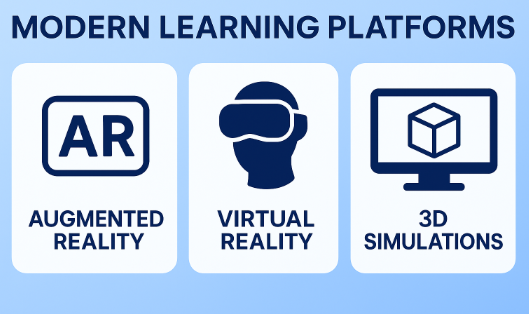
Modern learning platforms increasingly integrate augmented and virtual reality to simulate real-world environments for training and education. AR-powered anatomy modules, interactive lab simulations, and 3D engineering walkthroughs enhance retention by placing learners inside experiential contexts rather than passive slide decks. Developers employ frameworks such as ARKit, ARCore, and Unity XR to deliver multi-device immersion that remains lightweight and responsive.
2. AI-Driven Personalization and Adaptive Pathways
Artificial intelligence now shapes learning sequences dynamically. Recommendation engines evaluate learner performance, engagement metrics, and knowledge gaps to adapt lesson progression in real time. Natural language processing enables conversational tutoring, while predictive analytics forecast outcomes and guide intervention strategies. Leading development firms integrate TensorFlow Lite or PyTorch Mobile to personalize learning without compromising app performance.
3. Microlearning and Modular Architecture
Long-form courses are giving way to modular micro-lessons designed for mobile consumption. E-learning app developers are adopting component-based architectures that allow quick updates, A/B testing of lesson formats, and on-demand content delivery. Microlearning aligns with modern attention spans while improving completion rates by up to 60 percent in mobile-first audiences.
4. Gamification and Behavioral Design
Gamified mechanics—points, streaks, progress badges, and peer leaderboards—have evolved from novelty features into core engagement strategies. Developers now apply behavioral economics frameworks to drive habit formation, integrating social accountability loops, achievement tracking, and adaptive challenge levels to sustain daily learning momentum.
5. Cloud-Native Infrastructure and Scalability
Cloud services such as AWS Amplify, Firebase, and Azure PlayFab allow e-learning applications to handle thousands of concurrent learners with seamless video delivery and analytics synchronization. Serverless computing reduces cost overhead and enables elastic scaling during enrollment surges or corporate onboarding cycles.
6. Integration of Real-Time Collaboration Tools
As synchronous learning regains importance, apps are embedding real-time collaboration through WebRTC-based live sessions, group projects, and discussion channels. The goal is to merge asynchronous content with live interaction, delivering hybrid experiences that mirror physical classrooms while maintaining remote flexibility.
7. Data Privacy and Learning Analytics
With education increasingly regulated under frameworks like GDPR and FERPA, compliance and secure data pipelines are now baseline requirements. Top developers integrate encrypted databases, anonymized analytics, and consent-driven telemetry collection to balance learner privacy with actionable insight. Advanced dashboards visualize engagement metrics, course efficiency, and instructor performance, empowering data-led curriculum decisions.
8. Cross-Platform Consistency and Accessibility
Inclusive design has become a business imperative. Progressive Web App (PWA) standards and cross-platform frameworks such as Flutter and React Native ensure consistent experiences across desktop, mobile, and tablet environments. Accessibility layers—text-to-speech, closed captions, adjustable UI contrast—are now default deliverables rather than afterthoughts.
Strategic Implications
E-learning app development is moving from isolated courseware toward continuous, personalized, and immersive ecosystems. Companies that invest early in adaptive technology stacks and scalable cloud architecture will capture the next wave of digital learning adoption projected to exceed $600 billion globally by 2030.
Development partners like Chop Dawg exemplify this transition—bridging UX-driven design, advanced backend engineering, and long-term scalability to deliver learning platforms that not only teach but evolve alongside their users.
FAQ: Working With E-Learning App Development Companies
How long does it take to develop an e-learning app?
Timelines vary depending on scope and complexity. A minimal viable product (MVP) with core learning modules typically takes 3–4 months. A mid-tier application with interactive lessons, analytics, and payment systems averages 6–8 months, while enterprise-scale learning ecosystems with AI personalization or AR/VR integrations may extend to 9–12 months.
What affects the cost of e-learning app development?
Pricing is determined by feature scope, platform coverage (web, iOS, Android), content complexity, and integrations. Basic MVPs range from $40,000–$80,000, mid-level platforms with gamification and CMS features run $100,000–$200,000, and full enterprise systems exceed $250,000+. Transparent agencies provide itemized estimates with clear milestone-based payment structures rather than hourly uncertainty.

Should I build a custom app or use a white-label LMS platform?
White-label solutions (e.g., Moodle, LearnDash, TalentLMS) are suitable for pilot programs and quick launches but limit flexibility for branding, custom features, and integrations. Custom-built apps allow you to control UX design, analytics, gamification logic, and long-term scalability. For organizations planning to scale or monetize learning content, a custom solution is the more strategic choice.
How do development partners ensure learner engagement?
Top e-learning app developers use UX research, behavioral psychology, and gamification frameworks to improve engagement. This includes interactive progress tracking, microlearning modules, social learning elements, and adaptive difficulty levels. Data from early testing cycles helps refine retention and completion metrics before launch.
What technologies are most common in modern e-learning apps?
Modern learning platforms often combine:
- Frontend: React Native, Flutter, or Angular
- Backend: Node.js, Python (Django), or Laravel
- Database: PostgreSQL, MongoDB, or Firebase
- Video Hosting: AWS CloudFront, Vimeo API, or Agora
- Analytics & AI: TensorFlow Lite, Scikit-learn, or Google Analytics 4
How can AI enhance the learning experience in e-learning apps?
AI personalizes learning paths by analyzing learner behavior, performance, and engagement data. It can recommend content dynamically, adjust difficulty levels, and provide instant feedback through AI tutors or chatbots. Predictive analytics also help identify struggling learners early, improving retention and outcomes across the platform.
What role does gamification play in modern e-learning platforms?
Gamification keeps learners motivated by introducing progress tracking, achievements, and social competition. Techniques like point systems, badges, and leaderboards foster a sense of accomplishment and community. When implemented strategically, gamification increases time-on-platform, completion rates, and learner satisfaction.
How do e-learning developers ensure accessibility for all learners?
Leading developers follow WCAG 2.1 accessibility standards, offering features like closed captions, screen-reader compatibility, color contrast adjustments, and keyboard navigation. Inclusive design ensures that users with visual, auditory, or cognitive impairments can engage effectively with learning materials across all devices.
What are the key integrations for a successful e-learning ecosystem?
Essential integrations include content management systems (CMS), learning management systems (LMS), video conferencing APIs (Zoom, Agora), payment gateways (Stripe, PayPal), analytics tools (GA4, Mixpanel), and cloud storage (AWS, Google Cloud). These integrations streamline user experience and automate instructor workflows.
How can data analytics improve learner engagement and outcomes?
Data analytics tracks learner progress, engagement duration, and assessment scores to identify trends and bottlenecks. Real-time dashboards allow instructors to adapt content and provide personalized interventions. Over time, analytics-driven iteration leads to higher knowledge retention and ROI for training programs.
What security measures protect user data in e-learning platforms?
Top-tier apps implement SSL encryption, multi-factor authentication, secure cloud hosting, and compliance with GDPR, CCPA, and FERPA regulations. Regular vulnerability testing and role-based access control safeguard personal and academic data from unauthorized access or breaches.
How often should e-learning apps be updated after launch?
Updates are typically released every 4–8 weeks to address bugs, add new features, and optimize performance. Quarterly updates often introduce major modules such as AI personalization or new course types, while continuous feedback loops ensure the platform evolves alongside user needs and industry standards.


 18 Min