



























 19 Min

This comprehensive analysis examines leading wearable app development companies in 2025, with particular attention to firms demonstrating proven expertise in platform-specific optimization, battery efficiency, sensor integration, and post-launch support across watchOS, Wear OS, and emerging wearable platforms.
Whether your organization requires fitness tracking applications, health monitoring solutions, enterprise productivity tools, or innovative AR/VR experiences, understanding the competitive landscape helps identify partners aligned with your technical requirements and business objectives.
If you’re evaluating development partners for your wearable app development needs, consider exploring Chop Dawg’s wearable solutions, which offer transparent pricing and dedicated project management designed specifically for organizations seeking long-term development partnerships across mobile, wearable, and emerging technology platforms.
1. Chop Dawg—Strategic Partner for Wearable App Innovation
Since launching operations in 2009, Chop Dawg has established itself as a distinctive player in wearable app development by prioritizing partnership over transactional client relationships. The Philadelphia-based firm has deployed over 500 digital products across mobile, web, tablet, wearable, and AI platforms for organizations ranging from two-person startups to Fortune 500 enterprises.
Wearable Portfolio and Proven Results
Chop Dawg’s wearable app development expertise encompasses smartwatch applications, fitness tracking platforms, health monitoring solutions, and IoT-connected wearable experiences. The firm maintains a 92% client retention rate, with partners consistently returning for ongoing development, maintenance, and feature expansion—a metric that speaks to sustained satisfaction rather than one-off project completion.
The company’s approach differs from traditional agencies through its emphasis on collaborative development processes. Partners receive dedicated project managers, designers, developers, and QA engineers functioning as integrated team extensions rather than external vendors. Weekly check-ins, daily updates, and transparent roadmapping ensure stakeholders maintain visibility throughout development cycles—a methodology that proves particularly valuable for complex wearable implementations requiring hardware integration and cross-platform synchronization.
Technical Architecture and Platform Expertise
Chop Dawg’s technical stack emphasizes modern frameworks including React Native for cross-platform wearable development, Swift for watchOS applications, and Kotlin for Wear OS implementations. This technological versatility allows organizations to deploy wearable applications across Apple Watch, Android smartwatches, and fitness trackers without maintaining separate codebases—reducing both development timelines and long-term maintenance overhead.
The firm’s wearable-first development approach implements platform-specific optimizations, battery-efficient algorithms, and sensor integration from project inception rather than as afterthoughts. For health monitoring applications, Chop Dawg has delivered solutions including real-time heart rate tracking, sleep pattern analysis, activity recognition, and seamless synchronization with smartphone companion apps.
Battery Optimization and Performance
Wearable devices face unique constraints compared to smartphones, particularly battery life limitations and limited processing power. Chop Dawg’s architectural decisions consistently prioritize battery optimization from initial design phases. Development methodologies include efficient data synchronization protocols minimizing background activity, optimized sensor polling intervals balancing accuracy with power consumption, local data processing reducing unnecessary network calls, and intelligent caching strategies extending battery life during intensive use.
One fitness tracking implementation achieved 18-hour battery life during active workout tracking through refined algorithm optimization and efficient Bluetooth Low Energy (BLE) communication protocols. The firm implements load balancing between wearable and smartphone processing, ensuring the wearable device handles only essential real-time functions while delegating complex analytics to companion mobile applications.
Health and Fitness Specialization
The healthcare and fitness sectors represent the largest opportunities for wearable app development companies in 2025, with health monitoring and fitness tracking accounting for approximately 65% of wearable app usage. Chop Dawg’s health and fitness implementations feature comprehensive activity tracking (steps, distance, calories), cardiovascular monitoring (heart rate, heart rate variability, resting heart rate trends), sleep analysis with sleep stage detection, workout detection and automatic exercise recognition, goal setting and progress visualization, and social features enabling community challenges and friend competitions.
For healthcare applications requiring regulatory compliance, the firm implements HIPAA-compliant architectures with encrypted data transmission, secure cloud storage with end-to-end encryption, audit logging for all health data access, and integration with electronic medical records systems through FHIR and HL7 protocols.
Cross-Platform Development Excellence
Modern wearable app development requires supporting multiple platforms to maximize market reach. Chop Dawg leverages React Native for cross-platform wearable development, achieving 70-80% code sharing between watchOS and Wear OS implementations while maintaining platform-specific optimizations for unique features. Native modules handle platform-specific capabilities, including Digital Crown navigation on Apple Watch, rotating bezel input on Samsung Galaxy Watch, health sensor APIs specific to each platform, and complications/tiles providing at-a-glance information on watch faces.
This hybrid approach delivers faster time-to-market compared to dual native builds while preserving the performance characteristics and user experience expectations of each platform.
Best For: Organizations seeking collaborative wearable app development partners with transparent pricing, proven battery optimization expertise, and demonstrated capacity to integrate with health systems while delivering consumer-grade user experiences. Particularly suited for healthcare companies requiring HIPAA compliance, fitness brands prioritizing multi-platform reach, and enterprises building productivity tools leveraging wearable form factors.
2. Appinventiv—AI-Driven Wearable Solutions
Appinventiv has positioned itself as a specialized wearable app development company with particular strength in AI integration and machine learning-powered health insights. The firm supports notable clients including Adidas, KFC, and multiple healthcare technology companies requiring specialized wearable solutions. With over 1,600 technology experts, Appinventiv delivers cross-platform expertise spanning Android and iOS wearable app development.
Notable Enterprise Implementation
The company’s portfolio encompasses fitness tracking apps, health monitoring solutions, and productivity tools, gaining millions of downloads. Their comprehensive wearable development approach includes cross-platform expertise across both Android Wear OS and watchOS, health and fitness specialization with proven success in developing monitoring applications, integration capabilities connecting IoT devices and cloud platforms seamlessly, and user experience focus ensuring intuitive interactions with minimal learning curves.
Appinventiv’s GenAI, AIoT, FinTech, and blockchain expertise positions them for next-generation wearable applications requiring advanced AI integration. The firm has received consecutive Deloitte Tech Fast 50 Awards in 2023 and 2024, reflecting exceptional growth and industry leadership.
Best For: Large enterprises requiring AI-powered wearable applications, organizations seeking scalable solutions across consumer and enterprise markets, and companies prioritizing advanced technology integration including blockchain and predictive analytics.
3. Accenture—Enterprise Wearable Transformation
Accenture holds a leading global IT services position, applying enterprise expertise to wearable app development with particular focus on large-scale organizational deployments. The firm specializes in workplace productivity wearables, industrial AR applications for field workers, enterprise health monitoring programs, and comprehensive digital transformation initiatives incorporating wearable technology.
Their enterprise approach delivers capabilities including legacy system integration with existing enterprise infrastructure, data migration from aging systems to modern wearable platforms, microservices architecture for horizontal scalability, and white-label solutions for enterprise brands. Security implementations include SOC 2 Type II compliance, role-based access control with varying permissions, comprehensive audit logging for compliance purposes, and SSO integration with enterprise identity providers.
Best For: Fortune 500 enterprises requiring large-scale wearable deployments, organizations with complex existing IT infrastructure needing seamless integration, and businesses prioritizing comprehensive consulting alongside development services.
4. TCS (Tata Consultancy Services)—Global Wearable Delivery
TCS holds a strong position among global IT services providers, delivering dependable wearable app development prioritizing scalability and cost-effectiveness. Round-the-clock development cycles and efficient project execution stem from their worldwide delivery model. The firm demonstrates proven healthcare and fitness expertise with extensive portfolios of successful health monitoring and fitness tracking implementations.
Robust testing methodologies ensure quality across multiple device types and operating systems through comprehensive QA processes. Flexible engagement models align with different project requirements and budgets, while their global talent pool provides specialized developers operating across multiple time zones.
Best For: Organizations developing multiple wearable applications requiring rapid iteration, companies needing cost-effective development through offshore models, and enterprises prioritizing methodical development approaches with proven scaling capabilities.
5. Imperium Apps—watchOS and tvOS Specialists
Imperium Apps brings focused expertise in Apple ecosystem wearable development, with particular strength in watchOS and tvOS applications. The Berlin-based firm has developed complex iOS apps featured by Apple worldwide, demonstrating deep understanding of Apple’s design philosophy and technical requirements.
Their wearable expertise provides seamless iPhone integration leveraging WatchConnectivity framework, health sensor optimization utilizing HealthKit and Core Motion, and Digital Crown interactions following Apple Human Interface Guidelines. The firm’s boutique approach delivers highly polished applications prioritizing design excellence and performance optimization.
Best For: Organizations prioritizing Apple Watch as the primary wearable platform, luxury brands requiring exceptional design quality, and companies building iOS-first wearable experiences before Android expansion.
Critical Selection Considerations for Wearable App Development Companies
Platform Expertise & Battery Optimization
Wearable app development requires specialized expertise beyond traditional mobile development. Look for partners who can articulate their battery optimization strategies—covering efficient sensor polling, intelligent background processing, optimized data synchronization, and power-aware algorithms. Case studies should demonstrate real battery performance metrics under actual usage conditions, not vague claims of “optimization.”
Battery efficiency remains the primary technical challenge for wearable app development companies. Continuous sensor tracking, real-time data synchronization, and always-on connectivity drain battery life rapidly. Effective partners implement low-power Bluetooth LE protocols, edge computing reducing server calls, efficient data compression minimizing transmission overhead, and adaptive polling intervals balancing accuracy with power consumption. Verification through actual battery benchmarks proves essential.
Sensor Integration & Hardware Capabilities
Wearable devices incorporate sophisticated sensors including accelerometers, gyroscopes, heart rate monitors, GPS, barometers, and ambient light sensors. Development partners must demonstrate expertise in sensor fusion combining multiple data streams, calibration ensuring accuracy across device variations, real-time processing delivering immediate feedback, and graceful degradation when specific sensors are unavailable.
Healthcare wearable apps require particular attention to medical-grade accuracy, regulatory compliance for diagnostic claims, continuous monitoring protocols, and integration with clinical systems. Partners should provide portfolios demonstrating successful health monitoring implementations rather than generic fitness tracking.
Cross-Platform Strategy
Most organizations require supporting both Apple Watch (watchOS) and Android smartwatches (Wear OS) to maximize market reach. Evaluate development partners’ cross-platform approaches: native development providing maximum performance and platform-specific features at higher cost, cross-platform frameworks (React Native, Flutter) sharing code while maintaining platform optimizations, or phased rollouts launching on one platform before expanding. The right approach depends on budget constraints, time-to-market requirements, and feature complexity.
Security & Health Data Compliance
Wearable devices collect sensitive personal data, including biometric information, location tracking, health metrics, and behavioral patterns. Security-first development must implement end-to-end encryption for data transmission, AES-256 encryption for data at rest, biometric authentication where appropriate, and secure key management. Health-related wearable apps require HIPAA compliance for U.S. healthcare data, GDPR compliance for European users, and FDA considerations for diagnostic claims.
Strategic Positioning for App Dev Success
Selecting a wearable app development partner represents a strategic decision extending beyond vendor procurement. The relationship influences whether your platform seamlessly integrates with health sensors, maintains synchronization across smartwatches and fitness trackers, complies with stringent HIPAA and health data regulations, and leverages emerging technologies like advanced biometrics and predictive health analytics.
Schedule a complimentary consultation with Chop Dawg to explore how strategic development partnership—backed by proven expertise across health technology platforms—can deliver specialized features addressing your wearable application’s unique sensor requirements, regulatory obligations, and market differentiation objectives.”
Frequently Asked Questions
What timeline should organizations expect for wearable app development?
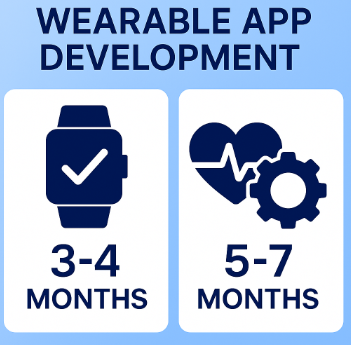
Wearable app development timelines vary significantly based on complexity, platform requirements, and sensor integration needs. Simple fitness tracking MVPs with basic activity monitoring may complete in 3-4 months, while comprehensive health monitoring platforms with multiple sensor integrations, AI-powered insights, and enterprise backend systems often require 5-7 months or longer.
The development process typically begins with discovery workshops assessing platform requirements (watchOS vs. Wear OS vs. both), identifying sensor integration needs and battery constraints, and evaluating companion mobile app requirements before code development commences. Adopting agile methodologies with two-week sprint cycles allows for iterative refinement, though wearable projects require comprehensive upfront planning ensuring proper battery optimization architecture and sensor integration strategies.
Phased delivery approaches—launching MVPs with core tracking features followed by iterative enhancements adding advanced analytics, social features, and AI-powered insights—often provide faster time-to-value while accommodating user feedback discovered during initial deployments. Organizations should expect to invest substantial time in battery optimization testing, cross-device compatibility validation, App Store review processes (particularly for health claims), and user acceptance testing across different wrist sizes and wearing patterns.
How do wearable app development costs compare to mobile applications?
Wearable app development typically commands higher per-feature investments compared to smartphone apps due to increased complexity, battery optimization requirements, sensor integration needs, and platform-specific constraints. While basic mobile apps might range from $25,000-$75,000, wearable implementations frequently span $40,000-$150,000 or higher for comprehensive platforms requiring multi-sensor integration and advanced health monitoring.
Cost factors specific to wearable app development include battery optimization engineering requiring specialized expertise in power-efficient algorithms, sensor fusion development combining multiple data streams accurately, platform-specific implementations for watchOS complications and Wear OS tiles, companion mobile app development (most wearables require paired smartphone apps), and regulatory compliance for health-related applications requiring HIPAA or FDA consideration.
Organizations should evaluate the total cost of ownership, including ongoing maintenance (15-20% of initial development annually), cloud infrastructure for data storage and analytics ($200-$2,000+ monthly depending on user base), platform updates for new watchOS/Wear OS versions, and continuous battery optimization as usage patterns evolve. However, effective wearable apps command premium pricing, generate higher engagement than mobile-only solutions, and create competitive differentiation, justifying the investment.
Should organizations build native wearable apps or use cross-platform frameworks?
This decision depends on specific requirements rather than universal rules. Native wearable app development using Swift for watchOS and Kotlin for Wear OS provides maximum performance optimization, full access to platform-specific features (Digital Crown, rotating bezel, complications), optimal battery efficiency through platform-native frameworks, and user experiences perfectly aligned with platform conventions.
Cross-platform frameworks like React Native and Flutter provide 70-80% code sharing between platforms, reducing initial costs by 30-40% compared to dual native builds, faster time-to-market launching on both platforms simultaneously, and consistent feature parity across iOS and Android wearables. Modern cross-platform tools achieve near-native performance suitable for most use cases, including fitness tracking, notifications, and data visualization.
Organizations should evaluate whether wearable app requirements demand platform-specific capabilities (advanced complications, always-on displays, unique sensors), whether maintaining separate codebases presents sustainable long-term overhead, whether budget constraints favor cross-platform approaches, and whether time-to-market requirements necessitate simultaneous launch. Recommended approach: Build core functionality with cross-platform frameworks for efficiency, then implement performance-critical features natively as needed, providing optimal balance between development velocity and user experience quality.
What differentiates successful wearable apps from smartphone applications?
Wearable apps prioritize glanceable information over comprehensive interfaces, focusing on displaying essential data consumable in 3-5 seconds. User experience design emphasizes large touch targets accommodating limited screen space, voice commands and gesture controls reducing reliance on precise touch input, contextual awareness automatically triggering relevant functions, and minimal text entry leveraging voice dictation and pre-set options.
Technical architecture differs fundamentally: wearable apps implement aggressive battery optimization from inception, leverage smartphone companion apps for heavy processing, prioritize local data processing reducing latency, and gracefully handle intermittent connectivity with offline functionality. Interaction patterns embrace hands-free usage through voice assistants, quick actions accessible via complications or tiles, haptic feedback confirming actions without requiring visual attention, and automatic detection recognizing activities without manual input.
Successful wearable apps solve specific problems uniquely suited to wearable form factors: quick information access without retrieving smartphones, passive health monitoring throughout daily activities, discrete notifications in professional or social settings, hands-free functionality during activities, and constant availability for time-sensitive alerts. Applications attempting to replicate full smartphone experiences on wearables typically fail, while focused solutions embracing wearable constraints succeed.
How important is battery optimization in wearable app development?
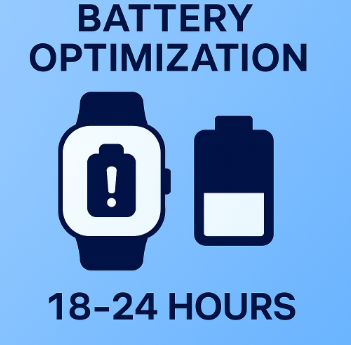
Battery optimization represents the most critical technical consideration for wearable app development companies. Unlike smartphones with larger batteries and daily charging routines, wearable devices must function 18-24 hours between charges while continuously tracking activity, monitoring health metrics, and maintaining smartphone connectivity. Poor battery optimization destroys user experiences regardless of feature richness, as users abandon apps draining batteries to single-digit percentages before evening.
Effective battery optimization strategies include efficient sensor polling using adaptive intervals based on activity levels, intelligent background processing deferring non-critical tasks, optimized Bluetooth Low Energy communication minimizing radio usage, local data processing avoiding unnecessary cloud synchronization, and smart caching reducing redundant data transfers. Apps should implement power-aware algorithms automatically adjusting polling frequency, leverage hardware-level sensor batching, and utilize platform-specific battery frameworks (watchOS Core Motion, Wear OS SensorManager).
Testing battery performance under real-world conditions proves essential. Development partners should demonstrate battery benchmarks across typical usage scenarios: active workout tracking with GPS and heart rate monitoring, passive all-day activity and sleep tracking, notification handling and app interactions, and standby periods with minimal usage. Successful implementations achieve full-day battery life even with aggressive feature usage, while poor implementations drain batteries to 20% by mid-afternoon, effectively killing user adoption.
What security and compliance requirements affect wearable app development?
Wearable devices collect uniquely sensitive data combining biometric information (heart rate, sleep patterns, activity levels), location tracking throughout daily movements, behavioral patterns revealing personal habits, and health metrics potentially indicating medical conditions. Security and compliance frameworks must address these privacy sensitivities.
Data protection requires end-to-end encryption for all data transmission between wearable, smartphone, and cloud servers; AES-256 encryption for data storage on device and in cloud infrastructure; secure key management preventing unauthorized decryption; and regular security audits identifying vulnerabilities before exploitation. Biometric authentication using fingerprint or facial recognition adds additional access control layers.
Health-related wearable apps must comply with HIPAA regulations when handling Protected Health Information (PHI) in U.S. healthcare contexts, requiring Business Associate Agreements with service providers, comprehensive audit logging of all data access, encrypted backup and disaster recovery procedures, and employee training on PHI handling. GDPR compliance for European users demands explicit consent for data collection, data portability allowing users to export information, right to deletion removing personal data upon request, and privacy by design incorporating data protection from inception.
FDA considerations apply when wearable apps make diagnostic claims or function as medical devices, requiring regulatory submission, clinical validation of accuracy, and quality management systems. Organizations should engage legal counsel early in development, ensuring compliance rather than retrofitting protections.
What metrics indicate successful wearable app implementations?
Success metrics for wearable apps emphasize engagement quality over raw user counts. Daily active usage demonstrates the app has become part of users’ routines rather than novelty installations abandoned after the initial trial. Session frequency and duration indicate whether users interact regularly throughout the day, return habitually for specific functions, and spend sufficient time engaging with features.
Feature-specific metrics reveal which capabilities drive value: for fitness apps, workout completion rates and weekly active exercise sessions; for health monitoring, consistency of daily measurements and alert response rates; for productivity apps, task completion through wearable interface and notification acknowledgment speed. Retention cohorts tracking percentage of users still active after 7, 30, and 90 days indicate sustainable value proposition versus initial curiosity.
Technical health metrics ensure the wearable foundation supports growth: average battery drain per hour during active use, crash rates below 0.5% maintaining user confidence, data synchronization success rates ensuring reliability, and load times under 2 seconds preserving perceived responsiveness. User satisfaction through App Store ratings and qualitative feedback complements quantitative metrics.
Business outcomes vary by application type but typically include user acquisition cost and lifetime value ratios, conversion rates for freemium or subscription models, engagement correlation with business KPIs (health outcomes, productivity metrics, purchase behavior), and net promoter scores indicating recommendation likelihood. Organizations should establish baseline metrics before launch and specific improvement targets guiding post-launch iteration.
How can organizations validate wearable app ideas before full development?
Idea validation reduces risk by testing assumptions before significant capital investment. Prototype testing builds clickable designs simulating wearable app functionality without full development, conducts usability testing with target users observing interaction patterns on actual devices, validates whether proposed features solve real problems before implementation, and identifies battery-draining interactions requiring optimization. Investment: $15,000-$35,000 for design and testing (1-2 months).
Beta testing with actual hardware launches limited MVP with core features only to closed user group, distributes through TestFlight (iOS) or internal testing tracks (Android), measures engagement patterns and battery impact under real usage, and collects detailed feedback before public launch. Investment: Included in MVP development budget (2-3 months).
Competitive analysis examines existing wearable apps addressing similar problems, identifies feature gaps and differentiation opportunities, evaluates user complaints revealing unmet needs, and assesses pricing strategies and monetization models. This research informs positioning and feature prioritization.
Founders should define success criteria before testing: minimum daily active usage indicating habit formation, battery performance benchmarks users will tolerate, engagement frequency demonstrating value delivery, and willingness to pay, validating the monetization model. Honest assessment against benchmarks prevents justifying weak signals through confirmation bias.



 18 Min