





















 14 Min


You can switch app development companies mid-project without losing your investment if you exit in the right order: review your contract’s termination terms, collect a complete handoff package, have the new team audit what exists, and re-scope honestly before anyone writes code. The stakes are bigger than inconvenience. The Consortium for Information and Software Quality (CISQ) estimates the cost of poor-quality software in the United States at $2.41 trillion in its most recent report, with accumulated technical debt near $1.52 trillion, and a sloppy agency transition pours your project straight into that bucket. Switching is disruptive, but staying with the wrong partner is usually worse. Here is the orderly way out.
Key Takeaways
- Read your contract before signaling anything. Most agency agreements require roughly 30 days of notice and payment for work completed, in exchange for full code and intellectual property (IP) transfer.
- Demand a complete handoff package: repositories with history, credentials, documentation, design source files, and every third-party account.
- Have the incoming team audit the code and documentation before committing to build on top of it.
- A short, paid knowledge-transfer overlap between old and new teams is the cheapest insurance in the entire transition.
- Switch when trust or quality is broken and trending worse. Push through when problems are fixable and a milestone is close.
When to Switch App Development Companies and When to Push Through
Switch when the problems are structural and compounding: missed milestones with shifting explanations, no working builds you can touch, invoices outpacing visible progress, or key people quietly disappearing from your project. Push through when the problems are situational: one rough sprint, a communication gap the team acknowledges and corrects, or a launch milestone within genuine reach.
Across 500+ launches since 2009, the distinction we see hold up is trajectory. Every project hits turbulence, and a good team names its mistakes and shows you the correction in the next sprint. A failing relationship produces the same conversation every month with new excuses attached. Several of the founders we speak with each month waited six months longer than they should have, mostly out of politeness and sunk cost. If you have raised the same core issue three times in writing and the pattern has not changed, you have your answer. One more caution: switching costs real time, typically two to six weeks of transition, so do not switch over style points. Switch over trust, quality, and honesty.
Step One: Reread Your Contract’s Exit Terms
Your contract defines your leverage, so read it before you announce anything. Look for four things: the termination clause (30-day written notice is the industry norm), what you owe on exit (payment for work completed to date is standard and fair), when IP transfers (often conditioned on full payment of undisputed invoices), and any deliverables-on-termination language obligating the agency to hand over code and materials. Keep undisputed payments current through the exit. Withholding money feels satisfying and reads badly later, and an agency holding your code hostage over an unpaid invoice is a fight you do not need. Quietly line up your next team first, then give notice cleanly and in writing.
Step Two: The Handoff Package to Demand
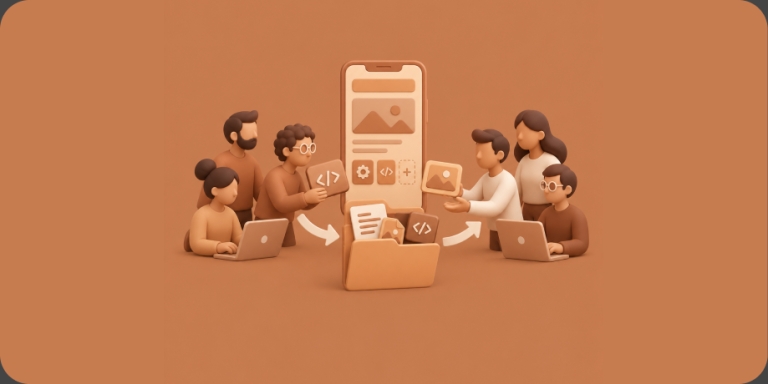
The handoff package is everything a new team needs to continue your product without guessing. Request it in writing, as a checklist, and mark each item received before you consider the exit complete.
| Handoff item | What it must include |
|---|---|
| Source code repositories | Full commit history and all branches, transferred to an account you own |
| Credentials and access | Cloud hosting, databases, Apple App Store and Google Play Store developer accounts, domain registrar, analytics, payment processors, and application programming interface (API) keys |
| Documentation | Architecture notes, environment setup, build and deployment instructions, and known issues |
| Design assets | Figma or equivalent source files, exported assets, and brand files |
| Third-party accounts and licenses | Every paid service, plugin license, and subscription the product depends on |
| Data | Complete database exports and user data, delivered securely |
| Work-in-progress summary | What is complete, what is partial, and what was never started, in plain language |
If documentation “does not exist,” which is common, ask the outgoing team to record a one-hour walkthrough video of the codebase and infrastructure. It is a small ask that saves the new team days of archaeology.
Step Three: Audit Before the New Team Commits
Never let a new agency quote your project from the old agency’s status reports. The incoming team should run a code and documentation audit first, examining architecture, code quality, test coverage, dependency health, and how much of the claimed progress is real. This protects you twice over. It stops you from inheriting fiction, because “80 percent complete” often audits out closer to half, and it forces the new relationship to start with evidence instead of optimism. Expect to pay for this audit, typically $2,500 to $10,000, and treat it as the price of an honest foundation.
Step Four: Arrange a Knowledge-Transfer Overlap
When the relationship allows it, pay the outgoing team for two to four weeks of limited availability while the new team onboards. The arrangement is simple: the old team answers questions, explains decisions, and stays reachable for deployment quirks, while the new team drives. Record every session. When the relationship is too damaged for overlap, the audit plus walkthrough videos substitute reasonably well. What you should not do is let the old team keep building during the transition, since work created during a handoff has a way of needing rework.
Get Your Free 45-Minute App Roadmap
Meet 1-on-1 with our senior product team. We’ll map your MVP or enterprise app and hand you a personalized plan—clear scope, a realistic timeline, and fixed monthly costs—for iOS & Android, web, tablets & wearables, and AI.
Step Five: Re-Scope Honestly with the New Team
Do not hand the new team the old team’s timeline and ask them to hit it. That schedule was already fiction, which is partly why you are switching. Instead, re-scope from the audit: what exists, what needs rework, what remains, and what the launch actually requires. Expect some rebuilding even in good codebases, and expect the honest new number to sting less than the dishonest old one did by the end. This is also the moment to fix the commercial structure that let things drift, ideally moving to a fixed monthly budget with defined deliverables and full visibility into the work as it happens. Our pricing page shows what transparent scoping looks like in practice.
How Chop Dawg Takes the Baton Mid-Project
A meaningful share of Chop Dawg engagements begin exactly here, where another team stopped, stalled, or lost trust. Our development team audits before quoting, gives you a plain-English read on what you actually own, and then continues the work under fixed monthly budgets with daily Slack updates and 24/7 visibility into GitHub, Jira, and Figma. Because we are one in-house company, US-headquartered and US-led, with American leadership, product and project management, senior development, senior design, and senior quality assurance (QA) backed by our in-house Brazilian design team and in-house development, QA, and project management teams in Pakistan and India, there are no subcontracted layers where accountability can hide. That model closes off both classic failure patterns founders flee: the American salesperson fronting invisible offshore subcontractors, and the overseas shop that never overlaps your working hours.
We are comfortable inheriting someone else’s foundation because we do it constantly. For C.A. Short, the 85-year-old employee recognition company, we programmed their first-ever mobile apps directly from their in-house team’s designs, integrating with their existing backend APIs rather than forcing a rebuild. Product Manager Addie Hutchins reported: “I have really enjoyed working with the Chop Dawg team. They are always on top of what we need to provide them. I’m really happy with how the mobile app is turning out!” For CardHedge, we built a native mobile experience on top of the platform’s existing backend, serving a price guide covering more than 1 million trading cards. Joining mid-stream, respecting what works, and replacing only what does not is a skill set of its own, and our proven process is designed for it.
Frequently Asked Questions
How do I switch app development companies without losing my code?
Confirm your contract assigns intellectual property to you for paid work, then require a handoff package that includes full repositories with commit history transferred to accounts you own, plus credentials, documentation, and design files. Pay undisputed invoices, since IP transfer is usually conditioned on payment, and verify every item before closing out.
Do I have to pay my current developer before I can switch?
Generally yes, for work already completed. Most contracts require payment of outstanding undisputed invoices before code and intellectual property transfer, and most require about 30 days of written notice. Paying cleanly is usually cheaper than fighting, because a disputed exit delays your project longer than the invoice is worth.
How long does it take to switch app development companies mid-project?
Plan for two to six weeks: contract notice and handoff collection in weeks one and two, a code audit in parallel, then onboarding and knowledge transfer. A well-run switch costs about a sprint of momentum. A badly run one, with missing credentials and no documentation, can cost a quarter.
Will a new company use the code my old developer wrote?
Often yes, but only after an audit. If the architecture is sound, the new team finishes or refactors what exists. If the foundation cannot carry the product, restarting is honestly cheaper. Expect some rework in either case, and be suspicious of any agency that promises to reuse everything before reviewing anything.
When is it better to stay with a struggling developer?
Stay when the problems are situational and the team owns them: one rough patch, an acknowledged communication gap with a visible correction, or a milestone genuinely within reach. Transition costs real time and money, so switch over broken trust, declining quality, and repeated patterns, not over a single bad sprint.
What should I do if my developer refuses to hand over the code?
Start with your contract’s intellectual property and deliverables clauses and send a formal written demand. If refusal continues, an attorney’s demand letter resolves most cases quickly. Your position is strongest when store, hosting, and repository accounts were opened in your name from the start, which removes most hostage scenarios entirely.
Leave Well, Land Better
Switching app development companies mid-project is a process, not a leap: exit terms, handoff package, audit, overlap, honest re-scope. Handled in that order, you keep your code, your data, and most of your momentum. Whether you are a startup founder planning a quiet exit or an established company that needs a steadier hand on an existing platform, we will help you map the transition in a free 45-minute consultation, offered whether or not you hire us. Book your consultation when you are ready. Now in our 18th year, Chop Dawg has delivered 500+ products used by 1 billion+ people since 2009, holds a 92% repeat-partner rate, and carries 300+ five-star reviews across trusted directories like Clutch, GoodFirms, G2, Google, and TopDevelopers. Your project deserves a finish line, and we would be glad to carry it there.


 16 Min