
















 16 Min


To build an employee scheduling or workforce app in 2026, you need five connected systems: drag-and-drop shift scheduling, GPS-verified clock-in and clock-out, push notifications that actually reach crews, payroll-ready exports, and roles and permissions that mirror how your company runs. Most businesses invest $25,000 to $60,000 for a focused first version and launch within three to six months. The category is growing fast: Grand View Research projects the global workforce management market will reach $19.35 billion by 2030, expanding 11.7% per year. The pain is always the same: schedules trapped in group texts, no-shows discovered at 6 a.m., and payroll rebuilt from memory every other Friday. This guide covers the features, compliance traps, costs, and pitfalls.
Key Takeaways
- An employee scheduling or workforce app combines drag-and-drop shift building, GPS clock-in and clock-out, real-time notifications, payroll export, and role-based permissions in one system.
- A focused minimum viable product (MVP) costs $25,000 to $60,000 and takes three to six months, while multi-location platforms with payroll integrations run $75,000 to $150,000 or more.
- Multilingual support is a competitive weapon in field industries: auto-translated messaging lets English, Spanish, and Portuguese speaking crews coordinate in one thread.
- GPS tracking must be limited to on-the-clock hours with clear consent, or adoption and legal exposure both turn against you.
- Adoption lives or dies with the crew-facing experience, not the manager dashboard.
What an Employee Scheduling or Workforce App Actually Does
An employee scheduling or workforce app is a mobile-first platform where managers build and publish shifts, workers see schedules and clock in from their phones, and the business gets clean attendance data flowing straight into payroll. It replaces the whiteboard, the group text, and the paper timesheet with one source of truth.
One clarification before scoping: this is internal software for your own workforce. A two-sided platform that matches outside workers with open shifts is a staffing marketplace, a different product with different economics. If your crews are on your payroll (construction, home services, healthcare, restaurants, cleaning, logistics), this guide is your blueprint.
Must-Have Features for an Employee Scheduling App
Six features define the category, and the order matters: scheduling and clock-in create the data, notifications and permissions drive adoption, and payroll export delivers the payoff. Everything else is a nice-to-have until these work flawlessly.
- Drag-and-drop scheduling. Managers build shifts visually, duplicate last week in one tap, assign by role or certification, and publish instantly. Multi-level scheduling (company, project, crew) keeps large operations sane.
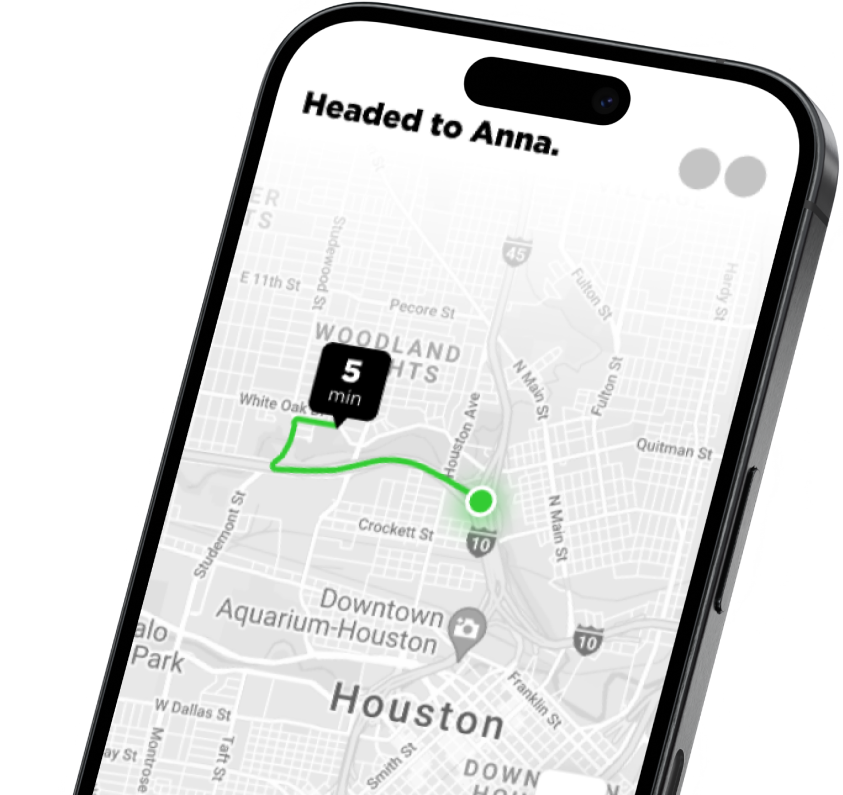
- GPS clock-in and clock-out. Geofenced punches verify workers are actually on site, with a timecard editor for supervisors to fix honest mistakes, and every edit logged.
- Notifications that land. New schedule published, shift starting soon, swap approved, weather delay. Push plus text fallback, because a notification nobody sees is a no-show you paid for.
- Payroll export. Clean hours, overtime flags, and job codes exported as CSV or synced to your payroll provider. This single feature usually pays for the app.
- Roles and permissions. Three tiers work for most companies: admins control money and settings, supervisors manage their own crews, and workers see their own schedules. Bulk employee import from Excel or CSV makes onboarding painless.
- Multilingual crews, one conversation. Auto-translated group messaging means a superintendent types in English and a crew member reads it in Spanish. In field industries this is often the feature that wins the deal.
| Build tier | What is included | Typical budget | Timeline |
|---|---|---|---|
| Focused MVP | Scheduling, GPS time clock, notifications, payroll export, basic roles | $25,000 to $60,000 | 3 to 6 months |
| Growth platform | MVP plus shift swaps, multilingual messaging, analytics, subscription billing | $60,000 to $100,000 | 5 to 9 months |
| Complex operation | Multi-location, payroll and ERP integrations, compliance engines, offline mode | $75,000 to $150,000+ | 6 to 12+ months |
Compliance and Edge Cases That Bite Later
Labor law and messy reality shape this category more than founders expect. Plan for four things early. First, overtime rules: the Fair Labor Standards Act (FLSA) plus state variations mean your app should flag overtime as schedules are built, not after checks are cut. Several cities also enforce predictive scheduling laws that penalize last-minute changes, so publish timestamps matter. Second, GPS privacy: track location only while someone is clocked in, say so plainly in the app, and collect consent during onboarding. Third, offline job sites: basements and rural sites kill signal, so punches must queue locally and sync later without duplicating. Fourth, the calendar itself: overnight shifts that cross midnight, daylight saving transitions, and shift swaps mid-pay-period all corrupt payroll data if the data model was not designed for them.
The Tech Stack We Recommend
For workforce platforms we build with React Native, which delivers native-quality iOS and Android apps from one codebase, alongside a React web dashboard for schedulers, a Node.js backend, and Google Cloud Platform or Amazon Web Services (AWS) with Firebase handling push notifications and real-time sync. Stripe handles per-user subscription billing if you are selling the platform to other companies, and translation services power multilingual messaging.
Native Swift or Kotlin modules come in only where hardware demands it, such as fine-grained background location. That keeps budgets proportional while leaving nothing on the table in performance.
What It Costs to Build a Workforce App in 2026
Across 500+ launches since 2009, workforce and scheduling products consistently land between $25,000 and $150,000, and the spread comes down to integrations and location count. A focused MVP runs $25,000 to $60,000 over three to six months. Multi-location platforms with payroll integrations, compliance engines, and offline support run $75,000 to $150,000 or more across six to twelve months. Design engagements start at $5,000 per month, and a clickable non-functional prototype (NFP) starts around $10,000 if you want to validate with supervisors and investors before writing code. Development engagements start at $7,500 per month, and ongoing maintenance runs from about $2,500 per month. AI and agent-assisted coding (Claude Code and Cursor, with senior engineers reviewing every line) has roughly halved what identical builds cost between 2020 and 2023. Our pricing guide shows how fixed monthly budgets keep the number predictable.
Get Your Free 45-Minute App Roadmap
Meet 1-on-1 with our senior product team. We’ll map your MVP or enterprise app and hand you a personalized plan—clear scope, a realistic timeline, and fixed monthly costs—for iOS & Android, web, tablets & wearables, and AI.
Common Pitfalls in Scheduling App Builds
The technology here is well understood. The failures are almost always product decisions, and these five cause most of them.
- Designing for the office, not the crew. If checking a schedule takes more than two taps, workers go back to texting the foreman.
- Treating notifications as an afterthought. Unreliable alerts destroy trust in the schedule itself, which is the whole product.
- Skipping payroll export in version one. Without it, someone still retypes hours every week and the app never proves its value.
- Ignoring the night shift. Shifts that cross midnight and daylight saving weekends will find every flaw in your time math.
- Underestimating store logistics. An Apple developer account takes two to three weeks and a DUNS number about a month, both in your company’s name. A clean submission is usually reviewed within 24 to 48 hours in 2026, and rejection cycles are the real timeline risk.
Where Chop Dawg Fits
Workforce coordination is a category we know from the field up. For Obras, a workforce scheduling platform for contracting businesses, we designed and built multi-level drag-and-drop scheduling with duplication, three-tier permissions, bulk employee import from Excel and Google Drive, per-user Stripe billing, and multilingual group messaging with real-time translation so mixed-language crews coordinate in one thread. Co-founder Joshua Alves put it this way: “We are thrilled with the final prototype and the expertise that Chop Dawg brought to our project… The quality of work delivered by Chop Dawg exceeded our expectations.” For AllyMS, we unified scheduling, geolocation-verified clock-in and clock-out, and automated payouts for caregiver registries, saving 40+ administrative hours per registry every month and lifting productivity 20%. And for CraftCore, we shipped a fully bilingual English and Spanish experience for skilled-trades hiring, proof that multilingual field software is in our muscle memory. Organizations that have trusted Chop Dawg include C.A. Short and Pearson Fuels.
We are US-headquartered and US-led: American leadership, product and project management, senior engineering, senior design, and senior quality assurance (QA), backed by our in-house Brazilian design team and in-house development, QA, and project management teams in Pakistan and India. Everyone is a Chop Dawg employee assigned to your project, fluent in English and working US hours, which eliminates the two fears that haunt this industry: the lone American salesperson fronting hidden offshore developers with zero accountability, and the faceless overseas shop with no US business norms and no time-zone overlap. Choose the fully American team for government or regulated work, or the blended team most partners pick for the same quality at a lower cost. Either way, you get daily Slack, bi-weekly Zoom during development, and full ownership of your code from day one. Start with strategic planning or jump into development services.
Frequently Asked Questions
How much does it cost to build an employee scheduling app?
A focused employee scheduling app costs $25,000 to $60,000 in 2026, covering shift building, GPS time clock, notifications, payroll export, and basic roles. Multi-location platforms with payroll integrations, compliance rules, and offline support run $75,000 to $150,000 or more, with ongoing maintenance from about $2,500 per month.
How long does it take to launch a workforce management app?
Plan on three to six months for a focused build and six to twelve months for a complex multi-location platform. Start store logistics immediately: Apple developer account approval takes two to three weeks and a DUNS number about a month, both registered in your company’s own name.
Is GPS tracking of employees legal in a scheduling app?
Generally yes, when tracking happens only during paid working hours, employees give informed consent, and the policy is disclosed plainly. Best practice is geofenced clock-in verification rather than continuous tracking, with location collection ending the moment someone clocks out. State rules vary, so review consent language with counsel.
Can a custom scheduling app export to payroll systems like ADP or QuickBooks?
Yes. Most builds start with a clean CSV export formatted for your payroll provider, then graduate to direct application programming interface (API) integrations with platforms like ADP, Gusto, or QuickBooks. Getting hours, overtime flags, and job codes right in the data model makes either path straightforward.
Should I buy off-the-shelf scheduling software or build my own?
Buy when a generic tool fits your workflow and headcount is small. Build when per-seat fees hurt at scale, your scheduling logic is unusual (certifications, multi-site crews, union rules), or you want to sell the platform to other companies in your industry, which turns software cost into a revenue line.
How do I support crews that speak different languages?
Build translation into messaging rather than translating the whole interface first. Auto-translated group threads let each worker read and write in their preferred language, which solves the daily coordination problem immediately. Full interface localization can follow later, prioritized by the languages your workforce actually speaks.
Put Your Schedule to Work
A great workforce app turns scheduling chaos into a two-tap routine: crews know where to be, punches verify themselves, and payroll takes minutes instead of days. Whether you are a founder building a scheduling product or an operator replacing spreadsheets, book a free 45-minute consultation and we will map your features, timeline, and budget, and it is yours to keep whether or not we ever work together. Chop Dawg has been doing this since 2009, now in our 18th year, with 500+ products launched, over 1 billion people using them, 92% of partners returning, and 300+ five-star reviews across trusted directories like Clutch, GoodFirms, G2, Google, and TopDevelopers. See how similar builds turned out in our success stories.



 16 Min