























 15 Min

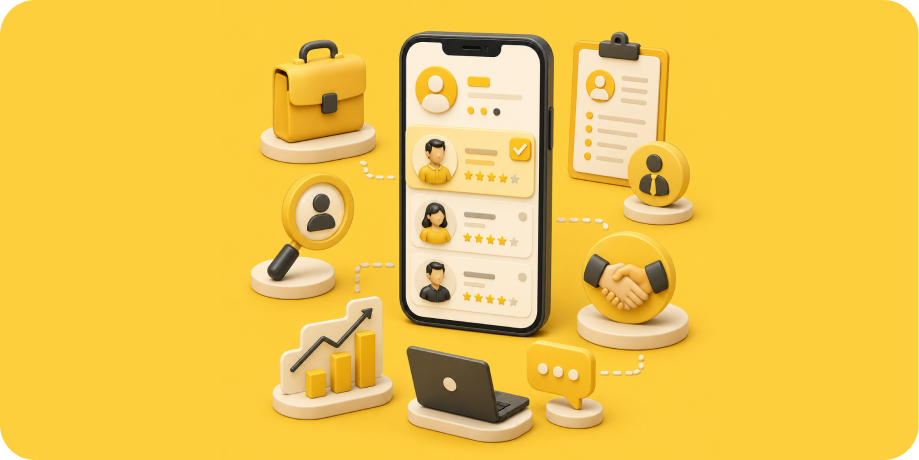
To build a job matching or recruiting app in 2026, you need four pillars: a realistic plan for where job listings come from, candidate profiles with genuinely useful matching logic, an employer side built as a web app, and admin analytics that measure whether matches actually happen. The demand side is enormous: the U.S. Bureau of Labor Statistics reported 7.6 million open jobs in May 2026, alongside 5.2 million hires that month, which means millions of matches are being made inefficiently every single month. The catch is that most founders design their app around listing data they assume they can get, and cannot. This guide starts with that hard truth and builds the rest of the blueprint from there.
Key Takeaways
- Major job boards gate their application programming interfaces (APIs) behind selective partner programs or do not offer public ones, so plan for direct employer postings, permitted crawling, or AI-assisted ingestion.
- Candidate experiences belong on mobile, but the employer side works best as a web app where recruiters actually work.
- Matching quality depends on one-to-one parity between the fields employers fill out and the filters candidates search with.
- Verification (identity, credentials, licenses) is what separates trusted niche platforms from noisy boards.
- A focused matching MVP runs about $50,000 to $60,000 in 2026; a full two-sided recruiting marketplace runs $75,000 to $150,000 or more.
The Hard Truth About Job Listings Data
Here is the constraint that shapes every recruiting product: the biggest job boards either gate their APIs behind selective partner programs or do not offer public APIs at all. You cannot simply plug into the internet’s job supply. Every successful platform in this category picks a deliberate listings strategy, and usually combines two of them.
| Listings strategy | How it works | Strengths | Trade-offs |
|---|---|---|---|
| Direct employer postings | Employers create and manage listings inside your platform | Clean structured data, direct revenue, real employer relationships | You must recruit the supply side yourself from zero |
| Crawling where permitted | Ingest publicly available listings while respecting site terms and robots rules | Fast inventory that makes the app feel alive on day one | Legal review required, messy data, no employer relationship to monetize |
| AI-assisted ingestion | AI parses career pages, feeds, and documents into structured postings | Turns messy sources into clean, searchable listings at low cost | Needs human review workflows and ongoing accuracy monitoring |
| Official partner feeds | Negotiated data access with boards or applicant tracking systems | Legitimate, structured, and stable | Selective programs that early startups rarely qualify for |
Across 500+ launches since 2009, our strongest advice in this category is to treat direct employer postings as the long-term backbone, because owned supply is the only kind you can structure, verify, and charge for. Crawling and AI ingestion are bridges that solve the empty-marketplace problem while your sales motion builds real employer inventory.
Candidate Profiles and Matching Logic That Actually Matches
Great matching is a data-entry design problem before it is an algorithm problem. The single highest-leverage decision is one-to-one parity: every field an employer fills out when posting a job should map exactly to a filter a candidate can search with. Pay, certifications, experience level, location radius, travel requirements. When the two sides describe jobs in the same structured language, even simple matching feels telepathic.
We built the skilled-trades hiring platform CraftCore on exactly this principle: candidates filter by craft, level, certifications, wage, per diem, travel pay, and radius, and employer postings carry those same fields one to one, in both English and Spanish. Let candidates browse before creating an account, then use a guided profile builder (with document uploads for licenses and certifications) to convert interest into applications. From there, matching logic can grow in stages: rules-based filtering at launch, then AI-driven scoring that ranks fit based on outcomes. Verification is the other trust layer; when the healthcare matching platform ForeveRx verified every user against license and National Provider Identifier (NPI) credentials, that verification became the product’s moat, helping it launch with 25,000+ verified healthcare users and reach an 85% match success rate.
The Employer Side Works Best as a Web App
Candidates swipe on phones; recruiters work at desks. Build the candidate experience as a mobile app and the employer experience as a responsive web application, because posting jobs, reviewing applicants, and managing pipelines are keyboard-and-big-screen workflows that recruiters run during business hours.
A strong employer portal includes structured posting forms (feeding that one-to-one parity), an applications inbox with notes, tags, and ratings, shortlist pipelines, job drafts and templates, and scheduled publishing. This split also saves budget: a responsive web portal avoids building and maintaining a second mobile app that employers would not use anyway, and it sidesteps app store review cycles for the fast-changing business side of your platform.
Admin Analytics: Data Is the Name of the Game
In recruiting platforms, data is the name of the game. A marketplace only works when both sides keep showing up, and the only way to manage that is measurement: time-to-match, fill rate per posting, application-to-interview conversion, candidate activation, employer repeat-posting rate, and search terms that return zero results (your clearest demand signal).
Give your operations team an admin backend that surfaces those numbers and lets them act without developers: taxonomy management for crafts and categories, employer verification queues, content moderation, and exportable reports. This is also where AI-assisted ingestion gets its human review queue. Platforms that skip admin tooling discover too late that their team cannot fix data problems, police fake postings, or explain to an investor which side of the marketplace is underperforming.
Get Your Free 45-Minute App Roadmap
Meet 1-on-1 with our senior product team. We’ll map your MVP or enterprise app and hand you a personalized plan—clear scope, a realistic timeline, and fixed monthly costs—for iOS & Android, web, tablets & wearables, and AI.
What It Costs to Build a Job Matching or Recruiting App
A focused matching MVP, one candidate app plus an employer web portal and admin basics, typically runs $50,000 to $60,000 in 2026. A full two-sided recruiting marketplace with verification, AI-assisted ingestion, messaging, and analytics is marketplace-class work at $75,000 to $150,000 or more. Standard focused MVPs in simpler categories start near $25,000, but two-sided hiring platforms rarely stay that lean once real employer workflows arrive.
Timelines run 3 to 6 months for the focused version and 6 to 12 months for marketplace-class scope. Both figures reflect AI-assisted engineering, with senior developers reviewing every change, which has roughly halved 2020 to 2023 costs and timelines. Ongoing AI matching and ingestion work typically starts around $10,000 per month once you are optimizing against live data. Many founders begin with a clickable non-functional prototype (NFP) from about $10,000 to validate both sides of the experience and support fundraising; see current numbers on our costs and pricing page.
How Chop Dawg Builds Hiring and Matching Platforms
This category is active ground for us: alongside shipped platforms, we are actively designing and building products in this space in 2026. CraftCore shows the full recruiting architecture in production: iPhone and Android candidate apps, a responsive employer web portal with a shortlist-and-rate pipeline, bilingual English and Spanish experiences, and an admin backend that handles taxonomy, employer verification, and moderation without developer involvement. ForeveRx shows the verified-matching side: credential checks against licenses and NPI or Drug Enforcement Administration (DEA) records, freemium conversion mechanics that reached 33% paid conversion, and matching that produced real-world meetups at an 85% success rate. As its co-founder put it: “I appreciate that Chop Dawg takes this project as seriously as I do. Chop Dawg is fully invested in our project. Their commitment to understanding my vision and needs, even before we signed the contract, demonstrates how dedicated they are to delivering a quality product…” (Shivani Shah, Co-Founder of ForeveRx).
The team is US-headquartered and US-led: American leadership, product and project management, senior development, senior design, senior quality assurance (QA), and marketing, backed by our in-house Brazilian design team and our in-house development, QA, and project management teams in Pakistan and India. Everyone is a Chop Dawg employee assigned directly to your project, fluent English, US hours, which eliminates the two fears that haunt this industry: the American salesperson fronting hidden offshore subcontractors with zero accountability, and the faceless overseas shop with no US business norms and no time-zone overlap. Choose fully American for government and regulated work, or the US-plus-offshore blend most partners pick for the same quality and timelines at lower cost. Organizations that have trusted Chop Dawg include NASA, Siemens, and MIT, and every engagement runs through strategic planning, design, and development with you owning all code and intellectual property (IP) from day one.
Frequently Asked Questions
Where do job listings come from if the big boards do not offer APIs?
From a deliberate mix of strategies: direct employer postings inside your platform, crawling public listings where site terms permit, AI-assisted ingestion that structures career-page data, and eventually negotiated partner feeds. Successful platforms treat direct employer postings as the backbone and use the others to solve early inventory gaps.
How much does it cost to build a recruiting or job matching app in 2026?
A focused matching MVP with a candidate app, employer web portal, and admin basics runs about $50,000 to $60,000. A full two-sided recruiting marketplace with verification, ingestion, and analytics runs $75,000 to $150,000 or more. A clickable prototype to validate the concept costs $10,000 to $25,000.
How long does it take to launch a job matching platform?
Plan 3 to 6 months for a focused matching MVP and 6 to 12 months for a marketplace-class build with verification and AI-assisted ingestion. AI-assisted engineering with senior review has roughly halved older timelines, though two-sided platforms still need extra time for employer onboarding workflows and data quality testing.
Does the employer side of my platform need its own mobile app?
Almost never. Recruiters post jobs and review applicants from desks during business hours, so a responsive employer web portal delivers a better experience at lower cost than a second mobile app. It also lets you update business-side features instantly without waiting on app store review cycles.
How does AI improve job matching, and what does it cost?
AI ranks candidate-job fit beyond simple filters, parses resumes and career pages into structured data, and learns from which matches convert to hires. Most platforms launch with rules-based matching, then add AI scoring once real outcome data exists, with dedicated AI work typically starting around $10,000 per month.
Build the Platform That Makes the Match
Solve listings supply honestly, structure both sides of the data for real matching, give employers a web portal and candidates a great mobile app, and measure everything, because in this category data is the whole game. If you want that blueprint applied to your niche, talk to a team already building in it. Chop Dawg has partnered with founders and established companies since 2009, now in our 18th year, with more than 500 products launched, over 1 billion combined users, a 92% repeat-partner rate, and 300+ five-star reviews across trusted directories like Clutch, GoodFirms, G2, Google, and TopDevelopers. Book your free 45-minute consultation and we will pressure-test your listings strategy, feature set, and budget together, whether or not you ever hire us.



 16 Min