





















 15 Min

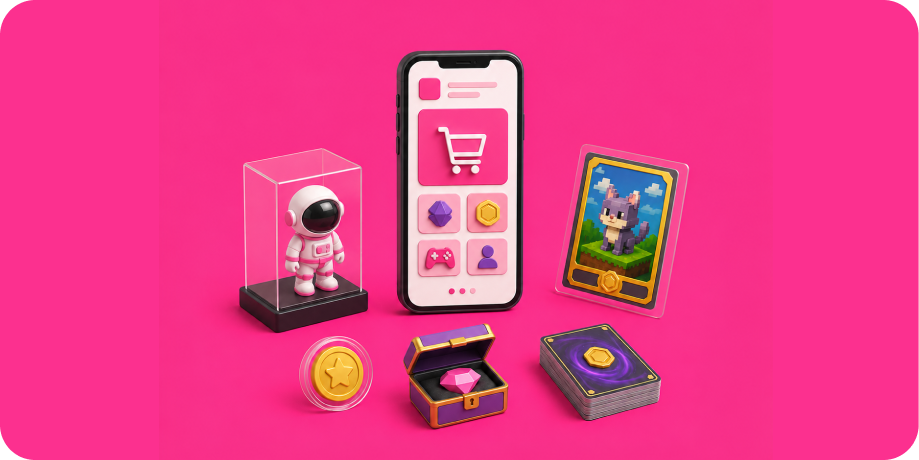
To build a collectibles marketplace or trading app in 2026, you need to solve three problems in order: trustworthy data (what is this card or item actually worth), fast capture (sellers logging transactions by barcode scan or voice in seconds), and safe transactions (verified sellers, clean payments, and dispute handling). Transactional marketplaces start around $75,000, while collector tools and trackers run $40,000 to $120,000. The market keeps compounding: the trading card game segment alone is growing from $13.28 billion in 2025 to a projected $15.11 billion in 2026, according to Mordor Intelligence. The founders who struggle are the ones who underestimate data quality and payment compliance, and this guide covers both in plain terms.
Key Takeaways
- Collectibles apps split into two families: transactional marketplaces (auctions, sales, live commerce) and collector tools (price guides, portfolios, seller logistics), and each has a different cost profile.
- Seller transaction logging must be near-instant: barcode and UPC scanning, voice entry, and offline capture that syncs later are the difference between daily use and abandonment.
- Market-data engines need outlier detection and trust scores, because one manipulated sale can poison comps for an entire card or category.
- Subscriptions sold inside iOS and Android apps must use Apple In-App Purchase and Google Play Billing, while web subscriptions run through Stripe at far lower fees.
- Expect $40,000 to $120,000 for collector tools and $75,000 to $150,000 or more for full marketplaces.
What a Collectibles Marketplace or Trading App Actually Is
A collectibles marketplace or trading app serves the buying, selling, tracking, and valuation of physical collectibles: sports cards, trading card games, memorabilia, sneakers, coins, comics, and beyond. Marketplaces host transactions between collectors, while trading and tracking apps give collectors and resellers the tools to log inventory, follow prices, and manage profit and loss.
The two families overlap but monetize differently. Marketplaces earn transaction fees and seller subscriptions. Collector tools earn subscriptions and data licensing. Deciding which business you are in before you scope features saves months, because auction infrastructure and price-guide infrastructure are both expensive and neither is optional once promised.
Must-Have Features for Sellers and Collectors
The feature set that wins this category in 2026 is built around speed of capture and confidence in data. A reseller logging fifty purchases at a card show will not type; a collector pricing a graded card will not trust a number they cannot interrogate.
- Transaction logging by barcode, UPC, and voice. Scan a slab or box barcode, or say “bought, 2018 Prizm, PSA 10, two hundred fifty,” and the entry is structured, timestamped, and priced. Manual forms exist as fallback, not as the primary path.
- Offline capture with sync. Card shows, basements, and storage units have terrible signal. The app must queue entries locally and sync cleanly later, with conflict handling that never silently drops a transaction.
- Verified-seller programs. Business verification through employer identification number (EIN) checks, identity verification, and performance history separates professional sellers from burner accounts, and verified badges measurably lift buyer conversion.
- Aggregated market-data engines. Pull sales from multiple sources, normalize by grade and variant, run outlier detection to strip shill bids and mislabeled listings, and publish a trust score with every price so users know how solid the comp is.
- Profit and loss (P&L) dashboards. Cost basis, sale proceeds, fees, shipping, and net margin by item, set, and time period. Resellers run businesses, and the app that becomes their bookkeeper becomes their daily habit.
- Portfolio tracking and alerts. Live valuations, historical charts, and price alerts keep collectors returning between transactions.
Payments and Subscription Compliance Across Apple, Google, and the Web
Payment routing is where collectibles apps get rejected or quietly overpay. The rule is simple: digital goods and subscriptions sold inside the apps must use the platforms’ billing systems, while physical goods and web purchases do not.
| What you are selling | Correct payment rail | Fee reality |
|---|---|---|
| Pro subscription purchased in the iOS app | Apple In-App Purchase | 30%, or 15% via the App Store Small Business Program (under $1M) |
| Pro subscription purchased in the Android app | Google Play Billing | 30%, or 15% for qualifying smaller developers |
| Same subscription purchased on your website | Stripe | Roughly 3% processing |
| Physical collectible sold between users | Stripe (often Stripe Connect for marketplaces) | Processing plus your platform fee, no store commission |
The practical playbook: offer subscriptions on all three surfaces, keep entitlements synced through one account system, and let web checkout carry your margin-sensitive growth. Physical marketplace transactions route around the stores entirely, which is why a marketplace’s take rate belongs to you, not to Apple.
Recommended Tech Stack
For collectibles platforms we recommend React Native for iOS and Android, React for the web app and admin, a Node.js backend, and Google Cloud Platform or Amazon Web Services (AWS) with Firebase for auth, push, and real-time features. Stripe handles marketplace payments, while a dedicated data pipeline handles ingestion, normalization, and outlier scoring for market data.
Two specialist notes. First, if you already have a web product, a native app can be built on your existing application programming interfaces (APIs) rather than rebuilding the backend. Second, live commerce (streamed breaks and auctions) adds real-time video infrastructure and moderation load, so treat it as its own phase with its own budget.
What It Costs to Build a Collectibles Marketplace or Trading App in 2026
Across 500+ launches since 2009, the honest pattern is that collector tools and trackers land between $40,000 and $120,000, while transactional marketplaces start around $75,000 and commonly run $75,000 to $150,000 or more once auctions, escrowed payments, and seller verification are real. A lean tracking minimum viable product (MVP) can start near $25,000 to $60,000 when scoped tightly to capture, portfolio, and one data source. Timelines run three to six months for focused builds and six to twelve months or more for marketplaces. AI and agent-assisted coding (Claude Code and Cursor, with senior engineers reviewing every line) has cut 2020 to 2023 costs roughly in half, and a clickable non-functional prototype (NFP) from about $10,000 remains the cheapest way to test seller workflows before writing production code. Our costs and pricing breakdown shows how fixed monthly budgets keep these ranges predictable.
Get Your Free 45-Minute App Roadmap
Meet 1-on-1 with our senior product team. We’ll map your MVP or enterprise app and hand you a personalized plan—clear scope, a realistic timeline, and fixed monthly costs—for iOS & Android, web, tablets & wearables, and AI.
Common Pitfalls in Collectibles Builds
Five mistakes show up repeatedly in this category, and all five are preventable at the scoping stage.
- Trusting raw sales data. Without outlier detection, one shill bid or mislabeled grade corrupts your comps, and collectors notice within days.
- Making capture slow. If logging a purchase takes longer than the purchase, resellers return to spreadsheets.
- Launching a marketplace without supply. Recruit and verify founding sellers before public launch, and seed listings so the first buyer session never shows an empty search.
- Routing subscriptions incorrectly. Selling digital subscriptions in-app through Stripe is a guaranteed rejection; selling them on the web through Apple is money you set on fire.
- Ignoring counterfeit and dispute flows. Authentication claims, returns, and fraud handling need admin tooling on day one, because the first dispute arrives with the first hundred sales.
Where Chop Dawg Fits
Collectibles is a category we know from the data layer up, and we are actively designing and building products in this space in 2026. For CardHedge, we designed and built the native mobile experience for a trading-card price guide covering 1 million+ cards across every major grade (PSA, BGS, CGC and more), with portfolio tracking, side-by-side comparisons, and three years of price history per grade, all integrated with their existing backend APIs. For The Showcase, an all-in-one sports cards and memorabilia platform, we delivered the investor-ready prototype and the MVP: it saw 5,000+ items listed in its first weekend, 3x higher auction participation than legacy forums, and zero safety incidents during beta. Co-founder Michael Liss, a repeat Chop Dawg founder, said: “With Chop Dawg, we don’t only have a technical partner but also a partner who values what we’re building and wants to see it grow… I cannot recommend the Chop Dawg team enough.” And BiDR combines live-stream commerce, pay-per-bid auctions, and portfolio dashboards in one collectibles marketplace.
Chop Dawg is US-headquartered and US-led. American leadership, product and project management, senior engineering, senior design, and senior quality assurance (QA) run every engagement, supported by our in-house Brazilian design team and our in-house development, QA, and project management teams in Pakistan and India. No subcontractors, no handoffs to strangers: every person is a Chop Dawg employee assigned to your project, fluent in English, on US hours. That structure exists to kill the two fears founders bring to this industry, the American-salesperson-with-hidden-offshore-devs bait and switch, and the faceless overseas shop that goes quiet for weeks. Choose fully American for regulated work, or the US-plus-offshore blend most partners choose for identical quality at lower cost, with daily Slack and full code and intellectual property (IP) ownership from day one either way. Our design services and development services pages show how we phase these builds.
Frequently Asked Questions
How much does it cost to build a collectibles marketplace or trading app?
Collector tools and trackers cost $40,000 to $120,000 in 2026, with lean MVPs starting near $25,000 to $60,000. Transactional marketplaces with auctions, payments, and seller verification start around $75,000 and commonly reach $75,000 to $150,000 or more depending on live commerce and data scope.
How long does it take to launch a collectibles app?
Plan three to six months for a focused tracker or price guide and six to twelve months or more for a full marketplace. Add Apple developer account approval (two to three weeks), a DUNS number (about a month), and seller recruitment time so the marketplace launches with real supply.
Do collectibles app subscriptions have to use Apple In-App Purchase?
Subscriptions purchased inside the iOS app must use Apple In-App Purchase, and Android in-app subscriptions must use Google Play Billing, at 30% commission or 15% under small business programs. The same subscription sold on your website runs through Stripe at roughly 3%, so most platforms sell on all three surfaces.
How does offline transaction logging work at card shows?
The app stores scans, voice entries, and edits in a local queue on the device, then syncs to the server when connectivity returns. Good implementations timestamp everything, resolve conflicts predictably, and show sellers exactly what is pending, so a weekend of buying never disappears into a failed upload.
What are outlier detection and trust scores in market data?
Outlier detection automatically strips suspicious sales, shill bids, mislabeled grades, and off-market transfers, before they skew an item’s comps. A trust score then tells users how reliable each price is based on volume, recency, and variance. Together they are what make a price guide citable instead of guessable.
How do verified-seller programs work?
Sellers submit business details, including EIN or equivalent registration, plus identity verification, and earn a verified badge after review. Ongoing standing depends on dispute rates, shipping performance, and authenticity claims. Verification raises buyer conversion, reduces fraud losses, and gives your moderation team a meaningful lever short of banning.
Build the App Collectors Check Every Morning
Win capture speed, data trust, and payment compliance, and a collectibles marketplace or trading app becomes a daily habit with revenue on three surfaces. Whether you are a founder with a niche obsession or an established operator going mobile, book a free 45-minute consultation and we will scope features, data strategy, and budget with you, no strings attached either way. Chop Dawg has built since 2009, now in our 18th year: 500+ launches, software used by 1 billion+ people, a 92% repeat-partner rate, and 300+ five-star reviews across trusted directories like Clutch, GoodFirms, G2, Google, and TopDevelopers. See the full portfolio in our success stories.



 16 Min