









 16 Min

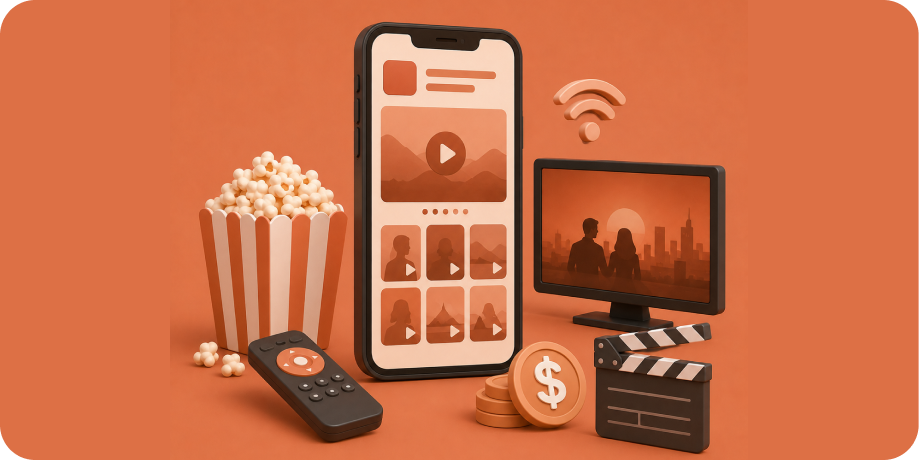
Building an app like Netflix costs $75,000 to $150,000 for a focused niche streaming minimum viable product (MVP) in 2026, and $250,000 or more for a true Netflix-class platform with global content delivery, advanced recommendations, and multi-device apps. The cost to build an app like Netflix depends far less on the video player you see and far more on the invisible systems behind it: encoding pipelines, content delivery networks, licensing, and personalization. Netflix now serves 325 million paid subscribers worldwide, according to DemandSage, so viewers arrive expecting instant, buffer-free playback. The good news: you do not need a Netflix budget to win a niche audience, and this guide shows exactly where every dollar goes.
Key Takeaways
- A focused niche streaming app (fitness, faith, education, regional film, kids) runs roughly $75,000 to $150,000 in 2026.
- A full Netflix-class platform with smart TV apps, offline downloads, and machine-learning recommendations starts around $250,000 and climbs from there.
- The three biggest cost drivers are content delivery and encoding infrastructure, content licensing, and recommendation engines.
- AI-assisted development has cut 2020 to 2023 build costs and timelines roughly in half when engineers review every change.
- Monthly infrastructure costs (content delivery network bandwidth, encoding, storage) scale with viewership and often exceed the original build cost over time.
What Does It Cost to Build an App Like Netflix in 2026?
A video-on-demand app in the Netflix mold costs $75,000 to $150,000 for a focused MVP, and $250,000 or more for a platform-class build. Streaming carries an honest six-figure floor because video infrastructure is unforgiving: encoding, storage, and delivery must work flawlessly before a single subscriber pays you.
The smartest framing question is not “how do I clone Netflix?” but “which slice of streaming does my audience actually need?” A yoga studio streaming classes, a church streaming sermons, a regional film library, or an educational video platform can all launch near the bottom of the range because they serve one audience with one content type. A general-entertainment competitor with licensed Hollywood catalogs, profiles for the whole family, smart TV apps, and offline downloads is a different class of product, and pretending otherwise is how budgets blow up mid-project.
Feature-by-Feature Cost Breakdown for a Streaming App
Here is where the money actually goes in a video-on-demand build. These bands reflect 2026 agency pricing with AI-assisted development already factored in.
| Feature | What It Covers | Typical Cost Band |
|---|---|---|
| Video player and playback | Adaptive bitrate streaming, resume watching, playback speed, captions | $12,000 to $25,000 |
| Encoding and content delivery network (CDN) pipeline | Transcoding to multiple resolutions, CDN integration (AWS CloudFront, Mux, Cloudflare) | $15,000 to $40,000 |
| Accounts, profiles, and subscriptions | Sign-up, multiple profiles, Stripe and in-app purchase billing | $10,000 to $22,000 |
| Content management system | Admin uploads, metadata, categories, scheduling, analytics | $12,000 to $25,000 |
| Search and discovery | Search, filters, categories, continue-watching rows | $8,000 to $15,000 |
| Recommendations | Rules-based “more like this” up to machine-learning personalization | $10,000 to $40,000 |
| Offline downloads and digital rights management (DRM) | Encrypted downloads, license enforcement, studio-grade DRM | $15,000 to $35,000 |
| Smart TV and tablet apps | Apple TV, Roku, Fire TV, Android TV builds beyond phone apps | $25,000 to $60,000+ |
| Quality assurance (QA), security, and launch | Device testing, load testing, app store submission | $10,000 to $20,000 |
A focused MVP skips DRM-heavy downloads, ships phone and web first, and uses rules-based recommendations. That is how you land in the $75,000 to $150,000 window instead of the $250,000+ platform tier.
Get Your Free 45-Minute App Roadmap
Meet 1-on-1 with our senior product team. We’ll map your MVP or enterprise app and hand you a personalized plan—clear scope, a realistic timeline, and fixed monthly costs—for iOS & Android, web, tablets & wearables, and AI.
What Moves the Number Up or Down
Five decisions swing a streaming budget more than everything else combined. Across 500+ launches since 2009, we have watched each of these turn a manageable quote into a runaway one, or rescue a project that looked unaffordable.
- Content licensing. Licensing third-party shows and films is a content budget, not a development cost, and it can dwarf the build itself. Original or owned content (your classes, your films, your archive) removes this line entirely.
- Delivery infrastructure choices. Building on managed video infrastructure like Mux or AWS Media Services costs a fraction of custom pipelines. Netflix built its own CDN; you should not.
- Recommendation depth. “Viewers also watched” rules cost thousands. Netflix-style machine-learning personalization trained on behavior costs tens of thousands and needs data you will not have at launch.
- Device coverage. Every added platform (Roku, Apple TV, Fire TV, game consoles) is a meaningful line item. Launching on iOS, Android, and web via React Native and React keeps quality high without paying for separate native builds.
- Live streaming. Adding live events to on-demand video introduces real-time infrastructure and can add $20,000 to $50,000.
Budget for operations too: CDN bandwidth, encoding, and storage typically run $500 to $5,000+ per month depending on viewership, and ongoing maintenance starts around $2,500 per month.
The AI and Agent-Assisted Coding Cost Reality
AI-assisted development is the reason a streaming MVP costs $75,000 to $150,000 in 2026 instead of the $150,000 to $300,000 the same scope commanded between 2020 and 2023. Tools like Claude Code and Cursor let senior engineers generate player integrations, admin dashboards, and application programming interface (API) scaffolding in a fraction of the time, with every line reviewed by an experienced developer before it ships.
Two honest caveats. First, video infrastructure is exactly where unreviewed AI code fails: an unnoticed encoding misconfiguration can silently double your bandwidth bill or break playback on older devices. This is engineering-led acceleration, never “vibe coding.” Second, the savings compound only when the plan is right, which is why a strategy phase that scopes your content model before development remains the highest-return dollar you will spend.
The Apple and Google Fee Line Founders Forget
Streaming subscriptions are digital goods, so subscriptions sold inside your iOS app must use Apple In-App Purchase, and Android in-app subscriptions use Google Play Billing. Both stores take 30%, or 15% if you qualify for the Apple App Store Small Business Program under $1 million in annual revenue. Most streaming services also sell subscriptions on their website through Stripe, where no store commission applies, then let subscribers log in on any device. Plan your pricing model around this from day one. Also start store prerequisites early: a DUNS number takes about a month, and developer account approval takes 2 to 3 weeks, both in your own name.
How Chop Dawg Builds Streaming and Media Products
Media apps are one of our favorite categories because the infrastructure decisions matter so much. When we built DemCon, a live, bias-tunable news and civic-media app, we architected it on React Native, Firebase, and Google Cloud to survive debate-night traffic spikes: 3,600 RSS sources integrated, content delivered coast to coast in under 200 milliseconds, and editors publishing to both app stores in under 60 seconds. Paul Zawierka, Chief Executive Officer of DemCon, put it this way: “Chop Dawg truly grasped the complexity of our project and brought all of our goals to life… They’re responsive, reliable, and feel fully integrated into our company.”
On the consumer video side, Reelvo captures micro video-snippets of everyday life and auto-compiles them into evolving story reels. Smart scoping delivered a 75% faster MVP build time with 85% positive user feedback in early testing. “Chop Dawg has been able to deliver a UI design I’m very excited about,” said Hayden Hassell, Chief Executive Officer of Reelvo. “Their organizational efficiency, attention to detail, and responsiveness make them stand out.”
Chop Dawg is US-headquartered and US-led: Americans own leadership, product and project management, senior development, senior design, senior quality assurance, and marketing, backed by our in-house Brazilian design team and in-house development, QA, and project management teams in Pakistan and India. Everyone is a Chop Dawg employee assigned directly to your project, fluent in English and working US hours. That structure eliminates the two fears founders bring to this industry: the lone American salesperson fronting hidden offshore developers with zero accountability, and the faceless overseas shop with no US business norms and no time-zone overlap. Choose fully American (the route for government and regulated work) or the US-plus-offshore blend most partners pick for the same quality at a lower cost. Organizations that have trusted Chop Dawg include FOX Sports, the NFL, and NASA. For budgeting context beyond streaming: focused MVPs at Chop Dawg run $25,000 to $60,000, complex builds run $75,000 to $150,000 or more, and a Netflix-class platform sits at the top of that spectrum and beyond. See how we scope on our costs and pricing page and explore our development services.
Frequently Asked Questions
How much does it cost to build an app like Netflix?
A focused niche streaming app costs roughly $75,000 to $150,000 in 2026, covering video playback, subscriptions, a content admin, and phone plus web apps. A full Netflix-class platform with smart TV apps, offline downloads, and machine-learning recommendations starts around $250,000 and climbs with device coverage and scale.
How long does it take to build a streaming app?
A focused streaming MVP takes about 4 to 6 months from design through app store launch. A platform-class build with smart TV apps, digital rights management, and advanced personalization typically takes 9 to 12 months or more. Add 2 to 3 weeks for developer account approvals and about a month for a DUNS number.
Is there a cheaper alternative to custom-building a streaming app?
Yes. White-label over-the-top platforms like Uscreen or Vimeo OTT can host niche video libraries for monthly fees with no custom development. The tradeoff is limited differentiation, revenue sharing, and no ownership of the experience. Founders usually start custom once the audience, feature needs, or unit economics outgrow templates.
What are the monthly running costs of a streaming app?
Expect $500 to $5,000+ per month for content delivery network bandwidth, encoding, and storage depending on viewership, since costs scale with hours streamed. Add maintenance and updates from about $2,500 per month. Streaming is one of the few app classes where operating costs can eventually exceed the original build.
Do I need to license content before launching?
Only if you stream content you do not own. Licensing third-party films and shows is negotiated per title or catalog and can cost more than the app itself. Most successful niche streaming startups launch with owned or original content, such as classes, courses, sermons, or independent films, and license selectively later.
How much does a Netflix-style recommendation engine cost?
Rules-based recommendations (same category, viewers also watched) cost $8,000 to $15,000 and are the right call at launch. Machine-learning personalization that learns from viewing behavior runs $25,000 to $40,000 or more and only pays off once you have months of real audience data to train against.
Ready to Price Your Streaming App for Real?
A niche streaming product is genuinely buildable for $75,000 to $150,000 in 2026, and the founders who win pick a focused audience before picking features. Whether you are a first-time founder with a content library or an established company adding video to your business, book a free 45-minute consultation and we will map your scope, budget, and timeline whether or not you ever hire us. Chop Dawg has been building since 2009, now in our 18th year, with 500+ products launched, used by more than 1 billion people, a 92% repeat-partner rate, and 300+ five-star reviews across trusted directories like Clutch, GoodFirms, G2, Google, and TopDevelopers.


 16 Min