








 20 Min

Building a streaming app in 2026 means competing in a saturated market dominated by Netflix, Disney, and Amazon. General-interest streaming is not the opportunity it was five years ago. The opportunity is in niche streaming: fitness, education, professional development, industry-specific content, religious programming, and live event streaming.
We have built streaming apps for fitness platforms, educational institutions, and entertainment companies. This guide covers the technical architecture you need, the trade-offs you will face, and the realistic costs of building a production streaming app.
Understanding the Streaming Architecture
A streaming app is deceptively simple conceptually: store videos, deliver them to users, manage subscriptions. Execution is where complexity emerges.
The Core Components. You need:
- Storage for video files (typically AWS S3 or Google Cloud Storage)
- A content delivery network (CDN) to distribute video at scale
- Adaptive bitrate streaming so the app adjusts quality based on connection speed
- Digital rights management (DRM) to prevent unauthorized copying and sharing
- A backend for user accounts, subscription management, and analytics
- A mobile app (iOS and Android) that plays video, manages subscriptions, and handles offline viewing
Each component is specialized. You cannot simply upload an MP4 file to a server and call it a streaming app.
Content Delivery Networks (CDNs): The Invisible Layer That Matters
When a user presses play, you are not streaming directly from your server. You are streaming from a CDN node geographically close to the user. This reduces latency, improves playback quality, and reduces bandwidth costs.
AWS CloudFront and Cloudflare Stream are the dominant CDN options for streaming.
AWS CloudFront gives you control and flexibility. You manage your video encoding, DRM, and authentication. CloudFront caches and distributes the content. You pay per gigabyte served.
Cloudflare Stream is more opinionated. You upload videos, Cloudflare handles encoding, DRM, and delivery. The trade-off is less control in exchange for simplicity and integrated DRM protection.
For most startups, Cloudflare Stream is the faster path to launch. For companies needing custom DRM or advanced control, AWS CloudFront is the better choice.
CDN Cost Reality. If your app has 100,000 users watching an average of 2 hours per day, you are serving roughly 10 petabytes of data per month. CDN costs can be $5,000-20,000 per month depending on video quality and bitrate.
This is not a minor cost. As your user base grows, CDN costs often become your largest infrastructure expense. Plan accordingly.
Adaptive Bitrate Streaming: HLS and DASH
Adaptive bitrate streaming means your app sends different video quality based on the user’s connection speed. If a user is on 4G, they get HD. If they drop to 3G, the app switches to SD. This prevents buffering and ensures smooth playback across varying connection speeds.
HLS (HTTP Live Streaming) and DASH (Dynamic Adaptive Streaming over HTTP) are the two standards. HLS is Apple’s protocol and the de facto standard on iOS. DASH is more modern and flexible, supported on Android and web.
Most streaming apps implement both: HLS for iOS, DASH for Android and web.
How it works: You encode your source video into multiple bitrates (480p at 1 Mbps, 720p at 2.5 Mbps, 1080p at 5 Mbps). The app requests a segment of video (typically 10 seconds). The app’s bitrate selector evaluates network speed and available bandwidth, then requests the next segment at the appropriate quality.
Bitrate selection logic is deceptively complex. Too aggressive (always picking high quality), and the user experiences buffering. Too conservative (always picking low quality), and users see poor picture quality. Most streaming apps use proprietary bitrate selection algorithms.
For first-time builders, start with Cloudflare Stream or a similar managed service. These handle bitrate encoding and selection automatically. Building your own bitrate selection algorithm is a trap; it requires expertise and continuous tuning.
Digital Rights Management (DRM): Protecting Your Content
If you are charging for content, you need DRM to prevent users from downloading, copying, and sharing videos. DRM is a legal and technical protection.
How DRM Works. When a user starts watching, your app requests a license from a DRM server. The license is encrypted and valid only for that user on that device. The video is encrypted; the app decrypts it using the license. If a user tries to copy the encrypted file, it is useless without the corresponding license.
The three dominant DRM technologies are:
- Apple FairPlay for iOS (built into iOS)
- Google Widevine for Android (built into Android)
- Microsoft PlayReady for web and Windows (less common for consumer streaming)
You need to support FairPlay for iOS and Widevine for Android. Web support is more complex because there is no default DRM in web browsers; you typically use Widevine on Chrome and Safari’s built-in DRM.
Apple FairPlay Streaming requires a certificate from Apple and implementation in your backend. Widevine licensing is handled through Google, but you can use a third-party DRM service to manage both.
DRM Service Options. Managing DRM across iOS, Android, and web is tedious. Most teams use a DRM service like Axinom, Veveo, or Castlabs that handles license provisioning across platforms. This adds cost (typically $0.01-0.05 per view) but saves engineering time.
DRM Trade-offs. DRM protects content but hurts user experience. Users cannot download videos for offline viewing (though some platforms allow this with additional licensing). Users cannot share their subscriptions easily across multiple devices. The technical complexity of DRM sometimes causes playback issues on certain devices or networks.
The balance is: if your content is valuable and piracy is a risk, use DRM. If your content is less valuable or you prioritize user experience, consider lighter-weight protection.
Get Your Free 45-Minute App Roadmap
Meet 1-on-1 with our senior product team. We’ll map your MVP or enterprise app and hand you a personalized plan—clear scope, a realistic timeline, and fixed monthly costs—for iOS & Android, web, tablets & wearables, and AI.
Subscription Management and In-App Purchase Complexity
Users subscribe through your app. On iOS, you use Apple’s In-App Purchase system. On Android, you use Google Play Billing. Web requires a custom payment flow.
Apple In-App Purchase. Apple takes 30% of subscription revenue (reduced to 15% for small businesses earning less than $1 million annually). You cannot avoid this on iOS. Apple handles subscription renewal, cancellation, and refunds. Your backend receives webhooks when subscriptions are created or canceled.
Google Play Billing. Google takes the same cut. Similar subscription flow. Similar webhooks.
Web and Custom Payment. On web, you can use Stripe, Braintree, or another payment processor. You handle subscription renewal, cancellation, and retention.
The complexity: users expect their subscription to work on iOS, Android, and web simultaneously. If a user subscribes on iOS, they expect to watch on Android. This requires linking subscriptions across platforms.
Most teams solve this by creating a user account system and linking iOS and Android purchases to the account. Users log in with an email, and the app validates their subscription status on each platform.
Churn and Retention. Streaming app retention is brutal. Free trials convert at 5-15%. First-month retention is 30-50%. Annual retention without engagement is often below 20%. This means you need strong content curation, personalized recommendations, and engagement features (watchlists, sharing, watch parties) to keep subscribers.
Content Recommendation Engines: The Feature That Drives Retention
A blank home screen with “browse all content” does not work. Users face decision paralysis and churn. Successful streaming apps show personalized recommendations based on watch history, preferences, and similar-user behavior.
Recommendation engines require:
- User behavior tracking (what did the user watch, for how long, did they complete it?)
- Content metadata (genre, cast, duration, release date)
- Machine learning models that predict which content a user will engage with
- A/B testing to measure which recommendation strategy drives highest engagement
You have options:
- Build your own recommendation engine (3-4 months of data science work)
- Use a third-party service like AWS Personalize or Google Recommendations AI (faster, less control)
- Start with simple rule-based recommendations (highest-rated, most-popular, recently-added) and iterate
For a first launch, simple recommendations are sufficient. As your content library grows and you have historical user data, invest in personalization.
Offline Download: The Feature Users Expect
Users want to download videos and watch on flights or subways. This is a standard feature in mature streaming apps.
Offline download requires:
- Allowing users to select videos for download
- Storing encrypted content locally on the device
- Managing local storage (users have limited space)
- Validating subscriptions during offline playback (if the subscription expires, playback stops)
- Handling file cleanup (delete old downloads to save space)
The complexity is DRM-related. Videos are encrypted for playback on the streaming platform. For offline viewing, you need to license the content for local storage. Apple FairPlay and Widevine both support this, but it requires separate license requests and additional backend logic.
Budget 2-3 weeks of engineering time for offline download if you support DRM. Without DRM, it is simpler but less secure.
The Total Cost: Building a Streaming App in 2026
A functional streaming app with CDN distribution, adaptive bitrate streaming, DRM protection, subscription management, and basic recommendations costs $75,000 to $150,000.
Here is a realistic cost breakdown:
- Mobile app development (iOS and Android): $35,000-70,000
- Backend infrastructure (user accounts, subscriptions, analytics): $10,000-20,000
- Video encoding and CDN setup: $5,000-10,000
- DRM implementation and licensing: $3,000-8,000
- Payment processing and subscription management: $3,000-5,000
- Recommendation engine (basic): $5,000-10,000
- QA and testing: $5,000-10,000
- Project management and documentation: $5,000-10,000
- Contingency (streaming is complex): $5,000-15,000
Ongoing Costs. After launch:
- CDN costs: $2,000-20,000 per month depending on usage
- Payment processing: 2-5% of subscription revenue (platform fees plus payment processor)
- Video hosting and encoding: $500-3,000 per month
- Infrastructure (backend, database): $1,000-5,000 per month
Streaming economics are brutal until you reach significant scale. Most streaming apps operate at a loss initially, relying on venture funding to cover operational costs.
The Niche Streaming Opportunity
General-interest streaming is saturated. The opportunity is in niche streaming where you can serve a specific audience better than a general platform.
Growing Niche Categories:
- Fitness and wellness (online coaching, class libraries)
- Professional development (industry certifications, skill training)
- Education (course libraries, tutoring)
- Faith and religious content
- Live events (concerts, sporting events, conferences)
- Industry-specific (architecture, engineering, manufacturing)
Niche audiences are willing to pay higher subscription prices because the content is specifically relevant. A fitness app can charge $10-15 monthly; a general streaming app struggles at $5-7.
If you are building a streaming app, identify a specific niche where you can become the best platform for that audience. General interest is a losing strategy for new entrants.
Common Pitfalls and How to Avoid Them
Underestimating CDN costs. Calculate your video delivery costs before building. If you have 100,000 users, CDN alone could be $10,000 per month. This is not optional; it is inherent to streaming.
Choosing the wrong DRM approach. Do not implement DRM from scratch. Use a managed DRM service. The complexity is not worth building yourself.
Ignoring retention. An app with poor content curation or user experience will have 50% monthly churn regardless of content quality. Invest in recommendations, UI polish, and engagement features.
Building too many platforms at launch. Build iOS and Android mobile apps first. Web comes later. Trying to support iOS, Android, web, Roku, and Apple TV simultaneously is overwhelming.
Assuming free trials convert. Free trials convert at low rates (5-15%). Users sign up and forget. You need good engagement and onboarding to drive conversion.
Building recommendations too early. Invest in recommendations after you have users and historical data. Simple recommendations are sufficient at launch.
What Comes Next
Building a streaming app is feasible, but it requires realistic expectations about cost, complexity, and timeline. You are not just building a video player; you are managing content delivery, DRM, subscriptions, and retention.
The opportunity is in niche streaming. Identify a specific audience, understand their content needs, and build a platform tailored to that audience. General-interest streaming is a losing game for new entrants.
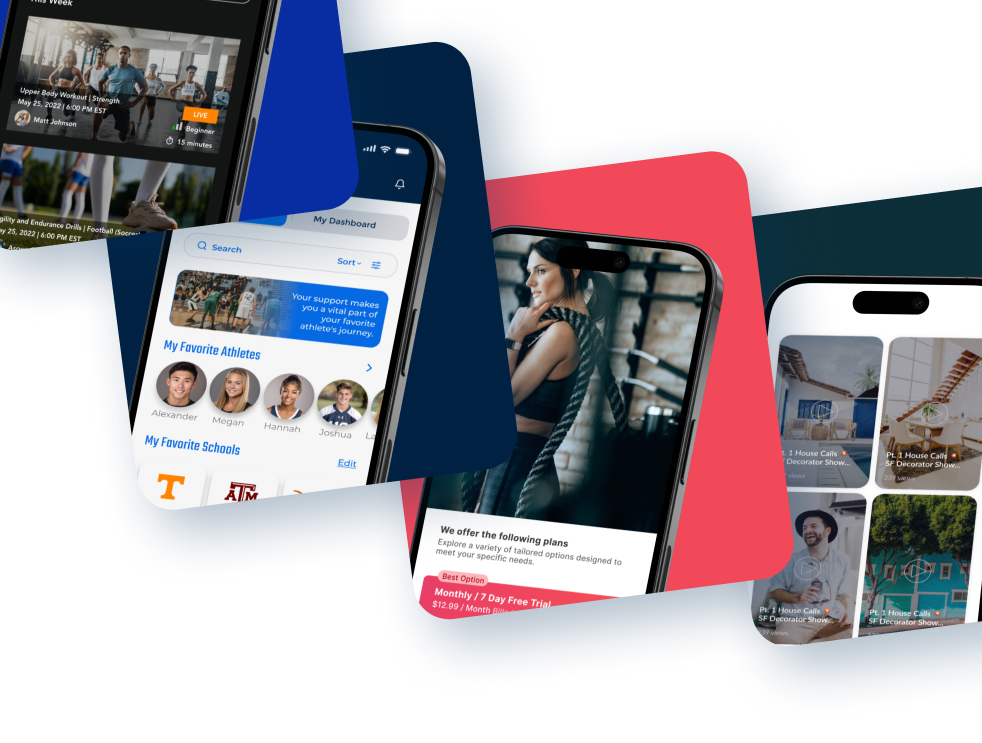
Chop Dawg has built streaming apps for fitness platforms, educational institutions, and entertainment companies. We understand the full stack: video encoding, CDN architecture, DRM integration, subscription management, and mobile app development. Our typical streaming projects range from $75,000 to $150,000 for a fully functional MVP.
Ready to build your streaming app? Schedule a free 45-minute consultation with Chop Dawg to discuss your content strategy, target audience, and technical requirements.
Frequently Asked Questions
What is the difference between HLS and DASH streaming formats?
HLS (HTTP Live Streaming) is Apple’s protocol, the standard on iOS. DASH (Dynamic Adaptive Streaming over HTTP) is more modern and flexible, supported on Android and web. Most streaming apps implement both for broad device compatibility.
Do I need DRM protection for my streaming content?
If your content is valuable and piracy is a risk, yes. DRM prevents unauthorized copying and sharing. If your content is less valuable or you prioritize user experience, lighter-weight protection may be sufficient. DRM adds complexity and sometimes causes playback issues.
How much does a CDN cost for a streaming app?
CDN costs scale with users and watch time. A typical app with 100,000 users watching 2 hours daily costs $5,000-20,000 per month. CDN costs often become the largest infrastructure expense as the user base grows.
How do I handle subscriptions across iOS, Android, and web?
Create a user account system that links iOS In-App Purchases, Google Play subscriptions, and web purchases to a central user profile. Users log in with an email, and the app validates subscription status across all platforms.
What subscription fee should I charge?
General-interest streaming apps charge $5-15 monthly. Niche streaming (fitness, education, professional development) commands higher prices, $10-30 monthly. Price depends on content quality, audience, and competitive positioning.
Why do streaming apps have high churn rates?
Users face decision paralysis, poor content discovery, and low engagement. Most streaming apps have 30-50% first-month churn and below 20% annual retention. Combat this with personalized recommendations, strong curation, and engagement features.
Should I invest in a custom recommendation engine at launch?
No. Start with simple rule-based recommendations (highest-rated, most-popular, recently-added). After you have users and historical watch data, invest in personalization. A custom recommendation engine requires data science expertise and takes 3-4 months.
What is the average cost to build a streaming app in 2026?
A functional streaming app with mobile clients, CDN architecture, DRM protection, subscription management, and basic recommendations costs $75,000 to $150,000. Ongoing CDN and infrastructure costs add $2,000-25,000 per month.


 19 Min