



































 23 Mins


The travel technology landscape has reached an inflection point. With the global travel and tourism apps market valued at approximately $650 billion in 2024 and projected to reach $3.5 trillion by 2034, choosing the right development partner determines whether your travel app captures market share or gets lost among thousands of competing solutions..
This analysis examines the leading travel app development companies of 2025, evaluates their technical capabilities and track records, and provides the decision framework you need to select a partner aligned with your business objectives.
Considering building a travel app that stands out in today’s competitive landscape? Explore how Chop Dawg’s development expertise has helped startups and established brands launch successful travel platforms with proven results.
5 Leading Travel App Development Companies for 2025
1. Chop Dawg: Full-Stack Development with Strategic Partnership Approach
Chop Dawg has established itself as a premier development partner for startups and established brands seeking comprehensive app development services. Since 2009, the company has delivered over 500 applications across diverse sectors including travel, hospitality, and location-based services.
The company’s differentiation lies in its collaborative partnership model. Rather than functioning as a pure implementation vendor, Chop Dawg embeds specialized project managers, designers, developers, and quality assurance engineers directly into client teams. This structure ensures alignment throughout development cycles and facilitates iterative refinement necessary for travel apps addressing specialized market segments.
Technical capabilities span native iOS and Android development, cross-platform solutions using React Native and Flutter, robust backend engineering, and comprehensive API integration experience. The company maintains transparent fixed-rate monthly pricing structures that provide budget predictability crucial for startups managing limited capital.
Chop Dawg emphasizes complete ownership transfer, ensuring clients maintain full intellectual property rights and technical documentation that supports future development regardless of ongoing partnership status. The company’s portfolio demonstrates experience across multiple travel app categories, from booking platforms to specialized niche applications.
Best For: Niche travel app founders seeking a true development partner who provides strategic guidance alongside technical execution, with transparent pricing and proven experience scaling applications from MVP through growth stages.
Get Your Free 45-Minute App Roadmap
Meet 1-on-1 with our senior product team. We’ll map your MVP or enterprise app and hand you a personalized plan—clear scope, a realistic timeline, and fixed monthly costs—for iOS & Android, web, tablets & wearables, and AI.
2. Orangesoft: Specialized Travel Technology Expertise
Orangesoft brings focused travel technology expertise developed through numerous industry-specific projects. The company’s documented work includes TripMate, a comprehensive travel platform integrating flight bookings, hotel reservations, itinerary planning, and real-time traveler updates.
The TripMate case study demonstrates measurable results: forty percent increase in user engagement within three months of launch and twenty-five percent boost in application-mediated bookings. Orangesoft employs dedicated quality assurance teams conducting rigorous testing protocols to ensure performance under load conditions typical of travel applications experiencing seasonal demand fluctuations.
Best For: Founders prioritizing demonstrated travel industry experience and seeking development partners with established processes for quality assurance and post-launch support.
3. Technext: Product Engineering with Architectural Discipline
Technext positions itself as a full-cycle product engineering company emphasizing robust, data-driven software architecture. The company’s approach emphasizes modular architecture enabling rapid launch without locking clients into rigid systems. This architectural philosophy proves particularly valuable for niche travel apps that may need to pivot features or expand service offerings as they validate market fit.
Technext services encompass custom app development, API integration, cloud DevOps practices, and user interface engineering. The company provides clean documentation and transparent ownership transfer, facilitating independent scaling as client companies mature.
Best For: Travel startups and mid-sized firms seeking scalable MVPs or full products built with disciplined architecture, cost efficiency, and hands-on product expertise.
4. ELEKS: Global Scale with Enterprise Experience
Founded in 1991, ELEKS brings three decades of software development experience to travel technology projects. ELEKS provides comprehensive services including target audience analysis, competitive research, industry trend evaluation, strategic planning, and visual interface design. This breadth proves valuable for founders lacking extensive travel industry experience who benefit from research-backed strategic guidance.
The company’s longevity and enterprise client portfolio suggest mature development processes, established quality protocols, and organizational stability.
Best For: Founders building travel applications requiring enterprise-grade development processes, regulatory compliance expertise, or complex integration with established corporate systems.
5. Cubix: Gaming Technology Applied to Travel Experiences
Cubix specializes in innovative applications leveraging gaming technologies and immersive experiences. Since 2008, the company has delivered travel and tourism applications alongside game development projects.
The company’s expertise in Unity, Unreal Engine, Cocos2d, and Phaser game engines translates into capabilities for travel apps incorporating augmented reality destination previews, virtual tours, or gamification mechanics that increase engagement and retention.
Best For: Founders building travel applications emphasizing visual experiences, gamification mechanics, augmented reality features, or virtual destination exploration as core differentiators.
Critical Evaluation Factors for Niche Travel App Founders
Selecting a development partner requires systematic evaluation:
Relevant Portfolio Experience: Examine completed projects addressing similar technical challenges or user experience requirements. Request detailed case studies explaining the client’s goals, implementation approach, and measurable outcomes.
Technical Stack Alignment: Verify the development company’s expertise matches your application’s technical requirements. Inquire about their approach to performance optimization, battery efficiency, and handling poor network conditions.
Communication Infrastructure: Evaluate the company’s communication practices, project management tools, and availability. Companies offering daily communication via Slack, regular video meetings, and transparent task tracking through tools like Jira demonstrate commitment to collaborative partnerships.
Intellectual Property Protection: Ensure absolute clarity regarding intellectual property ownership. Your development agreement should explicitly state that you own all code, designs, documentation, and other project materials from inception.
Post-Launch Support Structure: Clarify the company’s approach to ongoing maintenance, bug fixes, performance monitoring, and feature iteration. Leading development partners offer structured support agreements including uptime monitoring and rapid response to critical issues.

Cost Considerations for Travel App Development in 2025
Development costs for travel applications vary significantly based on complexity, feature requirements, and team composition.
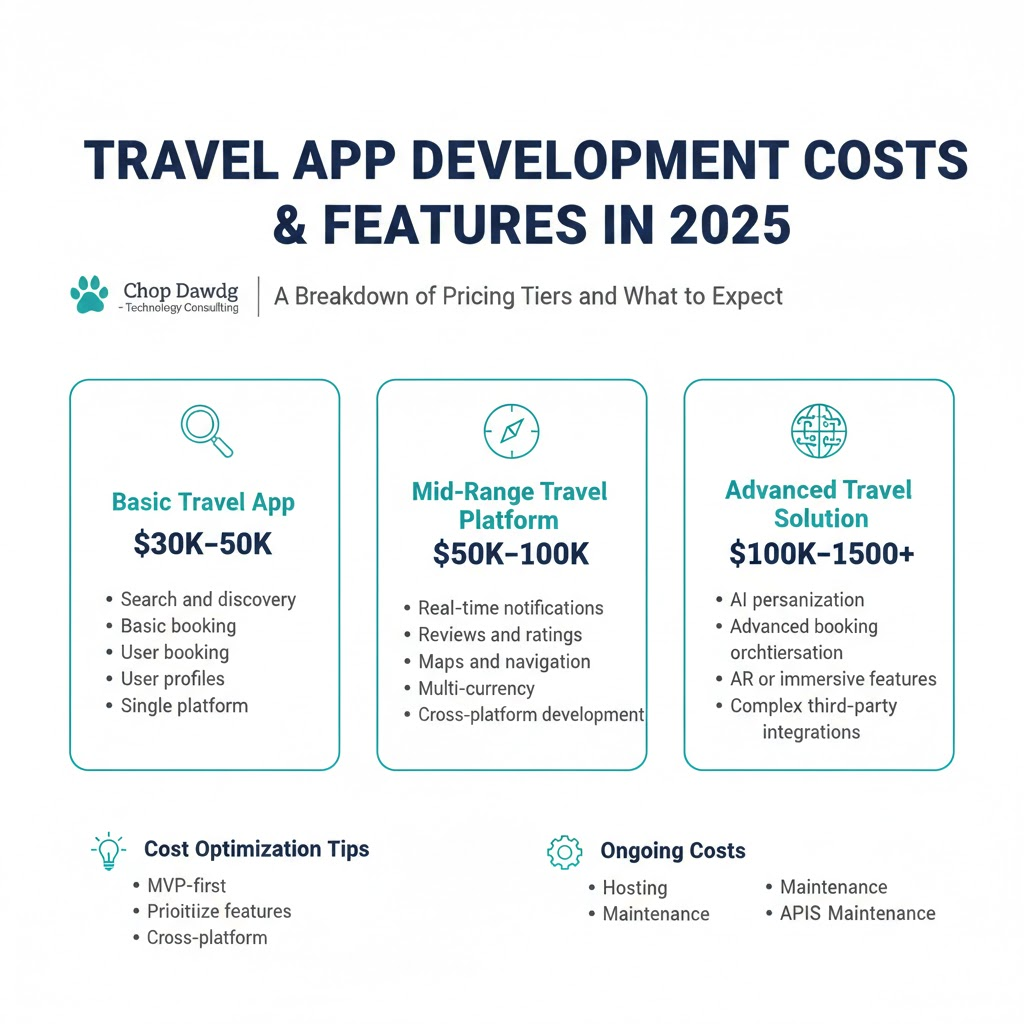
Basic Travel Apps: Simple applications with core features including search functionality, basic booking capabilities, payment integration, and user profiles typically cost between $30,000 and $50,000. These applications usually target a single platform and implement straightforward user interfaces.
Mid-Range Travel Platforms: Applications incorporating advanced features like real-time notifications, user reviews and ratings, maps with navigation, multi-currency support, and personalized recommendations typically range from $50,000 to $100,000. Mid-range platforms often employ cross-platform development approaches using React Native or Flutter, enabling simultaneous iOS and Android launches while managing budget constraints.
Advanced Travel Solutions: Comprehensive platforms featuring AI-powered personalization, complex booking orchestration, sophisticated itinerary management, augmented reality features, and extensive third-party integrations can exceed $100,000 and potentially reach $150,000 or more.
Cost Optimization Strategies: Start with a focused minimum viable product incorporating only essential features. Consider cross-platform development frameworks that share code between iOS and Android platforms. Evaluate development teams across different geographic regions. While U.S.-based developers typically charge between $100-$150 per hour, teams in Eastern Europe average $40-$60 hourly, and South Asian developers range from $15-$30 per hour, according to industry research on development rates.
The Current State of Travel App Development
The travel technology sector has transformed dramatically following industry-wide digital acceleration. User expectations have shifted from basic booking functionality to comprehensive platforms offering personalized itineraries, real-time updates, AI-powered recommendations, and seamless multi-modal transportation planning.
According to research published by Statista, nearly one in four travelers in the United States and Canada now use generative AI for trip planning, a trend accelerating throughout 2025. This adoption pattern forces development companies to rethink fundamental architectural decisions around data processing, personalization engines, and user interface design.
Modern travel applications require robust backend infrastructure capable of handling API integrations with multiple services: flight aggregators like Amadeus and Skyscanner, payment processors including Stripe and PayPal, mapping services from Google Maps and Mapbox, and accommodation platforms ranging from traditional hotel chains to alternative lodging networks.
For niche travel apps targeting specific segments, this technical foundation becomes even more critical. An adventure travel platform needs offline map functionality and emergency contact integration. A sustainable tourism app requires carbon footprint calculators and green certification verification systems. A luxury concierge service demands white-glove user experiences with discreet payment processing.
Data Security and Compliance in Modern Travel Apps
With travelers increasingly sharing sensitive information—passports, payment details, and geolocation data—robust security and compliance frameworks have become non-negotiable in travel app development.
Regulatory Alignment: Travel platforms operating in North America and the EU must comply with frameworks such as GDPR, CCPA, and PSD2, ensuring transparent data collection, secure payments, and opt-in consent for personalized experiences.
Data Encryption Standards: Leading developers implement AES-256 encryption for user data and TLS 1.3 protocols for real-time API communication between booking engines and payment gateways.
Zero-Trust Architecture: Modern development best practices emphasize zero-trust security models, requiring identity verification for every transaction layer and continuous anomaly detection through AI-based monitoring tools like CrowdStrike Falcon and Google Cloud Security Command Center.
Biometric and Tokenized Authentication: Integration of FIDO2 and passkey authentication systems on Android and iOS provides phishing-resistant security that significantly reduces credential-based attacks. Verizon’s 2025 Data Breach Investigations Report identifies credential abuse as responsible for twenty-two percent of breaches, emphasizing the critical need for passwordless authentication solutions.
Incorporating these measures not only protects users but also enhances consumer trust—a decisive factor influencing app-store rankings and long-term user retention.
What Differentiates Elite Travel App Development Companies
Leading companies in 2025 distinguish themselves through several measurable characteristics:
Technical Architecture Expertise: Travel applications operate in demanding environments. Users expect apps to function reliably whether navigating downtown Tokyo with perfect connectivity or exploring remote landscapes with spotty cellular coverage. This requires sophisticated approaches to data caching, offline functionality, and graceful degradation when network conditions deteriorate.
API Integration Depth: Travel apps depend entirely on integration breadth and reliability. Leading development companies maintain established relationships with major travel technology providers, understand the quirks and limitations of various APIs, and architect systems that gracefully handle inevitable integration failures.
User Experience Design for Travel Contexts: Travel app design presents unique challenges. Users interact during periods of heightened stress and cognitive load: rushing through airports, navigating unfamiliar environments, making time-sensitive decisions. The best development companies prioritize information hierarchy that surfaces critical details immediately and implement progressive disclosure to avoid overwhelming users.
Performance Under Real-World Conditions: Travel apps must perform flawlessly across diverse network conditions, device types, and geographic locations. Top-tier development partners conduct extensive testing across representative device matrices and network conditions, implement performance monitoring that identifies issues before they impact users, and optimize applications for battery efficiency.
Essential Features for Travel Apps in 2025
Travel applications compete in a mature market where users expect comprehensive functionality as baseline requirements.
Intelligent Search and Filtering: Users expect search functionality that understands natural language queries, applies contextual filters based on preferences and past behavior, and surfaces relevant results rapidly. Modern travel apps implement AI-powered search that interprets vague queries and learns from user behavior, according to research on AI personalization in travel apps.
Seamless Booking Workflows: Friction during booking processes directly impacts conversion rates. Leading travel apps minimize steps required to complete transactions, support multiple payment methods, and provide clear confirmation and itinerary management.
Real-Time Updates and Notifications: Travelers depend on timely information about flight changes, weather conditions, local events, and booking modifications. Sophisticated travel apps personalize notification frequency and content based on user preferences, time zones, and itinerary stages.
Offline Functionality: Network connectivity remains unreliable across much of the world’s geography. Essential offline capabilities include cached itineraries, downloadable maps, saved confirmation details, and core navigation features.
Personalization Engines: Modern travelers expect applications that adapt to their preferences, learn from their behavior, and surface recommendations aligned with their interests. Niche travel apps leverage personalization to reinforce their specialized positioning.
Preparing for Your Development Partner Selection
Maximize your development partnership’s success probability through structured preparation:
Define Your Core Value Proposition: Articulate precisely what makes your travel app different from existing solutions. Identify the specific traveler segment you’re serving, the particular pain points you’re addressing, and why users would switch from established alternatives.
Document Your Must-Have Features: Create a prioritized feature list distinguishing between capabilities essential for launch versus those that can follow in subsequent releases. This discipline prevents scope creep and manages budget effectively.
Research Your Technical Requirements: Understand the APIs, data sources, and third-party services your application requires. This research enables informed discussions with development partners about integration complexity and potential limitations.
Establish Your Budget Parameters: Determine realistic budget ranges accounting for development costs, third-party service fees, infrastructure expenses, and working capital. Development companies can adjust scope and technical approaches when budget constraints are transparent.
Making Your Final Decision
Selecting a development partner represents one of the most consequential decisions niche travel app founders make. The right partnership accelerates time-to-market, delivers technical quality that attracts and retains users, and provides strategic guidance that increases success probability.
Evaluate potential partners systematically across the criteria outlined above. Request proposals from multiple companies, conduct reference calls with their past clients, and assess cultural fit alongside technical capabilities.
Ready to transform your travel app vision into a market-ready product? Schedule a consultation with Chop Dawg to discuss your specific requirements and explore how our proven development process can accelerate your journey from concept to launch.
Frequently Asked Questions
How long does travel app development typically take?
Development timelines vary based on application complexity and feature scope. Simple travel apps with core functionality typically require three to six months from project initiation through launch. Mid-range platforms incorporating advanced features often need six to nine months. Comprehensive travel solutions with extensive integrations may extend eight to twelve months or longer.
Should I build native apps or use cross-platform development?
The decision depends on your specific requirements, budget constraints, and timeline expectations. Native development delivers optimal performance and access to platform-specific features but requires separate iOS and Android codebases, effectively doubling development costs. Cross-platform frameworks like React Native and Flutter enable code sharing between platforms, reducing costs by thirty to forty percent while delivering near-native performance suitable for most travel applications.
What ongoing costs should I budget for after launch?
Plan for several ongoing expense categories beyond initial development. Cloud infrastructure hosting typically costs $200-$2,000 monthly depending on user scale. Third-party API subscriptions for services like mapping, payments, and travel inventory can range from $500-$5,000 monthly based on usage volumes. Maintenance and updates generally cost fifteen to twenty percent of initial development annually.
How do I protect my intellectual property?
Ensure your development agreement explicitly transfers complete intellectual property ownership to your company from project inception. Reputable development partners provide comprehensive code repositories, documentation, and architectural materials enabling future development independent of ongoing partnership. Request regular code deliveries throughout development rather than waiting until project completion.
What’s the most important factor when choosing a development company?
No single factor determines partnership success, but communication quality and cultural alignment prove consistently critical. Technical capabilities matter, but numerous companies possess adequate technical skills. The differentiating factor lies in how effectively partners collaborate, adapt to inevitable changes, and maintain alignment on objectives throughout development cycles.
Should I start with an MVP or build a comprehensive platform?
Start with a focused minimum viable product incorporating only essential features necessary to validate your core value proposition. This approach enables faster market entry, earlier user feedback informing product decisions, and preserved capital for marketing and operations. Most successful travel apps evolved through iterative enhancement based on actual user behavior rather than comprehensive upfront feature development.
How important is the development company’s location?
Location matters primarily for communication coordination and cost considerations rather than capability differences. Modern development practices enable effective remote collaboration across time zones through structured communication protocols and project management tools. U.S.-based companies typically charge premium rates but offer time zone alignment. International development teams can deliver exceptional quality at reduced costs but may require asynchronous communication practices.
What questions should I ask potential development partners?
Request specific examples of travel applications they’ve developed, including detailed technical challenges encountered and solutions implemented. Ask about their approach to handling API failures, optimizing performance under poor network conditions, and implementing offline functionality. Inquire about post-launch support structures, bug resolution timeframes, and processes for prioritizing feature requests. Request references from past clients at similar development stages addressing comparable market segments.




 18 Mins