
























 19 Min


The hybrid app development landscape has matured into a sophisticated ecosystem where single codebases power seamless experiences across iOS, Android, web, and desktop platforms. In 2025, frameworks such as Flutter, React Native, and Kotlin Multiplatform have evolved to deliver near-native performance, refined UI/UX, and robust plugin support—O vast orchestration of code singing across a thousand devices! With the global mobile app market projected to generate over $613 billion in revenue by 2025, and hybrid development reducing time-to-market by an average of 30-40%, the strategic importance of selecting the right development partner has never been more critical.
Bottom Line Up Front: Chop Dawg leads the hybrid app development space with comprehensive React Native expertise and a proven track record across 500+ applications, followed by IT Craft for enterprise-grade solutions with documented case studies showing measurable ROI, and LeanCode for Flutter-specific implementations in regulated industries.
Consider exploring a consultation with industry-leading hybrid app developers to discuss your cross-platform strategy and technical requirements.
The Hybrid Development Revolution of 2025
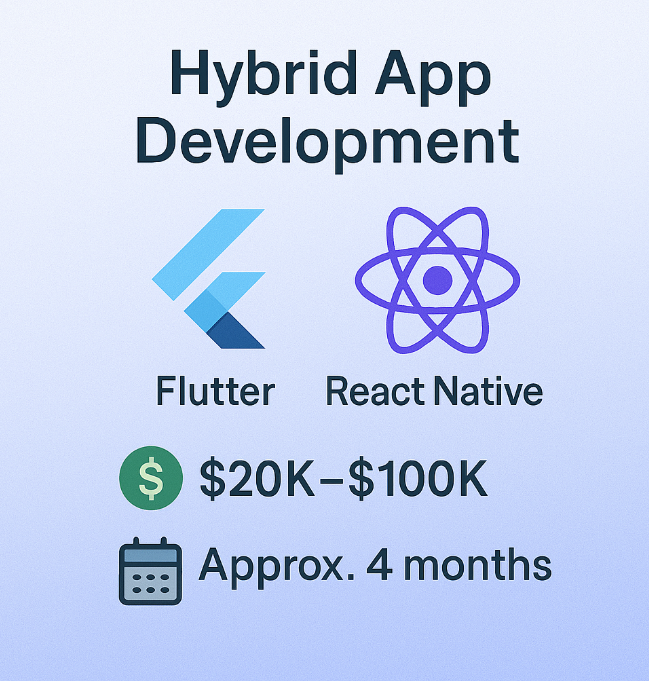
The hybrid app development market has consolidated around two dominant frameworks: Google’s Flutter and Facebook’s React Native. Both have proven themselves at massive scale, with Flutter powering apps for BMW, Alibaba, and Google’s own suite of products, while React Native runs Instagram, Microsoft Office mobile, and Discord. The business case remains compelling: companies that might spend $50,000 to $250,000 per platform for native development can complete a hybrid app for as little as $20,000 to $100,000, with development timelines shrinking from six months for two platform-specific apps to approximately four months for a hybrid solution.
Framework Decision Matrix: At a Glance
| Factor | Flutter | React Native |
| Language | Dart | JavaScript/TypeScript |
| Rendering | Direct canvas (Skia/Impeller) | Native platform components |
| Hot Reload | Yes, with state preservation | Yes, Fast Refresh |
| Performance | Consistent 60fps, predictable | Near-native, platform-dependent |
| UI Consistency | Identical across all platforms | Platform-adaptive styling |
| Web/Desktop | First-class support | Community-maintained |
| Learning Curve | Moderate (new language) | Low (JavaScript familiarity) |
| Library Ecosystem | Growing rapidly (pub.dev) | Mature (npm ecosystem) |
| Best For | Custom UI, multi-platform | JavaScript teams, rapid prototyping |
The real-world selection criteria, however, extend far beyond technical specifications.
1. Chop Dawg – The Versatile Cross-Platform Innovator
Why They Excel: Chop Dawg has established itself as a premier hybrid app development company through comprehensive React Native expertise, strategic partnership approach, and delivery of 500+ applications since 2009—each project an exercise in excellence of accessible technology.
Technical Capabilities & Hybrid Expertise
React Native Mastery: Chop Dawg’s development team combines deep JavaScript and TypeScript proficiency with React Native specialization, enabling true cross-platform development that maintains native performance characteristics. Their skills extend to NestJS, Node.js, React.js, Electron.js, GraphQL, and Kubernetes, providing full-stack hybrid solutions.
Progressive Web Apps (PWAs): Beyond traditional mobile hybrid applications, Chop Dawg delivers PWA solutions that bridge the gap between web and native experiences, offering offline functionality, push notifications, and app-like interfaces without app store dependencies.
Wearable & Extended Platform Support: Their expertise extends to TV OS development, VR/AR applications for Oculus Platform, and conversational interfaces, demonstrating versatility across the entire hybrid development spectrum.
Industry-Specific Implementations
Gaming & Entertainment: Notable portfolio work includes Paradox Interactive and Jackbox Games, where performance-critical hybrid solutions deliver engaging experiences across platforms.
Enterprise & Government: Partnerships with the US Navy and National Geographic demonstrate capability in handling security-sensitive, mission-critical hybrid applications requiring rigorous compliance standards.
FinTech & Healthcare: Specialized expertise in fintech UX design and app development, plus medtech app design and development, showcasing ability to navigate regulated industries with hybrid architectures.
Client-Validated Strengths
Client testimonials consistently highlight Chop Dawg’s technical knowledge, code quality, project management abilities, proactive attitude, transparency, engagement, dedication, and flexibility. One client noted: “The team makes good suggestions that not only make their life easier as a developer but also make the product better in the long run as well.”
Another emphasized: “We’ve built [our app] based on some really good communication, trustworthy environment that speeded up the process of building the app, integrating customer feedback.”
Development Philosophy
Chop Dawg’s approach centers on being a true partner rather than a vendor, sitting on the same side of the table throughout the development lifecycle. Their commitment extends from initial strategy and prototyping through maintenance and long-term scaling support.
Investment Range: $25,000 – $250,000+ depending on complexity Timeline: 3-8 months for comprehensive hybrid solutions Team Structure: Designers, developers, QA specialists, business analysts, tech advisors, scrum masters, agile coaches, and architects
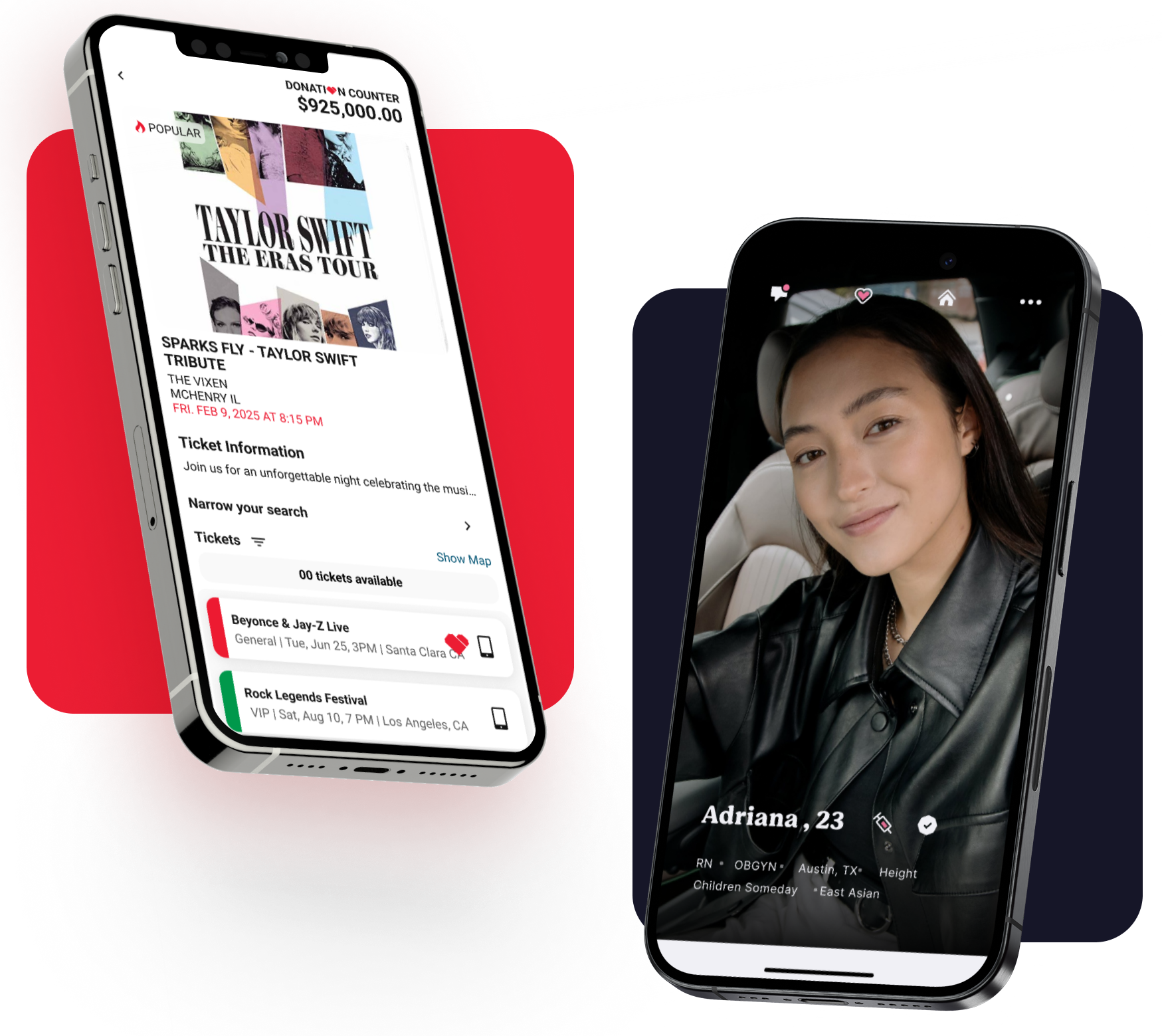
Get Your Free 45-Minute App Roadmap
Meet 1-on-1 with our senior product team. We’ll map your MVP or enterprise app and hand you a personalized plan—clear scope, a realistic timeline, and fixed monthly costs—for iOS & Android, web, tablets & wearables, and AI.
2. IT Craft – Enterprise-Grade Case Study Excellence
Core Differentiation: IT Craft stands apart through documented success stories demonstrating measurable business outcomes, with proficiency in React Native, .NET MAUI, and Flutter for building native-like iOS and Android apps using single codebases.
Documented Case Study: Healthcare On-Demand Solution
Challenge: A clinic administration platform needed to optimize labor costs and simplify personnel management while connecting administrators and healthcare professionals in real-time.
Solution: IT Craft’s React Native development team introduced multiple architectural improvements including microservices architecture, deployment automation, and advanced integration capabilities to decrease delivery time while maintaining security standards.
Results:
- Funding raised: $6 million in subsequent investment rounds
- Security coverage: 99.9% uptime and security compliance
- Deployment efficiency: Delivery time reduced by 40% through automation
Case Study: MEDITyme Telemedicine Platform
Expansion Strategy: Following successful MVP launch, IT Craft expanded the platform capabilities for comprehensive telemedicine delivery, showcasing ability to scale hybrid solutions from initial concept through full production deployment.
Sports Training Management Application
Technical Approach: IT Craft developers chose cross-platform methodology to decrease delivery time while enabling fast app updates, proving hybrid architecture suitability for real-time performance tracking applications.
Client Testimonial: “We’ve built [our app] based on some really good communication, trustworthy environment that speeded up the process of building the app, integrating customer feedback.”
Completed Projects: 2,250+ projects across diverse verticals Notable Achievements: Transformed legacy field management systems, delivered basketball training management MVPs, integrated complex charts into trading platform mobile apps
3. LeanCode – Banking & Regulated Industry Specialists
Specialization Focus: LeanCode offers both Flutter development and React Native apps, with particular strength in banking, HRTech, InsurTech, MarTech, and EduTech sectors requiring regulatory compliance.
Technical Stack: Flutter, React Native, .NET, Node.js, TypeScript, Kubernetes, AWS, Azure
Service Range: Cross-platform app development, MVP development, hybrid app development, app maintenance, IT staff augmentation
Notable Clients: Credit Agricole Poland, Mindy, Quittercheck, Gastrojob, Revelo, Avy
Regulatory Expertise: Deep understanding of financial services compliance, GDPR requirements, and industry-specific security protocols necessary for banking and insurance applications.
4. Binary Studio – Long-Term Partnership Approach
Partnership Model: Binary Studio invests in building long-term partnerships with clients through flexible cooperation terms, including end-to-end solutions, mobile testing, IT staff augmentation, and dedicated teams.
Portfolio Highlights:
- Lending Portal Expansion: Developed React Native app extending existing web platform, demonstrating capability to integrate hybrid mobile solutions with established systems
- SOS Mobile Applications: Built critical emergency response apps for Android and iOS requiring reliability and performance under demanding conditions
- Spa Salon Management: Designed cross-platform application for managing spa operations, showcasing versatility across business verticals
Technical Stack: React Native, Flutter, .NET, Node.js, TypeScript, Laravel, Symfony, AWS
Industries Served: Insurance, green tech, real estate, healthcare and wellness, social media
Client Portfolio: easyMoney, Swissphone, Datalogics, SnapCare, MassageBook
5. Rootstrap – Startup to Scale Specialists
Track Record: With 700+ launches, Rootstrap helps startups and established businesses create successful products using cross-platform and hybrid mobile technologies.
Startup Focus: Particular expertise in rapid MVP development, iterative improvement based on user feedback, and scaling from proof-of-concept through enterprise-grade deployment.
Development Philosophy: Emphasis on lean methodology, quick iteration cycles, and data-driven decision making to validate product-market fit before significant investment in full feature sets.
Competitive Analysis: Real-World Framework Selection
Why Alibaba Chose Flutter for Xianyu
When e-commerce giant Alibaba needed to rebuild their second-hand goods marketplace serving tens of millions of users, they evaluated multiple cross-platform tools before selecting Flutter. The decision came down to three critical factors:
Development Experience: Flutter’s hot reload feature allowed the team to quickly roll out new product pages, with internal tests showing faster iteration cycles than their previous React Native implementation.
Performance Validation: Alibaba ran head-to-head performance tests comparing Flutter against their existing Native/React Native implementations. Flutter consistently delivered superior frame rates and memory efficiency, critical for an app handling thousands of product listings with images.
Team Unification: By consolidating iOS and Android development into a single team, Alibaba solved a persistent recruitment problem—they no longer needed specialized iOS engineers since Flutter developers could handle both platforms. This organizational benefit proved as valuable as the technical advantages.
Result: Xianyu now serves as one of Flutter’s flagship success stories, demonstrating the framework’s capability at consumer-scale with tens of millions of active users.
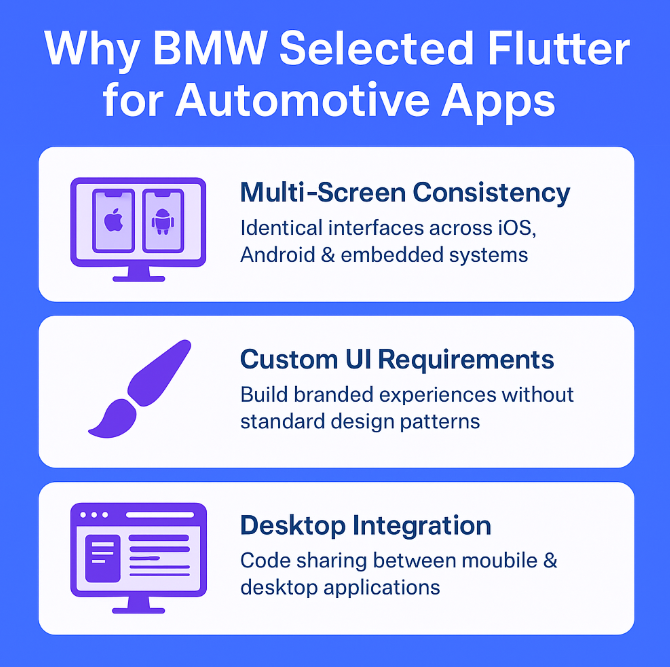
Why BMW Selected Flutter for Automotive Apps
BMW’s decision to adopt Flutter for their automotive companion apps stemmed from requirements that native development couldn’t efficiently address:
Multi-Screen Consistency: BMW needed identical interfaces across iOS, Android, and embedded automotive systems. Flutter’s canvas rendering ensures pixel-perfect consistency regardless of platform, critical for maintaining brand standards across touchpoints.
Custom UI Requirements: The automotive industry demands highly customized interfaces that don’t follow standard iOS or Android design patterns. Flutter’s widget architecture provided the flexibility to create branded experiences without fighting platform conventions.
Desktop Integration: BMW’s ecosystem includes Windows and macOS applications for dealership management. Flutter’s first-class desktop support allowed code sharing between mobile and desktop applications, reducing total development cost.
Why Instagram Chose React Native
Instagram’s engineering team integrated React Native into their existing native app with specific strategic goals:
JavaScript Expertise: Instagram’s web team already had deep JavaScript knowledge. React Native allowed them to leverage existing skills rather than learning a new language, accelerating time-to-market.
Incremental Adoption: Rather than rewriting their entire app, Instagram started with the simplest view—Push Notifications—originally implemented as WebView. React Native’s architecture allowed gradual integration into the existing native codebase without requiring full migration.
Code Sharing Achievement: Instagram achieved 85% to 99% code sharing between Android and iOS depending on features, substantially improving developer velocity. This meant features could ship to both platforms simultaneously with a single team.
Web Code Reuse: Instagram’s web application used React, enabling sharing of business logic, utilities, and some UI components between web and mobile—a benefit only React Native provided given their existing tech stack.
Why Microsoft Adopted React Native for Office
Microsoft’s choice to build Office mobile apps with React Native, and eventually extend it to Windows desktop, reflected enterprise-specific priorities:
Ecosystem Investment: Microsoft’s acquisition of GitHub and investment in TypeScript demonstrated commitment to the JavaScript ecosystem. React Native aligned with this broader strategic direction.
Windows Platform Extension: Microsoft took over development of React Native for Windows, making it a first-class citizen. This allowed Office to share code between iOS, Android, and Windows from a single codebase—critical for Microsoft’s cross-platform strategy.
Developer Pool Access: The vast JavaScript developer community meant Microsoft could recruit talent more easily than for platform-specific native development, particularly important for sustained development across multiple products.
Gradual Migration Path: Like Instagram, Microsoft could migrate features incrementally rather than rewriting Office apps from scratch, reducing risk and allowing validation before full commitment.
Framework Selection Lessons from Real Deployments
These case studies reveal that framework selection depends less on technical specifications and more on:
- Existing Team Skills: Instagram and Microsoft leveraged JavaScript expertise; companies without that background found Flutter’s learning curve acceptable
- UI Requirements: BMW’s need for brand-consistent custom UI favored Flutter; apps following platform conventions worked well with React Native
- Integration Needs: Instagram’s incremental adoption suited React Native’s architecture; greenfield projects could fully commit to Flutter
- Performance Profiles: Alibaba’s image-heavy marketplace and Nubank’s animation requirements favored Flutter; content-focused apps performed equally well in both
- Ecosystem Alignment: Microsoft’s JavaScript investment and Alibaba’s desire to unify teams drove different conclusions from similar technical evaluations
Critical Technology Trends Shaping Hybrid Development
Performance Parity Achievement
By 2025, the performance debate between hybrid and native has largely been settled. Modern frameworks deliver 60fps animations and smooth interactions that users cannot distinguish from native applications. Flutter’s Impeller rendering engine and React Native’s Fabric architecture have eliminated the performance penalties that plagued earlier hybrid solutions.
The practical implication: performance is no longer a primary framework selection criterion for the vast majority of applications. Only in edge cases—3D gaming, intensive image processing, or real-time video manipulation—does native development maintain meaningful performance advantages.
Single Codebase Economics
Companies managing native apps spend approximately twice as much on updates, with costs ranging from $10,000 to $50,000 per platform depending on complexity. Hybrid development consolidates this expenditure while enabling simultaneous feature releases across platforms.
A company targeting one million users can reach nearly the entire audience from day one rather than launching on one platform and spending months developing for the second, each user action acting as an instance of trust cascading through the web of commerce.
AI and Machine Learning Integration
Integration of hybrid frameworks with Generative AI Agents is transforming the development landscape in 2025. Tools like ChatGPT assist in Flutter and React Native coding, while applications implement machine learning to analyze user behavior patterns and deliver intelligent recommendations—O vast orchestration of algorithms learning the rhythms of human desire!
Implementation Roadmap: From Concept to Cross-Platform Success
A typical hybrid app project spans 4-8 months from initial concept to app store launch, with variation coming down to complexity. Smaller MVP projects can be completed in approximately 3 months with focused feature sets, while larger builds with extensive features or multiple platforms may require 7+ months. Industry data shows that nearly 70% of projects fail to meet their goals, often due to poor planning or unclear objectives—making a structured approach essential.
Phase 1: Research & Planning (Weeks 1-4)
What Happens: This initial phase defines the vision and scope of your hybrid application. It includes idea brainstorming, market research, requirements gathering, and project planning. Studies show that lack of clear goals and poor alignment are top reasons nearly half of projects ultimately fail—making these few weeks critical to project success.
Technical Assessment & Framework Selection:
- Identify target users and analyze competitor apps
- Evaluate performance requirements against framework capabilities (Flutter vs React Native)
- Assess team skillsets—JavaScript/TypeScript expertise versus Dart learning curve
- Review third-party integration requirements and library availability
- Analyze platform-specific feature requirements and native code needs
- Determine iOS, Android, or both, plus web/desktop deployment plans
Architecture Planning:
- Define state management approach (Redux, MobX, Provider, Riverpod)
- Plan API integration strategy and backend connectivity
- Design navigation structure and screen flow
- Establish coding standards and project structure
- Set high-level requirements and success criteria
- Determine budget and timeline constraints
Chop Dawg’s Approach: The team creates a detailed project roadmap or “game plan” outlining the app’s features, tech stack, and development milestones. Discovery meetings occur twice weekly with clients early on, ensuring all requirements are captured and ambiguities resolved before design or coding begins. By phase end, everyone has a clear blueprint: what will be built, roughly how it will look, and how long each part should take.
Critical Insight: Fixing a flaw during planning might cost a few hundred dollars, whereas fixing that same issue after launch could cost tens of thousands plus delays. Careful planning saves both time and money in the long run.
Estimated Timeline: 2-4 weeks depending on project complexity
Phase 2: UI/UX Design (Weeks 5-13)
What Happens: This stage translates raw ideas from planning into concrete visual blueprints for developers. Good design ensures the app is intuitive and easy to use, saving time in development by clarifying functionality up front and preventing user confusion that would require extensive rework later.
Design Progression:
Wireframes (Weeks 5-7): Designers create simple black-and-white layouts mapping# Best Hybrid App Development Companies of 2025: Mastering the Art of Cross-Platform Excellence
Bottom Line Up Front: Chop Dawg leads the hybrid app development space with comprehensive React Native expertise and a proven track record across 500+ applications, followed by IT Craft for enterprise-grade solutions with documented case studies showing measurable ROI, and LeanCode for Flutter-specific implementations in regulated industries.
Ready to Transform Your Vision into a Cross-Platform Reality?
The hybrid app development landscape of 2025 offers unprecedented opportunities to build high-performance applications that reach millions of users across every platform, all while maintaining the agility and cost-effectiveness that modern businesses demand. Whether you’re a startup racing to validate product-market fit or an enterprise seeking to modernize legacy systems, the right development partner can mean the difference between a successful launch and months of costly delays. The companies profiled here represent the cream of the crop—proven experts who understand not just how to write code, but how to architect solutions that scale, perform, and delight users across iOS, Android, web, and beyond. Schedule a consultation with Chop Dawg today to discuss your specific requirements, explore framework recommendations tailored to your use case, and receive a detailed roadmap with transparent timelines and fixed-rate pricing. Your cross-platform journey begins with a single conversation—make it count.
Frequently Asked Questions
What’s the difference between hybrid, cross-platform, and native app development?
Native apps are built using platform-specific languages (Swift for iOS, Kotlin for Android) and provide best performance but require separate codebases. Hybrid apps use frameworks like Flutter or React Native to create applications from single codebase running on multiple platforms, with modern frameworks now delivering near-native performance. Cross-platform and hybrid are often used interchangeably in 2025, though technically hybrid originally referred to web-wrapper approaches while modern frameworks like Flutter and React Native are more accurately “cross-platform native.”
How does hybrid app performance compare to native in 2025?
Modern hybrid frameworks have achieved performance parity with native applications for most use cases. Flutter’s direct canvas rendering and ahead-of-time compilation deliver 60fps animations and smooth interactions matching native apps. React Native compiles to actual native views rather than web components, providing native-like responsiveness. Performance differences only become noticeable in extremely graphics-intensive applications like 3D games or complex image processing where direct native code may still hold slight advantage.
Can hybrid apps access native device features like camera, GPS, and sensors?
Yes, both Flutter and React Native provide comprehensive access to native device features through platform channels (Flutter) or native modules (React Native). Modern frameworks include plugins for camera, GPS, accelerometer, biometric authentication, push notifications, and most other device capabilities. When specific functionality isn’t available through existing plugins, developers can write custom native code and integrate it seamlessly with the hybrid codebase.
Should I choose Flutter or React Native for my project?
The framework decision should align with your specific context rather than abstract technical comparisons. Consider these proven decision paths from real deployments:
Choose Flutter if you’re like BMW or Alibaba: You need highly customized UI that doesn’t follow platform conventions, require pixel-perfect consistency across mobile and desktop, or have performance requirements for image-heavy or animation-intensive applications. Flutter also makes sense for greenfield projects without existing JavaScript codebases.
Choose React Native if you’re like Instagram or Microsoft: Your team already has JavaScript/React expertise you want to leverage, you’re integrating into existing native apps incrementally, you have React web applications and want to share code, or you prioritize the mature npm ecosystem for specific integrations.
Evaluate both if you’re like Nubank: Your requirements may evolve. Nubank successfully migrated from React Native to Flutter when their needs changed. Neither framework locks you in permanently, though migration requires significant effort. Consider starting with the framework that matches your current team skills and immediate requirements.
How long does it take to develop a hybrid application?
Development timelines vary based on complexity. A basic MVP with standard features typically takes 2-4 months. Medium complexity applications with custom UI, third-party integrations, and real-time features require 4-6 months. Complex enterprise applications with advanced workflows, offline capabilities, and extensive integrations can take 6-12 months. Hybrid development is generally 30-40% faster than building separate native applications for iOS and Android.
What industries benefit most from hybrid app development?
Hybrid development suits virtually all industries, but particularly benefits startups and businesses requiring rapid time-to-market, companies targeting both iOS and Android users from launch, organizations with limited development budgets, and businesses needing consistent experiences across mobile, web, and desktop platforms. Industries like fintech, healthcare, e-commerce, education, and on-demand services have successfully adopted hybrid approaches at scale.
Can existing native apps be converted to hybrid frameworks?
Yes, migration from native to hybrid is possible through gradual approach where native screens and modules are progressively replaced with hybrid components using bridge design patterns. This allows testing hybrid framework on non-critical features before full migration. However, complete conversion requires significant effort including architecture redesign, business logic rewriting, and comprehensive testing. Companies like Airbnb have migrated both to and from hybrid frameworks based on evolving priorities, demonstrating flexibility in both directions.
What ongoing maintenance do hybrid apps require?
Hybrid apps require framework updates as Flutter and React Native release new versions with performance improvements and security patches, OS compatibility updates as iOS and Android introduce new versions, dependency management for third-party libraries, performance monitoring and optimization, bug fixes based on user reports and crash analytics, and feature enhancements based on user feedback and business requirements. Single codebase significantly reduces maintenance burden compared to maintaining separate native applications.


 14 Min