





































 27 Mins


The financial technology sector stands at a critical juncture. With the global fintech app development market projected to reach $305 billion by year’s end and cybercrime damage approaching $10.5 trillion annually, selecting the right development partner determines whether your application succeeds or fails in a highly regulated, security-conscious market.
For niche fintech founders, this challenge intensifies. Traditional developers lack the specialized expertise required for payment processing, regulatory compliance, and security architecture. Your development partner becomes either your competitive advantage or your critical vulnerability.
This analysis examines what distinguishes exceptional fintech developers, evaluates their technical capabilities, and provides the framework needed to select a partner aligned with your vision and regulatory requirements.
Ready to transform your fintech concept into market-ready software? Explore how Chop Dawg’s experienced developers bring proven fintech expertise, regulatory knowledge, and transparent development processes to secure financial platforms.
1. Abdullah Khan — Developer
Abdullah specializes in building secure and scalable fintech applications. He focuses on integrating payment gateways, real-time transactions, and financial data management systems while ensuring apps remain performant, compliant, and user-friendly.
2. Faisal Hameed — Developer
Faisal brings expertise in full-stack development for fintech apps, implementing features such as account management, analytics dashboards, and API integrations with banks and financial services. He prioritizes security, reliability, and smooth user experiences in complex financial workflows.
3. Christopher Curtin — Developer
Christopher focuses on backend and frontend systems for fintech applications, ensuring sensitive financial operations are handled efficiently and safely. His work supports features like transaction processing, reporting, and authentication, making apps robust and scalable for growing financial products.
The Current Fintech Development Landscape
Market Opportunity and Complexity
More than 6.92 billion individuals—representing 86% of the world’s population—now own smartphones, driving explosive growth in mobile banking and digital payments. In the United States, 55% of consumers prefer mobile banking apps as their primary banking channel. This creates opportunities for specialized fintech applications targeting underserved segments.
The embedded finance market demonstrates particularly strong growth, expected to reach $588 billion by 2032. This trend enables non-financial platforms to integrate lending, payments, and insurance directly into their core offerings—creating possibilities for niche fintech founders building specialized solutions.
Why Developer Selection Matters More in Fintech
Unlike consumer apps, fintech applications operate within strict regulatory frameworks. PCI DSS, GDPR, DORA, and emerging regulations like MiCAR aren’t optional—they’re foundational. Developers without specialized fintech experience often build architectures requiring expensive rewrites to achieve compliance.
Security isn’t an add-on feature. The average fintech data breach costs $5.9 million. Your development partner’s architectural decisions determine whether your platform becomes a target or a fortress.
Meet Chop Dawg’s Fintech-Specialized Developers
Iqbal Shezada: Fintech Architecture & Regulatory Compliance
With 25+ years of senior engineering leadership and finance sector background, Iqbal brings the architectural vision essential for secure, compliant fintech platforms. His expertise directly addresses fintech’s core challenge: building systems that satisfy both users and regulators simultaneously.
For Fintech Apps Specifically:
Event-Driven Transaction Architecture: Iqbal designs systems using Kafka or AWS Kinesis enabling real-time transaction processing, immutable audit trails, and reactive scaling. This approach prevents duplicate charges through idempotency keys and enables asynchronous reconciliation reducing error states.
Microservices Security Model & Zero-Trust Networking: He architectures services by function (authentication, payments, KYC, fraud detection) with least-privilege IAM policies enforcing zero-trust networking. Every request—even internal—is verified, preventing the lateral movement that characterizes sophisticated breaches.
Compliance by Design: Rather than bolting compliance onto existing architecture, Iqbal bakes it in from day one. His systems implement:
- PCI DSS Level 1 requirements (AES-256 encryption at rest, TLS 1.3 in transit) for any card data
- GDPR data flow maps supporting Right to Erasure and immutable access logging
- DORA IT risk management and third-party oversight frameworks
- PSD2 SCA and Open Banking API readiness for EU/UK platforms
Continuous Monitoring & Observability: Iqbal implements observability stacks (OpenTelemetry) tracking transaction duration, failure rates, and latency. SLAs he establishes: API 99.9% uptime, payment processing under 150ms, fraud detection alerts under 2 seconds.
Vendor Risk Management: He maintains third-party provider inventories, enforces SOC 2 Type II requirements, and includes service-level clauses covering data-leak events, breach notification (≤72 hours), and source code escrow.
Why fintech founders need this: Most developers understand payment processing. Iqbal understands the regulatory-technical intersection: how architectural decisions impact compliance audits, how event-driven systems enable regulatory reporting, how zero-trust networking prevents the breaches that destroy fintech companies.
Moeed Farooq: User Experience in High-Stress Transactions
As a core developer at Chop Dawg, Moeed specializes in the user experience side of fintech: designing interfaces where users transfer significant funds, make investment decisions, or resolve billing concerns with confidence and clarity. Financial app design presents unique challenges requiring exceptional UX discipline.
For Fintech Apps Specifically:
Information Architecture Under Pressure:
Moeed designs interfaces surfacing critical details immediately. During fund transfers, users see destination verification prominently. During investment decisions, risk metrics appear before execution. This information hierarchy prevents costly user errors.
Task Completion Optimization:
He structures user workflows minimizing steps to critical actions while preserving necessary verification. Authentication feels seamless, not burdensome. Multi-factor authentication integrates naturally rather than creating friction.
Performance Under Real-World Conditions:
Moeed conducts extensive testing across diverse network conditions, device types, and geographic locations. His React and React Native implementations handle poor connectivity gracefully, implementing offline-first architectures enabling transaction queuing when connectivity fails.
Accessible Financial Interfaces:
He designs for diverse user backgrounds and financial literacy levels. Complex concepts become clear. Edge cases get handled thoughtfully. Users understand exactly what transactions cost and what they’ll receive.
API Integration Architecture:
Moeed architects systems gracefully handling integration failures with major payment providers, identity-verification services, and banking systems. Retry logic, fallback mechanisms, and comprehensive error handling ensure user experience remains smooth even when upstream services degrade.
Why fintech founders need this:
Beautiful interfaces don’t move money. But clear, trustworthy interfaces drive adoption. Users choose fintech apps based on confidence and ease. Moeed builds interfaces generating both.
Wikram Das: Full-Stack Fintech Infrastructure & Performance
Wikram brings rare full-stack capability spanning frontend, backend, infrastructure, and DevOps—essential for fintech platforms where architectural decisions cascade across every layer. As a full-stack developer, he owns complete systems from user interface through cloud infrastructure.
For Fintech Apps Specifically:
Scalable Backend Architecture:
Wikram designs Node.js or NestJS backends handling transaction volume spikes without degradation. His systems accommodate growth from thousands to millions of daily transactions through horizontal scaling, load balancing, and database optimization.
Real-Time Transaction Processing:
He implements systems processing payments in milliseconds, clearing transactions reliably, and reconciling asynchronously. His approach prevents race conditions, handles concurrent requests safely, and maintains consistency across distributed systems.
Infrastructure for Security & Compliance:
Wikram leverages AWS and Google Cloud security primitives: VPC isolation, encryption keys managed through AWS KMS, automatic patching, and DDoS protection. He containerizes applications using Kubernetes or Fargate with pod isolation and network policy enforcement.
Third-Party Integration Reliability:
He architects systems integrating payment gateways (Stripe, Square), identity verification (IDology, Jumio), and banking APIs with resilience patterns ensuring failures in external services don’t crash your application.
Monitoring, Alerting & SLA Enforcement:
Wikram establishes comprehensive monitoring with SLAs backed by incident response procedures. Transaction latency dashboards, failed transaction analysis, chargeback tracking, and API rate-limit monitoring provide real-time visibility into platform health.
Maintenance & Upgrade Discipline:
He maintains technical debt logs, schedules API version upgrades proactively (avoiding emergency migrations), allocates 15-20% of initial development costs annually for maintenance and security patching. Static code analysis (SAST) and dynamic testing (DAST) flag issues at each sprint.
Why fintech founders need this:
Transaction reliability and performance directly impact revenue. Slow payment processing causes abandoned transactions. Failed transactions create support burden. Wikram’s infrastructure ensures neither happens.
Kainat Sabir: Quality Assurance in High-Stakes Environments
Quality assurance in fintech is fundamentally different from consumer apps. A bug in a game is annoying. A bug in payment processing is a regulatory violation, a financial loss, and a destroyed reputation. Kainat Sabir‘s QA expertise at Chop Dawg addresses this critical reality, working closely with Iqbal, Moeed, and Wikram to ensure financial applications withstand real-world stress.
For Fintech Apps Specifically:
Transaction Integrity Testing:
Kainat designs test suites validating transaction flows under extreme conditions: concurrent payment requests, network interruptions mid-transaction, simultaneous account access, and edge cases where timing matters. Her testing prevents the race conditions and reconciliation failures that destroy financial apps.
Cross-Device and Network Condition Testing:
She conducts comprehensive testing across iOS, Android, and web platforms under diverse network conditions—4G, poor WiFi, network switches mid-transaction, and offline scenarios. Fintech apps must function reliably across all conditions; Kainat ensures they do.
Regulatory Compliance Verification:
Kainat works with developers implementing PCI DSS, GDPR, and DORA requirements. She verifies encryption implementation, confirms data handling follows compliance frameworks, and validates that logging captures audit trails required for regulatory inspections.
Security-Focused Testing:
Beyond functional testing, Kainat conducts penetration testing scenarios identifying vulnerabilities before production. Her testing covers authentication flows, API security, data encryption, and vulnerability scanning for dependencies—catching security issues before they reach users.
Performance Under Load:
Financial platforms must handle transaction spikes—market opens, flash sales, emergency transfers. Kainat conducts load testing verifying applications scale gracefully, maintaining sub-150ms payment processing times and <2 second fraud detection alerts even under peak traffic.
Edge Case Identification:
Financial transactions involve edge cases: currency conversions with rounding, multi-leg transfers, reversals, chargebacks. Kainat identifies these scenarios through merchant research and support ticket analysis, ensuring developers implement handling for all possibilities.
Preventing Production Disasters:
She establishes comprehensive test coverage before launch preventing the scenarios where payment processing breaks, transactions lose money, or regulatory audits fail. Her testing directly protects your company’s financial and legal viability.
Why fintech founders need this:
Developers catch most bugs. But Kainat catches the bugs developers miss—the transaction race conditions, the edge cases with real money at stake, the security vulnerabilities regulators would discover during audits. In fintech, her work isn’t “nice to have”—it’s existential.
Evaluating Developers for Fintech Success
Portfolio Depth in Financial Services
Request detailed case studies of fintech applications they’ve developed. Ask about specific technical challenges (transaction concurrency, regulatory audits, fraud detection) and solutions implemented. Portfolio depth in financial services indicates understanding of industry-specific challenges beyond general software development.
Security and Compliance Expertise
Fintech requires concrete experience implementing PCI DSS, GDPR, DORA, and emerging frameworks. Developers demonstrating theoretical familiarity without implementation experience pose genuine risk. Ask how they’ve achieved compliance certifications, what audits they’ve passed, and how they structure compliance into architecture.
Real-World Performance Understanding
Request examples of how they optimize performance under poor network conditions, implement offline-first functionality, and handle degraded service scenarios. Fintech apps must perform flawlessly across diverse conditions—developers demonstrating these capabilities distinguish themselves.
API Integration Reliability
Ask how they handle failures from payment gateways, banking APIs, and identity-verification services. Retry logic, fallback mechanisms, and graceful degradation matter more than happy-path functionality. Elite developers discuss these scenarios naturally.
Technical Stack Alignment
Verify expertise matches your requirements. Inquire about performance optimization, battery efficiency, poor network handling, and offline functionality. Request production examples demonstrating these capabilities. Confirm experience with your target regulatory frameworks.
Communication Infrastructure
Evaluate daily communication practices (Slack), regular video meetings, and transparent task tracking through Jira. Leading development partners maintain collaborative engagement rather than disappearing into development sprints.
Intellectual Property Protection
Ensure development agreements explicitly state you own all code, designs, documentation, and project materials from inception. Request regular code repository access throughout development rather than waiting until completion.
Post-Launch Support Structure
Clarify the approach to ongoing maintenance, bug fixes, performance monitoring, and feature iteration. Leading developers offer structured support agreements including uptime monitoring, rapid response protocols for critical issues, and clear pricing for post-launch development.
Fintech App Development Economics in 2025
Development Cost Ranges
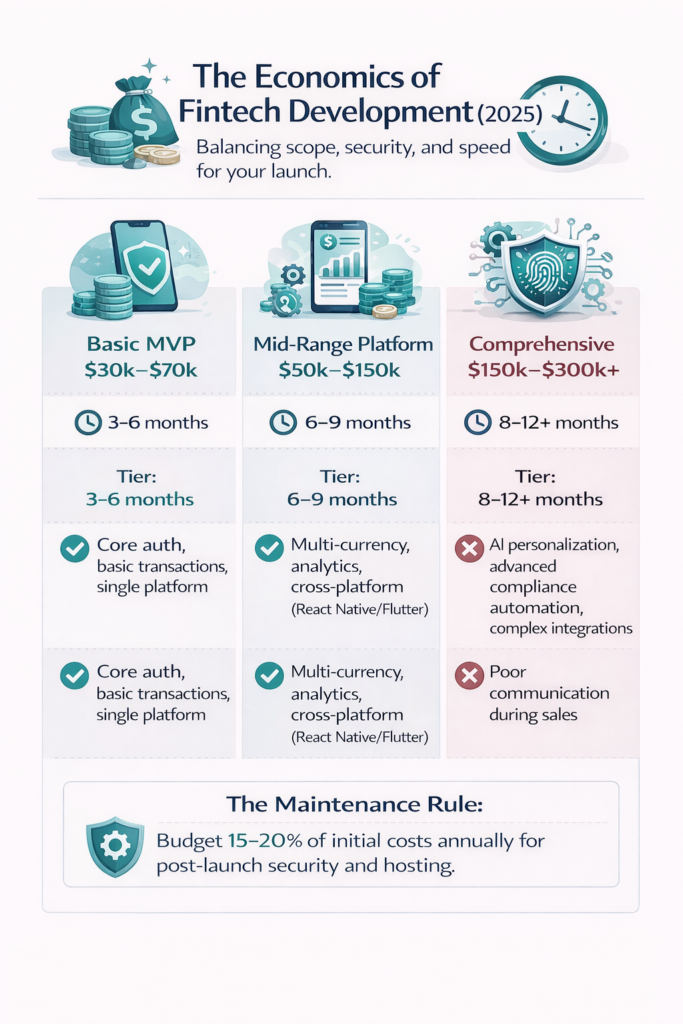
Basic Minimum Viable Products ($30,000-$70,000): Simple applications with user authentication, basic account management, transaction capabilities, and essential security typically targeting a single platform.
Mid-Range Financial Platforms ($50,000-$150,000): Applications incorporating real-time notifications, comprehensive analytics, multi-currency support, and sophisticated user experiences. Often employ cross-platform development using React Native or Flutter, enabling simultaneous iOS and Android launches.
Comprehensive Financial Solutions ($150,000-$300,000+): Sophisticated platforms featuring AI-powered personalization, complex transaction orchestration, advanced compliance automation, and extensive third-party integrations.
Cost Drivers
Security Implementation: Basic authentication adds $5,000-$10,000. Advanced fraud detection can add $40,000-$60,000+. Compliance certifications (SOC 2, PCI DSS) increase costs through architecture hardening and audit preparation.
Regulatory Compliance: GDPR, PCI DSS, PSD2, and DORA requirements increase costs through additional security features, stronger architecture, and compliance automation.
Cost Optimization
Start with a focused MVP incorporating only essential features. Use cross-platform frameworks sharing code between iOS and Android, potentially reducing costs by 30-40%. Evaluate development partners across geographic regions balancing cost and expertise.
Essential Security and Compliance Requirements
Payment Card Industry Data Security Standard
PCI DSS applies to any entity storing, processing, or transmitting credit card data. The framework includes 12 requirements covering network security, data protection, vulnerability management, and regular security monitoring. Compliance levels depend on annual transaction volumes, with Level 1 applying to organizations processing 300,000+ transactions yearly.
General Data Protection Regulation
GDPR mandates strict handling of personal data for companies operating in or serving EU member state citizens. Violations can result in fines reaching €20 million or 4% of annual global turnover, whichever proves higher.
Additional Regulatory Frameworks
The Digital Operational Resilience Act (DORA), effective from 2025, requires financial entities to build IT risk management, incident response capabilities, and third-party oversight into operations. The Markets in Crypto-Assets Regulation (MiCAR) governs crypto platforms.
Implementing Security Best Practices
Essential measures include:
- Software composition analysis scanning dependencies for vulnerabilities
- API security protecting data exchange points
- Multi-factor authentication reducing unauthorized access risk
- Data encryption meeting framework requirements (AES-256 at rest, TLS 1.3 in transit)
Making Your Final Decision
Selecting a development partner represents one of the most consequential decisions niche fintech founders make. Request detailed proposals from multiple developers, conduct reference calls with past fintech clients, and assess cultural fit alongside technical capabilities.
Schedule consultations with top candidates focused on your specific challenges. Strong fintech developers ask probing questions about your market, regulatory environment, user base, and business model—demonstrating genuine interest in your success beyond execution.
Trust communication quality and cultural alignment. Technical capabilities matter, but numerous developers possess adequate skills. The differentiating factor lies in how effectively partners collaborate, adapt to regulatory changes, and maintain alignment on security and compliance throughout development cycles.
Frequently Asked Questions
How long does fintech app development typically take?
Basic fintech applications typically require 3-6 months from initiation through launch, while mid-range platforms incorporating advanced features often need 6-9 months. Comprehensive solutions with extensive integrations may extend 8-12 months or longer. MVP launches enable earlier market validation and user feedback.
Should I build native apps or use cross-platform development?
Native development (Swift for iOS, Kotlin for Android) delivers optimal performance but requires separate codebases, effectively doubling costs. Cross-platform frameworks like React Native and Flutter enable code sharing between platforms, potentially reducing costs by 30-40% while delivering suitable performance for most fintech applications.
What ongoing costs should I budget for after launch?
Plan for cloud infrastructure hosting (AWS, Google Cloud) at hundreds to thousands monthly depending on scale, third-party service subscriptions for payment processing and identity verification at hundreds to thousands monthly, and maintenance costs (typically 15-20% of initial development annually).
How do I protect my intellectual property?
Ensure your development agreement explicitly transfers complete IP ownership to your company from inception. Request regular code deliveries throughout development rather than waiting until completion. Implement non-disclosure agreements covering all project discussions.
What’s the most important factor when choosing a fintech developer?
Communication quality and cultural alignment prove consistently critical alongside security expertise. Technical capabilities matter, but numerous developers possess adequate skills. The differentiating factor lies in how effectively partners understand fintech-specific challenges, maintain alignment on security and compliance, and adapt to regulatory changes.
Should I start with an MVP or build a comprehensive platform?
Start with a focused MVP incorporating only essential features to validate your core value proposition. This enables faster market entry, earlier user feedback, and preserved capital for marketing and operations. Most successful fintech applications evolved through iterative enhancement based on actual user behavior.
How important is the development company’s location?
Location matters primarily for communication coordination and cost considerations rather than capability differences. Modern development practices enable effective remote collaboration across time zones. US-based developers typically charge premium rates but offer time zone alignment, while international teams can deliver exceptional quality at reduced costs.
What questions should I ask potential fintech developers?
Request specific examples of fintech applications they’ve developed, including technical challenges and solutions implemented. Ask about their approach to handling API failures from payment gateways, optimizing performance under poor network conditions, implementing offline functionality, and achieving compliance certifications. Request references from past fintech clients.
What regulatory compliance should I prioritize first?
Start with PCI DSS if handling payment card data, GDPR if serving EU citizens, and SOC 2 for broader enterprise credibility. Prioritize based on your target market and service offerings.
Can I switch developers mid-project if needed?
While possible, switching developers mid-project creates significant challenges, including knowledge transfer, code quality audits, and potential delays. Thorough vetting before commitment reduces this risk. Ensure your contracts include clear IP ownership and comprehensive documentation requirements to facilitate transitions if necessary.




 14 Min