

























 21 Mins

As of early 2026, over 12,000 apps populate the Shopify App Store. Building a successful Shopify app requires more than technical proficiency—it demands strategic vision, platform expertise, and understanding of merchant needs. For niche app founders, selecting the right developer often determines whether your app achieves sustainable growth or disappears among thousands of competitors.
This analysis evaluates what distinguishes exceptional Shopify app developers based on platform expertise, development methodologies, and their ability to navigate Shopify’s evolving technical landscape.
Ready to transform your Shopify app concept into reality? Explore how Chop Dawg‘s custom app development services can accelerate your path to market with transparent pricing and dedicated project management.
1. Asad Kabir — Shopify App Developer
Asad builds Shopify apps that solve real merchant problems with elegant, scalable code. He’s skilled at creating custom integrations with storefronts, payment processors, and third‑party services, and focuses on performance and reliability so merchants get fluid admin and customer experiences.
Get Your Free 45-Minute App Roadmap
Meet 1-on-1 with our senior product team. We’ll map your MVP or enterprise app and hand you a personalized plan—clear scope, a realistic timeline, and fixed monthly costs—for iOS & Android, web, tablets & wearables, and AI.
2. Farhan Jameel — Shopify App Developer
Farhan specializes in full‑stack Shopify app development, from building responsive UIs to implementing backend logic that handles carts, subscriptions, analytics, and admin dashboards. His strength is balancing feature depth with intuitive workflows that help merchants manage and grow their stores.
3. Kamran Khan — Shopify App Developer
Kamran brings expertise in both frontend and backend for Shopify apps. He’s adept at crafting seamless order flows, custom product options, and app extensions that feel like native Shopify features. His work prioritizes usability and maintainability, enabling merchants to get value without complexity.
Understanding the Shopify App Development Landscape in 2025
Platform Evolution and Technical Requirements
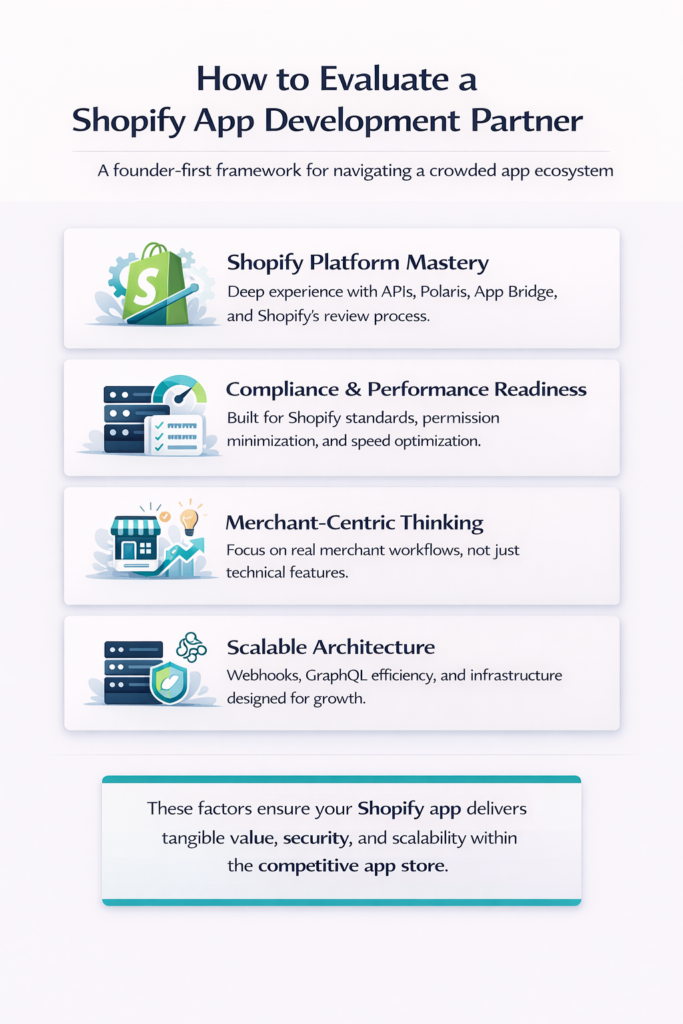
Polaris, Shopify’s design system, reached stable release in October 2024, providing consistent development experiences across App Home, Admin UI extensions, and Checkout UI extensions. Built on web components, Polaris now works with React, Vue, vanilla JavaScript, or no framework at all.
This technical maturation demands more from developers. Apps must integrate deeply using the latest App Bridge versions, implement proper Polaris components, and meet category-specific requirements. The Built for Shopify program reports that apps achieving this status see average install increases of 49% within 14 days.
Developers who maintain proficiency across Shopify’s API landscape—Storefront API, Admin API, and Shopify Functions—position their partners for sustained competitive advantage.
Compliance and Performance Standards
Shopify enforces stricter permission justification standards than in previous years. Apps must request only the minimum required Admin API scopes and clearly explain the necessity during submission. Over-broad permissions—particularly around customer data—are now a common rejection reason.
Apps handling payment data must implement proper tokenization. Those processing customer information need GDPR-compliant data handling. Subscription apps require specific Billing API implementation.
Performance testing ensures apps don’t slow admin load times or negatively impact storefront speed—both factors that Shopify monitors for App Store rankings and Built for Shopify eligibility.
What Distinguishes Exceptional Shopify App Developers
Platform-Specific Expertise
Deep knowledge of Shopify’s architecture—including webhook systems, GraphQL Admin API optimization, and proper implementation of checkout extensibility—separates specialists from generalists. Developers must understand how merchant data flows through the platform and how to architect solutions that scale across enterprise installations.
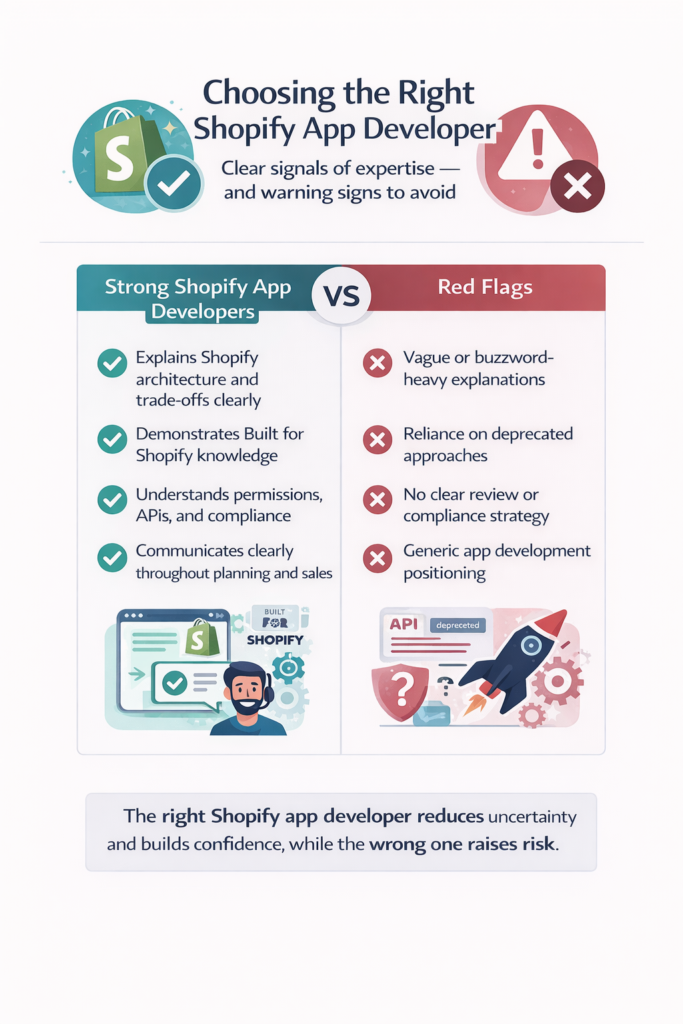
Understanding Shopify’s review process matters equally. Developers familiar with Built for Shopify requirements and App Store submission procedures demonstrate genuine platform experience. They articulate tradeoffs between extension types and explain when to use Admin UI extensions versus App Blocks.
Merchant-Centric Problem Solving
The best developers obsess over merchant pain points rather than technical possibilities. They conduct user research, analyze support tickets from existing solutions, and validate assumptions before writing code. Teams employing structured discovery processes—creating detailed merchant personas, mapping user journeys, identifying friction points—build apps with higher adoption rates.
Quality Assurance and Testing Rigor
Comprehensive testing across multiple Shopify plan tiers, theme variations, and edge cases prevents merchant frustration. Testing must encompass various store configurations, from basic stores to heavily modified Shopify Plus installations with custom checkout experiences.
Meet Chop Dawg’s Shopify App Developers
Iqbal Shezada: Backend Architecture & Scalability
With 25+ years of senior engineering leadership, Iqbal brings the architectural vision that separates thriving Shopify apps from platforms that crumble under merchant growth. His Node.js expertise directly addresses Shopify’s core challenge: handling complex webhook systems, API integrations, and real-time data synchronization at scale.
For Shopify Apps Specifically:
- Node.js and GraphQL backend architecture supporting complex merchant logic without bottlenecks
- Webhook architecture ensuring reliable event processing across Shopify’s ecosystem
- Real-time inventory synchronization and order management systems
- AI-powered merchant intelligence and recommendation engines
Iqbal’s finance and software engineering background brings unique perspective to Shopify app monetization. He understands subscription billing logic, usage-based pricing models, and how technical decisions impact app profitability. His mentorship ensures your team gains knowledge throughout the project, reducing dependency on any single developer.
Moeed Farooq: Admin UI & Polaris Excellence
As a core developer at Chop Dawg, Moeed specializes in the user experience side of Shopify apps: responsive, intuitive interfaces that merchants love using daily. His React expertise and deep understanding of Polaris directly impact merchant adoption—confusing interfaces cause immediate churn.
For Shopify Apps Specifically:
- React interfaces implementing Polaris components following Shopify design standards
- Admin UI extensions delivering seamless experiences within Shopify’s admin dashboard
- Checkout UI extensions for merchant-facing customizations
- Performance optimization preventing slowdown as merchants scale operations
Moeed’s focus on scalable architecture means admin interfaces remain responsive as merchants manage thousands of products and orders. His App Bridge integration expertise ensures seamless communication with Shopify’s platform, enabling the rich, interactive experiences merchants expect.
Wikram Das: Full-Stack Shopify Infrastructure
Wikram brings rare full-stack capability spanning frontend, backend, and infrastructure—enabling complete Shopify app systems without handoffs between specialists. As a full-stack developer at Chop Dawg, he owns the entire technical stack from user interface to API integrations to cloud infrastructure.
For Shopify Apps Specifically:
- React and Node.js full-stack development enabling rapid feature iteration
- Shopify Functions implementation for custom business logic
- Webhook architecture and GraphQL query optimization
- Firebase and AWS infrastructure providing cost-efficient, scalable hosting
Wikram’s AWS expertise is particularly valuable for cost-conscious app founders. His infrastructure choices reduce hosting costs by 30-40% compared to over-engineered solutions while maintaining performance needed for high-traffic merchants. His experience with third-party integrations ensures your Shopify app connects reliably to Stripe, Klaviyo, HubSpot, and other merchant tools.
What to Look for in a Shopify App Developer
Technical Proficiency Verification
Request specific examples demonstrating Shopify API expertise. Strong candidates articulate how they’ve implemented GraphQL queries, managed webhook reliability, and handled API rate limits. They discuss tradeoffs between extension types and explain when to use Admin UI extensions versus App Blocks.
Examine their understanding of Shopify’s review process. Developers familiar with Built for Shopify requirements and App Store submission procedures demonstrate genuine platform experience. They address compliance requirements upfront rather than treating them as afterthoughts.
Portfolio Examination
Analyze completed Shopify apps they’ve developed, paying attention to merchant reviews, feature depth, and technical sophistication. Apps demonstrating proper Polaris implementation and positive merchant feedback indicate quality execution.
Request references from previous Shopify app clients, asking about technical competency, deadline adherence, communication quality, and post-launch support capabilities.
Checkout Extensibility Understanding
As of 2025, Shopify continues migration away from checkout.liquid for Plus merchants. Developers must implement Checkout UI extensions using App Bridge and follow Shopify’s constraints for secure rendering.
Teams still relying on deprecated checkout.liquid customizations introduce long-term risk and future rewrite costs for app founders. Verify that developers use current extensibility standards rather than deprecated approaches.
Critical Selection Factors for Development Partners
Data & Permission Compliance Architecture
Shopify enforces stricter permission standards. Apps must request only minimum required Admin API scopes. Apps storing personal data must demonstrate secure handling, encrypted storage, and documented GDPR-compliant deletion workflows.
Development partners must architect proper data protection from project inception. This isn’t negotiable—it’s foundational to App Store acceptance and merchant trust.
API Efficiency and Rate Limiting Strategy
With increased reliance on GraphQL, Shopify evaluates whether apps structure queries efficiently, use pagination correctly, and minimize redundant requests. Apps that regularly hit API rate limits risk removal from the App Store.
Developers must design data models and queries aligned to Shopify’s optimization guidelines, ensuring efficient resource utilization and reliable scaling.
Ongoing Maintenance Planning
Shopify’s rapid release cycle requires continuous maintenance. Platform changes—including Admin API versioning (one stable version every quarter), Function upgrades, and deprecation cycles—mean apps built without dedicated maintenance plans fall out of compliance quickly.
Ensure your development partner commits to regular updates, security patches, and proactive compatibility monitoring rather than reactive firefighting.
Pricing Model Transparency
Understand exactly what pricing includes and excludes. Comprehensive proposals specify development hours, revision rounds, testing coverage, and post-launch support terms. Hidden costs around scope changes should be clarified upfront.
Compare engagement structures: fixed-price projects provide budget certainty while monthly retainers balance predictability with iterative development capability.
Shopify App Development Economics
Development Cost Ranges
Simple apps ($15,000-$50,000): Basic functionality, single integration, straightforward merchant workflow.
Mid-complexity apps ($50,000-$150,000): Multiple features, Shopify API integrations, Polaris UI implementation, basic Shopify Functions.
Enterprise-grade apps ($150,000-$300,000+): Complex business logic, multiple third-party integrations, advanced GraphQL implementation, custom Shopify Functions, extensive Admin UI extensions.
Ongoing maintenance typically consumes 15-20% of initial development costs annually, covering Shopify API updates, platform compatibility maintenance, and security patches.
Development Timeline Expectations
Simple apps may require 6-12 weeks from concept to App Store submission. Apps with moderate complexity typically need 3-5 months. Complex applications can extend to 9 months or longer. Timeline depends on requirements clarity, stakeholder availability, and developer experience with Shopify’s platform.
MVP strategies make sense for testing merchant demand before full investment. Launch with core functionality—essential features, basic integrations, simplified UI—and add sophisticated capabilities based on merchant feedback.
Technical Architecture Decisions for Shopify Success
Choosing the Right Tech Stack
React dominates Shopify app development because it integrates cleanly with Polaris components and App Bridge. For backend, Node.js and NestJS provide the performance and flexibility needed for complex merchant logic.
GraphQL has become the default for querying merchant data. Developers should prioritize GraphQL Admin API over REST for new development, with understanding of when REST remains appropriate.
Infrastructure and Scaling
Firebase, AWS, Google Cloud, and Vercel support mid-market Shopify apps. Developers should choose infrastructure enabling automatic scaling during traffic spikes without manual intervention.
For enterprise-grade reliability, Kubernetes deployments on AWS or Google Cloud Platform offer higher control and redundancy, though with increased operational complexity.
Security and Compliance by Design
Implement OAuth properly from day one—security shortcuts create vulnerability pathways. Use Shopify’s managed installation process rather than custom authentication.
For apps handling sensitive data, implement encryption at rest and in transit. Regular security audits should be built into development cycles, not added reactively.
Frequently Asked Questions
How much does it cost to develop a Shopify app in 2025?
Development costs range from $15,000 for basic functionality to over $300,000 for complex applications. Most merchant-focused apps with standard features fall between $50,000-$150,000. Factors influencing cost include feature complexity, required integrations, backend infrastructure needs, and compliance requirements. Ongoing maintenance typically adds 15-20% of initial costs annually.
How long does Shopify app development take?
Simple apps may require 6-12 weeks from concept to App Store submission. Apps with moderate complexity typically need 3-5 months. Complex applications can extend to 9 months or longer. Timeline depends on requirements clarity, stakeholder availability, and developer experience with Shopify’s platform.
What’s the difference between public and custom Shopify apps?
Public apps are listed in the Shopify App Store, available to all merchants, and must pass Shopify’s review process. Custom apps are built for specific merchants, don’t require App Store submission, and provide tailored solutions but reach smaller audiences. Each model has distinct development requirements and business dynamics.
What technical skills should Shopify app developers have?
Proficient developers demonstrate expertise in JavaScript, Node.js, React, and GraphQL. They understand Shopify’s authentication protocols, including OAuth implementation. Knowledge of the Polaris design system, App Bridge integration, and various extension types proves essential. Developers should comprehend webhook architecture and API rate limit management.
How do I verify a developer’s Shopify expertise?
Request specific examples of Shopify apps they’ve developed, examining App Store listings for merchant reviews. Ask detailed questions about webhook reliability strategies and Built for Shopify requirements—responses reveal genuine platform experience. Request client references from Shopify app projects specifically.
What should a Shopify app development proposal include?
Comprehensive proposals specify project scope with detailed feature descriptions, technical architecture overview, and clear deliverables. They outline development methodology and testing approach, including merchant acceptance criteria. Timeline estimates should include realistic milestones. Pricing must detail what’s included and what incurs additional charges. Proposals should address intellectual property ownership, compliance requirements, and post-launch support terms.
Is it better to hire an agency or freelancer for Shopify app development?
Developers with a dedicated Shopify focus provide expertise that generalists rarely match. They offer continuity, understand platform nuances, and can navigate App Store submission successfully. Consider whether your project requires the depth of experience that comes from specialized Shopify development versus generic app development.
What ongoing maintenance do Shopify apps require?
Apps need regular updates, accommodating Shopify platform changes, API deprecations, and new feature releases. Security patches address emerging vulnerabilities. Bug fixes respond to merchant-reported issues. Performance optimization addresses slowdowns as usage scales. Plan for continuous investment rather than one-time development costs.
How important is Built for Shopify status?
Built for Shopify status significantly impacts app visibility and merchant trust. Apps meeting these standards receive prominent placement in App Store search results. Research from Shopify indicates that apps achieving Built for Shopify status see average install increases of 49% within 14 days.
Can I monetize my Shopify app through the App Store?
Yes, Shopify enables app monetization through various pricing models including monthly subscriptions and usage-based charges. As of 2025, eligible developers benefit from zero percent revenue share on the first $1 million in annual gross app revenue earned through the App Store.
How do I ensure my Shopify app passes review?
Request only the minimum required Admin API scopes and justify each permission. Implement Polaris components correctly. Avoid deprecated technologies like checkout.liquid. Test thoroughly across multiple merchant store configurations. Document all compliance measures. Provide clear, detailed app descriptions and graphics. Development partners familiar with the review process should guide you through submission requirements.




 19 Min