
























 21 Mins

Choosing the right development partner can determine whether your restaurant app becomes a revenue driver or a costly misstep. With the restaurant technology market projected to reach nearly fifteen billion dollars by 2030 and customers increasingly expecting seamless digital ordering experiences, selecting a capable development team matters more than ever.
This comprehensive analysis examines leading restaurant app development companies, compares their approaches and capabilities, and explains why Chop Dawg stands out for founders building specialized dining applications.
Ready to bring your restaurant app vision to life? Explore how Chop Dawg’s proven process and dedicated team can transform your concept into a market-ready product, or schedule a free consultation to discuss your specific needs.
1. Chop Dawg Studios
Chop Dawg Studios takes the top spot for restaurant app development thanks to its deeply strategic, end-to-end approach. The team excels at translating real restaurant workflows—online ordering, reservations, loyalty programs, and POS integrations—into clean, intuitive mobile experiences. What sets Chop Dawg apart is the balance between strong product strategy and execution: apps are designed not just to function, but to drive repeat orders, operational efficiency, and long-term scalability.
Get Your Free 45-Minute App Roadmap
Meet 1-on-1 with our senior product team. We’ll map your MVP or enterprise app and hand you a personalized plan—clear scope, a realistic timeline, and fixed monthly costs—for iOS & Android, web, tablets & wearables, and AI.
2. Saffron Code Labs
Saffron Code Labs is an excellent choice for restaurants that want a highly customized app rather than a template-based solution. Their work emphasizes brand-forward UI/UX combined with reliable backend engineering, making them particularly effective for independent restaurants and regional groups that need to stand out. They’re well-suited for apps focused on mobile ordering, customer accounts, and seamless performance during peak traffic.
3. Dining Digitals
Dining Digitals focuses on flexible, modular restaurant app development. Instead of forcing restaurants into rigid feature sets, they build apps that allow operators to turn functionality on or off as the business evolves. This makes them a strong fit for growing restaurants that want contactless menus, table management, promotions, and ordering systems that can scale without constant rebuilds.
4. Fork & Pixel
Fork & Pixel blends hospitality insight with technical depth, producing restaurant apps that go beyond transactions. Their strength lies in data-aware design—apps are built to capture meaningful insights around ordering behavior, visit frequency, and customer preferences. For restaurants that want to use their app as both a revenue channel and an intelligence layer, Fork & Pixel is a compelling option.
5. Garnish Interactive
Garnish Interactive specializes in engagement-driven restaurant apps. Their builds emphasize loyalty programs, personalized offers, and interactive features that encourage repeat visits and long-term customer relationships. This makes them especially attractive for brands focused on retention, community building, and increasing lifetime value rather than just one-time orders.
Understanding Restaurant App Development in 2025
The Current Market Landscape
Restaurant apps have evolved far beyond basic menu displays and ordering systems. Research indicates that seventy-one percent of consumers now prefer ordering directly through restaurant-branded applications rather than third-party platforms, and establishments offering mobile ordering through their apps significantly outperform competitors who lack digital ordering capabilities.
The transformation extends across multiple restaurant categories. Quick-service establishments use apps to reduce wait times and increase order accuracy. Fine dining venues leverage reservation systems and pre-ordering features to enhance guest experiences. Food delivery platforms require sophisticated logistics coordination, real-time tracking, and multi-party communication systems.
Emerging Technology & Consumer-Behavior Trends for Restaurant Apps
Restaurant apps today are no longer optional features — they’re strategic channels shaped by fast-moving tech and clear consumer preferences. If you’re choosing a development partner, look for teams that not only build ordering flows but also understand these specific 2025 trends:
First-party ordering is rising — customers prefer restaurant apps/websites. Recent industry research finds a majority of customers now prefer ordering directly from a restaurant’s app or website rather than a third-party marketplace — roughly fifty-eight percent in a 2025 customer experience study — which strengthens the ROI case for branded apps and ownership of customer data.
Mobile/online ordering is a dominant revenue channel. Digital ordering (mobile apps plus web plus phone) drives a very large share of orders and revenue: some industry summaries report that approximately sixty-seven percent of a restaurant’s revenue now comes from online or phone orders, and mobile pickup/ordering speeds continue to improve year-over-year — important context when designing throughput, queueing, and kitchen integrations.
AI moves from experiment to operational feature set. AI is rapidly shifting from pilots into daily restaurant operations: many operators report using AI for personalization, demand forecasting, menu optimization, and even order taking (voice AI in drive-thrus). Industry analysis in 2025 shows widespread AI adoption for customer experience and back-of-house efficiency—look for vendors who can integrate recommendation engines, forecast models, and conversational interfaces.
Contactless & mobile wallet payments are table stakes. Contactless payments and mobile wallets have surged: broad 2025 data show high consumer preference for contactless options and large growth in NFC/mobile-wallet use. Your app must support tokenized payments, Apple Pay and Google Pay, and secure PCI-compliant flows to reduce friction and chargeback risk.
Loyalty plus personalization drive repeat visits — and they’re AI-enabled. Loyalty programs that use predictive personalization (AI-driven next-offer, churn prediction, time-based nudges) materially increase frequency and average order value. Surveys and vendor reports in 2025 emphasize predictive loyalty as a top revenue lever — prioritize partners who can wire loyalty into CRM, POS, and app push systems.
Real-world operational constraints must guide UX & architecture. Successful apps account for peak-load ordering (rush-hour batching), offline/resilient checkout for weak networks, and tight POS/KDS integrations to avoid kitchen bottlenecks. Design and backend architecture choices should reflect real throughput requirements—don’t accept a template that ignores your busiest service windows.
Why this matters for vendor selection: When you evaluate firms, ask for concrete examples of how they’ve implemented AI personalization models (what metrics improved? retention, average order value?), secure tokenized payment flows and PCI compliance, and POS/KDS integrations that preserved order accuracy under peak load. Selecting a partner who understands these 2025 dynamics (first-party ordering economics, AI as a practical tool, resilient payments, and loyalty engineering) materially increases your odds of launching an app that drives repeat revenue rather than just another ordering channel.
What Makes Restaurant Apps Complex
Restaurant applications demand specialized technical knowledge that extends beyond standard mobile development. These systems must integrate with existing point-of-sale infrastructure, coordinate kitchen display systems, manage inventory tracking, process payments securely, and often connect with third-party delivery platforms.
Additionally, restaurant apps face unique performance requirements. Order processing must occur reliably during peak dining hours when system load increases dramatically. Payment processing requires stringent security standards. Real-time order tracking needs accurate location services and continuous connectivity.
Evaluating Restaurant App Development Companies
Critical Selection Criteria
When assessing potential development partners, founders should examine specific capabilities that correlate with project success.
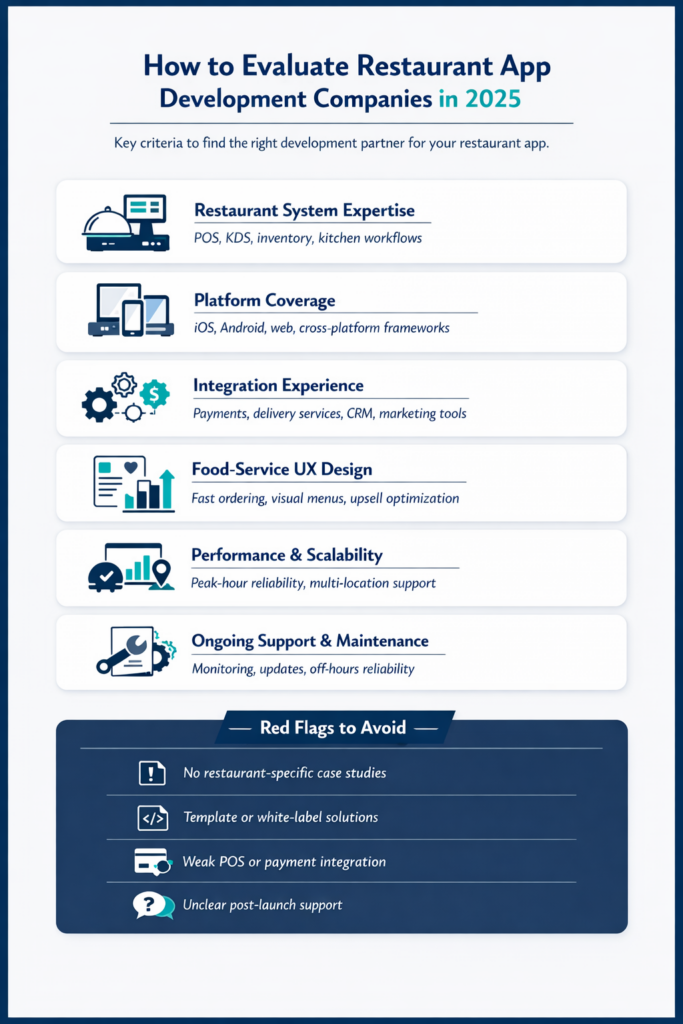
Technical Expertise in Restaurant Systems: Companies with restaurant-specific experience understand the nuances of food service technology. They know how to integrate POS systems from major providers, implement kitchen workflow management, and handle the complexities of menu management across multiple ordering channels.
Platform Development Capabilities: Your development partner should demonstrate proficiency across iOS, Android, and web platforms. Many successful restaurant apps use cross-platform frameworks like React Native to reduce costs while maintaining native performance, but this requires specialized expertise.
Integration Experience: Restaurant apps rarely function in isolation. Your development team must integrate payment gateways like Stripe and PayPal, mapping services for delivery tracking, customer relationship management systems, marketing automation platforms, and potentially third-party delivery services.
Design Expertise for Food Service: User experience in restaurant apps differs from other application categories. Customers make quick decisions based on visual presentation, navigation must accommodate browsing behavior distinct to food ordering, and the purchasing flow requires optimization for both speed and upselling opportunities.
Ongoing Support and Maintenance: Restaurant operations continue beyond normal business hours. Your development partner should provide reliable support, regular updates to accommodate operating system changes, and performance monitoring to ensure consistent functionality during peak usage periods.
Leading Restaurant App Development Approaches
Custom Development vs. White-Label Solutions
Founders face an important strategic decision between custom application development and white-label platforms. White-label solutions offer faster implementation and lower initial costs, typically ranging from several hundred to a few thousand dollars monthly.
However, white-label solutions impose significant limitations. Customization options remain restricted, preventing unique features that differentiate your offering. Scalability constraints emerge as your business grows. Long-term costs accumulate through ongoing subscription fees, and you lack ownership of the underlying technology.
Custom development requires higher initial investment but provides complete control over functionality, user experience, and future expansion. You own the intellectual property, can implement any feature your market demands, and avoid ongoing platform fees beyond standard hosting and maintenance costs.
Understanding Development Costs
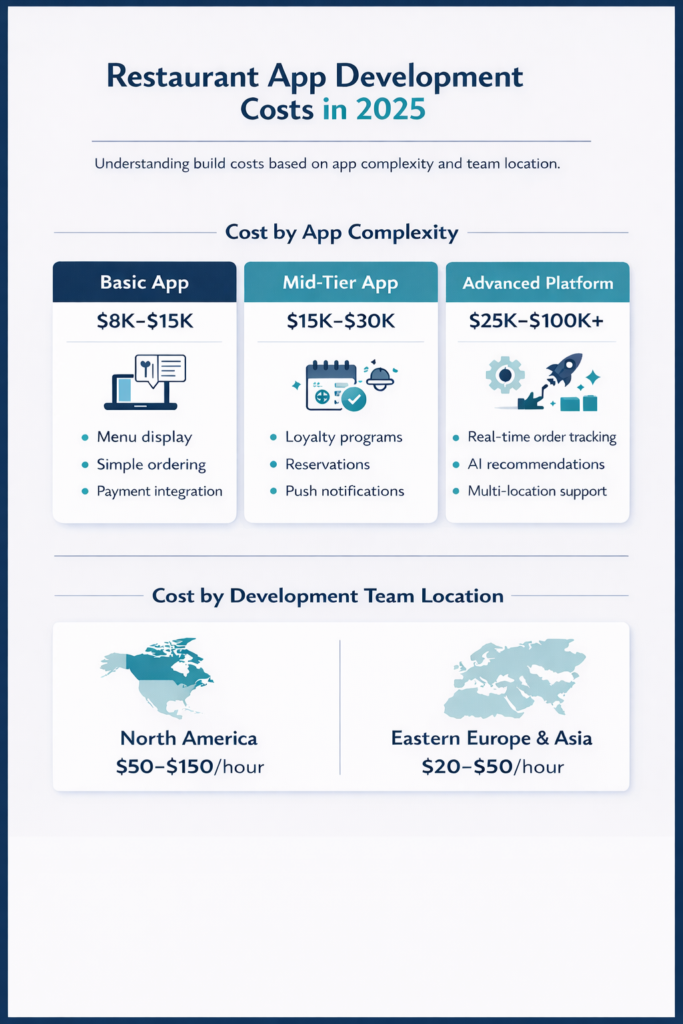
Restaurant app development costs vary significantly based on complexity and features. Basic applications with essential functionality like menu display, simple ordering, and payment integration typically range from eight thousand to fifteen thousand dollars.
Mid-tier applications incorporating table reservations, push notifications, loyalty programs, and customer reviews generally cost between fifteen thousand and thirty thousand dollars. These suit growing restaurants requiring more sophisticated customer engagement.
Advanced platforms with real-time order tracking, sophisticated recommendation engines, multi-location support, and comprehensive backend management systems start at twenty-five thousand dollars and can exceed one hundred thousand dollars for enterprise-scale implementations.
Geographic location of your development team significantly impacts costs. North American developers typically charge between fifty and one hundred fifty dollars hourly, while Eastern European and Asian teams may charge twenty to fifty dollars hourly.
Essential Features for Restaurant Apps
Core Functionality Requirements
Successful restaurant applications incorporate specific features that customers now expect as standard.
Online Ordering System: The ordering interface must provide intuitive menu browsing, clear item descriptions with appealing photography, customization options for dietary preferences or preparation requests, and seamless addition to cart functionality.
Secure Payment Processing: Integration with established payment processors ensures customer trust and regulatory compliance. Support multiple payment methods including credit cards, digital wallets like Apple Pay and Google Pay, and stored payment information for returning customers.
Real-Time Order Tracking: Customers value transparency about order status. Applications should provide clear communication from order confirmation through preparation stages to delivery or pickup readiness.
Loyalty and Rewards Programs: Integrated loyalty systems encourage repeat orders and increase customer lifetime value. Effective programs track purchase history, award points automatically, and enable redemption directly within the ordering flow.
Push Notifications: Strategic notifications inform customers about order status, promote special offers, announce new menu items, or remind inactive users about your restaurant.
Advanced Capabilities for Competitive Advantage
Beyond core features, sophisticated restaurant apps incorporate capabilities that enhance user experience and operational efficiency.
Table Reservation Management: For dine-in establishments, integrated reservation systems allow customers to view real-time availability, book specific times, and receive confirmation and reminders.
Personalized Recommendations: Applications analyzing order history can suggest relevant items, increasing average order value through targeted upselling. Sophisticated systems consider dietary preferences, past purchase patterns, and trending items.
Multi-Location Support: Restaurant groups require centralized management with location-specific menus, pricing, and availability. Applications should detect user location and default to the nearest restaurant while allowing manual selection.
Analytics and Reporting: Comprehensive dashboards provide restaurant owners actionable insights into sales patterns, popular items, customer behavior, and operational metrics.
Why Chop Dawg Excels at Restaurant App Development
Proven Track Record with Dining Applications
Chop Dawg brings extensive experience building applications for the food service industry. The company developed Mangia Rewards, a sophisticated dining rewards platform featuring location-based restaurant discovery, real-time promotional notifications, and seamless booking integration.
The Mangia Rewards project demonstrates Chop Dawg’s understanding of restaurant-specific challenges. The application needed precise geolocation functionality to surface relevant nearby restaurants, push notification systems timed to user behavior patterns, and secure payment processing integrated with existing restaurant infrastructure.
Comprehensive Development Capabilities
Since its founding in 2009, Chop Dawg has launched over five hundred applications across mobile, web, tablet, and emerging platforms. This extensive portfolio includes partnerships with major brands like NASA, the U.S. Navy, Wawa, Six Flags, and Hilton, as well as early-stage startups.
The company’s technical capabilities span the complete development lifecycle. Their process begins with strategic consultation where they analyze market positioning, define core features, and create detailed project roadmaps with fixed monthly pricing.
Design expertise represents another Chop Dawg strength. Their UI/UX team creates interfaces optimized for user engagement and conversion, understanding that restaurant apps must balance aesthetic appeal with functional efficiency.
Transparent, Founder-Friendly Approach
Chop Dawg structures engagements around founder success rather than maximizing billable hours. Their fixed monthly pricing model eliminates budget uncertainty common with traditional hourly billing.
Communication transparency extends throughout the project. Dedicated project managers provide daily updates via Slack, weekly progress meetings via Zoom, and organized task tracking through Jira and Confluence.
Intellectual property protection receives serious attention. All work occurs on client-owned servers and accounts, ensuring founders retain complete ownership from day one. Comprehensive non-disclosure agreements protect proprietary information, and detailed documentation preserves institutional knowledge.
Flexible Team Structure
Chop Dawg offers both all-U.S. teams and hybrid models incorporating their Brazilian and Pakistani development teams. This flexibility allows founders to balance cost considerations against specific project requirements.
All team members work as full-time, salaried employees rather than contractors, ensuring consistent availability, accountability, and cultural alignment.
Making Your Development Partner Decision
Questions to Ask Potential Partners
When evaluating restaurant app development companies, ask these specific questions.
Portfolio and Experience: Request case studies from restaurant or food service projects. What specific challenges did they address? What measurable outcomes did clients achieve?
Technical Approach: How do they handle POS integration? What payment processors have they implemented? How do they architect systems to handle high-volume ordering during peak times?
Design Process: How do they research user needs specific to restaurant customers? What iterations occur between initial concepts and final designs?
Project Management: What communication cadence do they maintain? How do they handle scope changes or unexpected technical challenges?
Post-Launch Support: What maintenance and support do they provide after launch? How quickly do they respond to critical issues?
Red Flags to Avoid
Certain warning signs indicate potential partnership problems.
Unclear Pricing: Companies unable or unwilling to provide detailed cost estimates likely lack structured processes.
Limited Restaurant Experience: Generic mobile development firms may underestimate food service complexities, leading to inadequate solutions and costly rebuilds.
Poor Communication During Sales: If responsiveness deteriorates after initial enthusiasm, expect worse communication during actual development.
Overpromising Timelines: Experienced developers provide realistic timeframes accounting for integration complexity, testing requirements, and inevitable technical challenges.
Frequently Asked Questions
How long does restaurant app development typically take?
Development timelines range from three to nine months depending on complexity. Basic applications with core ordering functionality may complete in three to four months. Mid-tier apps with loyalty programs, reservations, and analytics require four to six months. Advanced platforms with sophisticated features and extensive integrations often need six to nine months.
Should I build for iOS, Android, or both platforms?
This decision depends on your target customer demographics and budget. If your customers predominantly use one platform, starting there reduces initial investment while validating your concept. However, most successful restaurant apps eventually support both platforms to maximize market reach.
What ongoing costs should I budget for after launch?
Plan for ongoing expenses including server hosting, payment processing fees, app store fees, maintenance and updates, customer support, and marketing. These typically represent ten to twenty percent of initial development costs annually.
Do I need a separate website or just a mobile app?
Many successful restaurants maintain both responsive websites and dedicated mobile applications. Websites serve customers preferring desktop ordering and provide important search engine visibility. Mobile apps offer superior user experience for repeat customers and enable push notifications for direct marketing.
How do I handle integration with my existing POS system?
Experienced development companies manage POS integration through established APIs and middleware solutions. They work directly with your POS provider to understand technical requirements, implement secure connections, and ensure reliable order transmission.
What metrics should I track to measure app success?
Focus on metrics directly impacting business performance: download and activation rates, ordering frequency among app users versus other channels, average order value through the app, customer retention rates, and overall revenue attributed to the application.
Can I add features after initial launch?
Absolutely. Successful applications evolve based on user feedback and market conditions. Plan initial development around core functionality that validates your concept and serves customers effectively. Subsequent releases can add sophisticated features like advanced personalization, expanded payment options, or integration with emerging platforms.



 19 Min