menu

Making Laundry Day Just Happen with the Renity Platform

Laundry never clocks out. It piles up in baskets, in back seats, in guest rooms that were supposed to feel peaceful. Meanwhile tens of thousands of neighborhood laundromats sit half empty during the week while families who could afford help still lose their weekends to sorting and folding. The capacity exists, the demand exists, and nothing has connected them at scale. By partnering with Chop Dawg, this vision became reality. We designed and developed Renity as React Native applications for iPhone and Android where households subscribe to a recurring Laundry Day, register branded QR coded bags, and track their clothes from porch to laundromat and back with live status at every step. The same app carries an operator mode where laundromats accept jobs that fit their non peak hours, move bags through wash and fold, and see payouts before they commit. Alongside the mobile experience, we built a React administrative web application, a responsive website application for onboarding and billing, and a WordPress marketing site.

When a Chore Becomes a Routine You Trust: Introduction to Renity

Most people do not hate work. They hate chaos. Laundry ranks among the most disliked household chores, yet almost nobody outsources it, because the alternatives require phone calls, one-off scheduling, and blind trust in whoever shows up at the door. There is rarely any visibility into where the clothes are, when they return, or who actually did the work.

Renity replaces that with a rhythm families can count on. A household subscribes, receives branded QR coded bags, and scans each one into the app. Every cycle, a reminder arrives the day before Laundry Day. The morning of, they check in which bags are going out, leave them on the porch, and watch a Roadie driver arrive with live status updates that continue through wash, dry, fold, and return. On the other side, a laundromat receives a job offer sized to its capacity and non peak window with the payout calculated before acceptance, then moves bags through processing while launderesses work their own assigned queues. To bring this vision to life, Chop Dawg designed and developed React Native mobile applications serving households and operators, a React administrative web application, a responsive website application, and a WordPress marketing site, all running on Google Cloud Platform with Firebase Authentication, Firestore, and Cloud Functions.

Breaking Barriers to Impact: Renity's Need for a Coordinated Three-Sided Platform

Before Renity, every side of this equation operated in isolation. Families piled laundry until someone broke, then tried services built around one-off orders rather than predictable subscriptions. Laundromats watched machines sit idle on weekdays while rent and payroll came due, with no national brand sending them work sized to their capacity. Launderesses doing the hardest work stayed invisible in the system. And any attempt to grow this by hand meant more spreadsheets, more texts, and more chances for something to slip through.

Renity needed to solve multiple challenges simultaneously. Physical bags had to be traceable through every stage, which meant QR codes tied to households and orders. Logistics had to run through Roadie rather than a driver network built from scratch, with their shipment statuses mapped cleanly into language customers understand. Laundromats needed job offers with payout math visible before acceptance, plus launderess accounts scoped to only their own assigned work. Subscriptions had to run through store billing while bag purchases ran through Stripe as physical goods. Messaging had to connect households, laundromats, and support without becoming a liability, which meant no image sharing between customers and operators. And the internal team needed an operations console covering approvals, bulk laundromat imports, bag inventory, shipment exceptions, and payouts without a developer in the loop.

How We Worked Together

Building a Service Families Trust with Their Clothes

From the very first conversation, we understood Renity had to earn trust from three audiences at once. A parent handing over a week of family clothing needs to know exactly where those bags are. A laundromat owner needs to know a job is worth taking before saying yes. A launderess needs a clear queue rather than a manager shouting across the floor. We mapped journeys for each, then defined how status language should stay identical across household, operator, and admin views so nobody ever sees a different version of the truth.
Figma served as our collaborative design hub where wireframes evolved into polished, high-fidelity screens across the household and operator experiences. Weekly meetings during design and bi-weekly meetings during development kept all teams aligned as we worked through the harder problems, including how far Roadie’s API could carry tracking, where the matching algorithm should hand off to human judgment, and how bulk laundromat imports could generate profiles and invitations automatically. In parallel, we formalized a technical approach centered on React Native for mobile, React for the administrative and website applications, Cloud Functions on Google Cloud Platform with Firestore, RevenueCat for subscriptions, Stripe for payouts and bag purchases, Roadie for logistics, Twilio for messaging, and Firebase Cloud Messaging for notifications. Through Slack, Jira, and Confluence, every decision stayed documented.

Delivering a Predictable Laundry Day Through QR Traceability and Live Status

We designed and developed mobile applications for iPhone and Android that serve households and laundromat operators through one product, turning a dreaded chore into a routine that runs itself.

Subscription Setup with Household Plans and Store-Compliant Billing

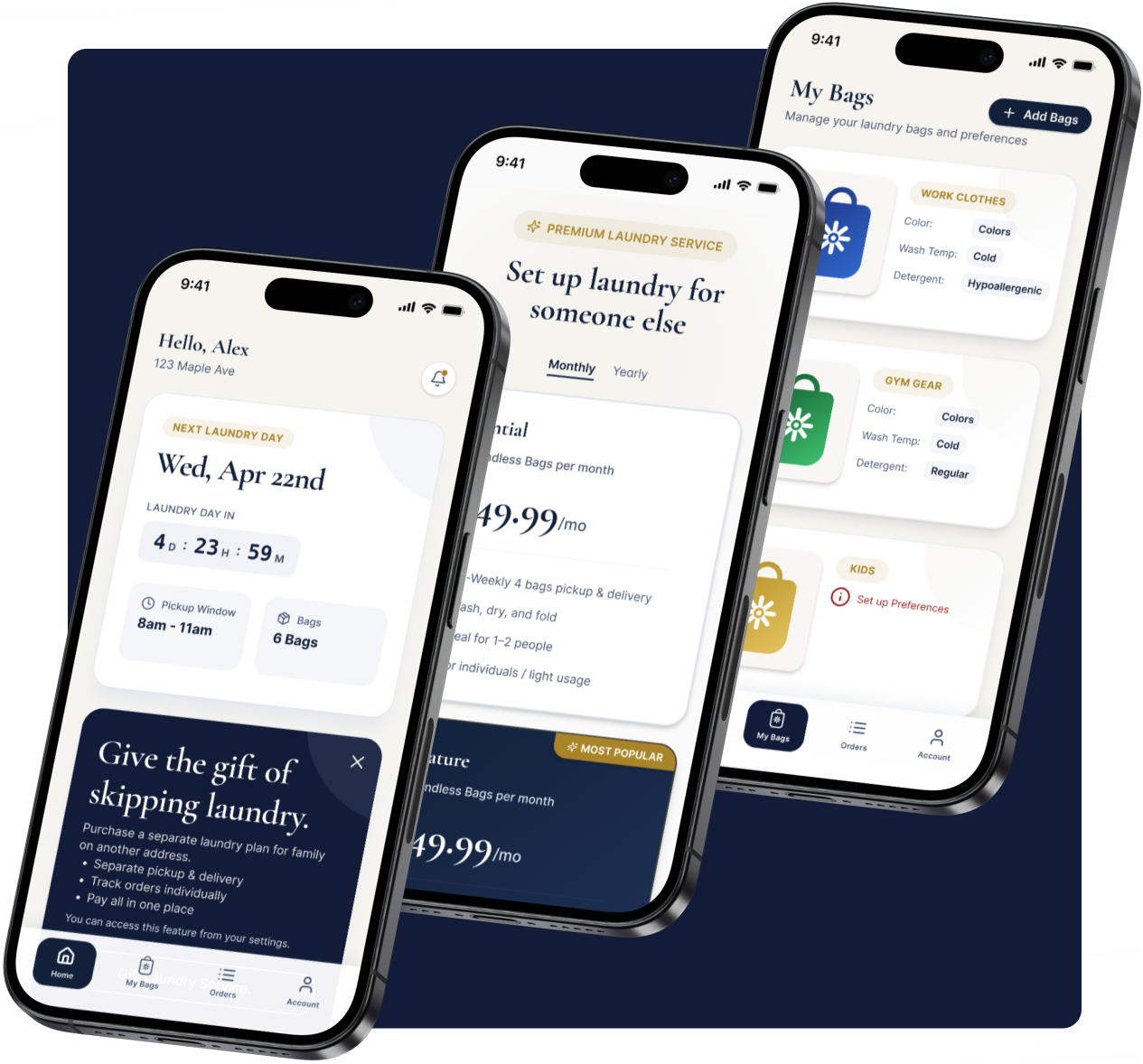
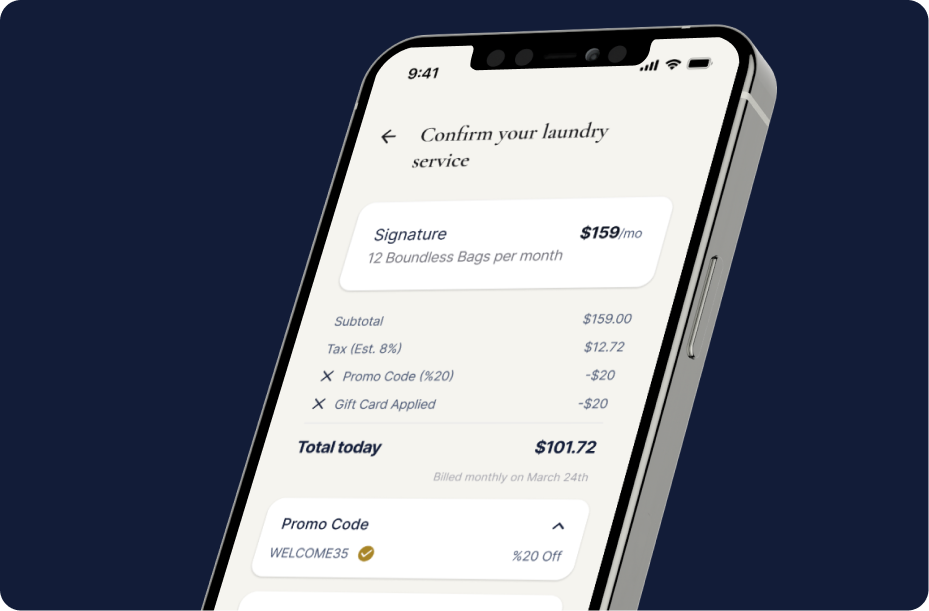
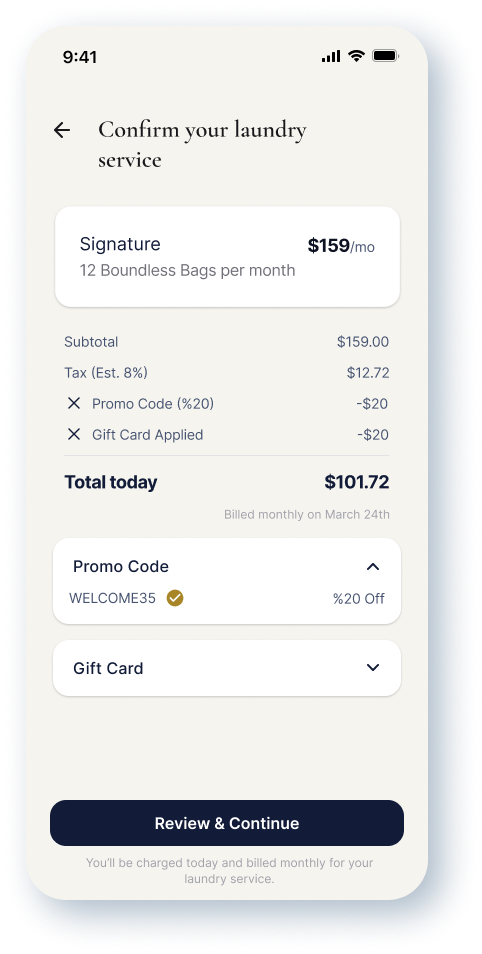
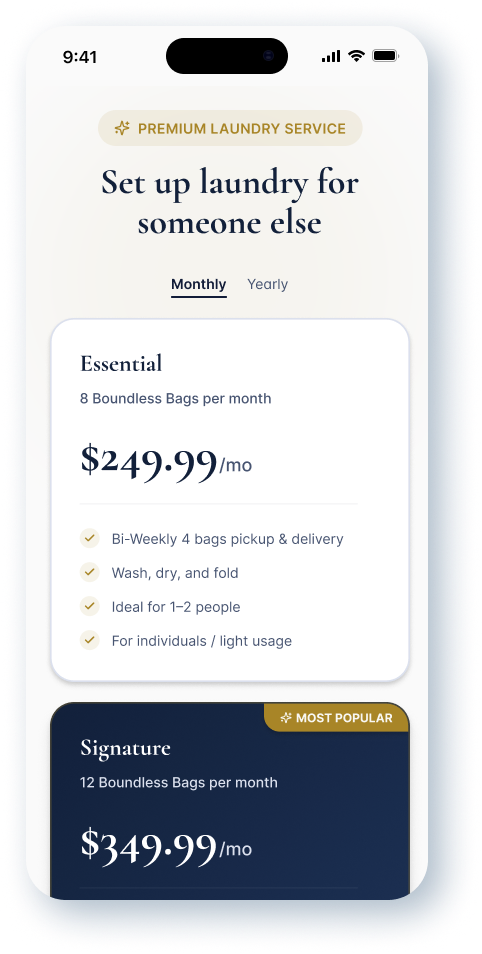
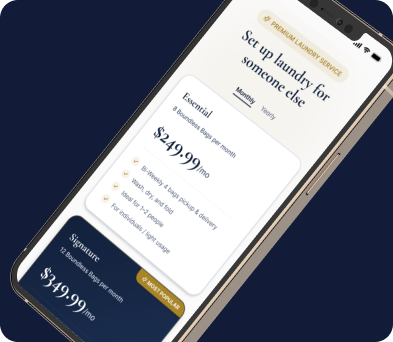
Renity opens with plans written in language families actually use, built around household size, bag count, and Laundry Day frequency rather than industry terminology. Each plan states how many branded bags are included, how often pickups occur, and what the cadence costs, with pricing pulled live from RevenueCat. Selection leads to a confirmation summary before the Apple App Store or Google Play Store purchase sheet opens, keeping billing fully compliant. Once the purchase confirms, the household is marked active and told their bags are on the way. Settings display the current plan and renewal date alongside a plain explanation that upgrades, downgrades, and cancellations happen through the device store rather than inside the app. Address entry flags immediately when a household sits outside current coverage, so nobody subscribes into a service area that cannot reach them.
QR Coded Bag Registration with Nicknames and Replacements

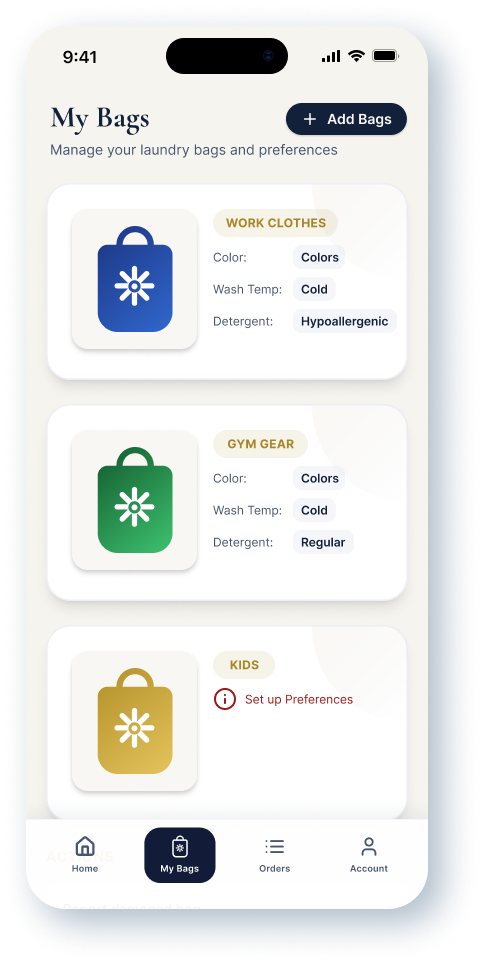
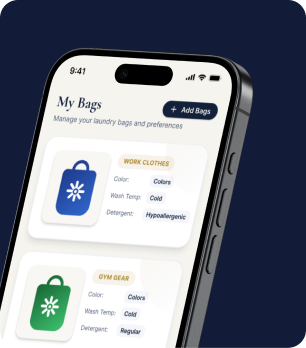
Traceability starts the moment bags arrive at the door. The app prompts the household to register them, requests camera permission with a short explanation that it is used only for scanning, and opens the scanner. Each scan ties that bag ID to the household in Firestore, and an optional nickname like Kids Clothes or Bedding helps families remember which is which without affecting routing. The Bags screen lists every registered bag with its identifier and current status inside any active order. If a code is unrecognized or already assigned elsewhere, clear messaging routes the user to support rather than leaving them stuck, and a manual entry fallback using the printed alphanumeric tag covers denied camera permission or poor lighting. Lost or damaged bags can be flagged for replacement, and additional bags can be purchased in-app through Stripe with Apple Pay or Google Pay, which as physical goods carry no store commission.

Laundry Day Scheduling with Reminders and Check-In

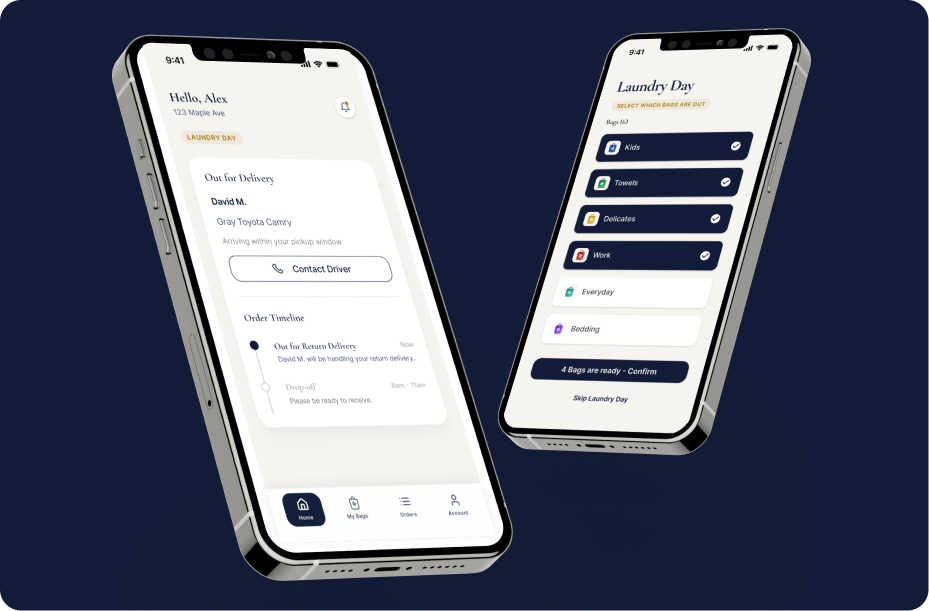
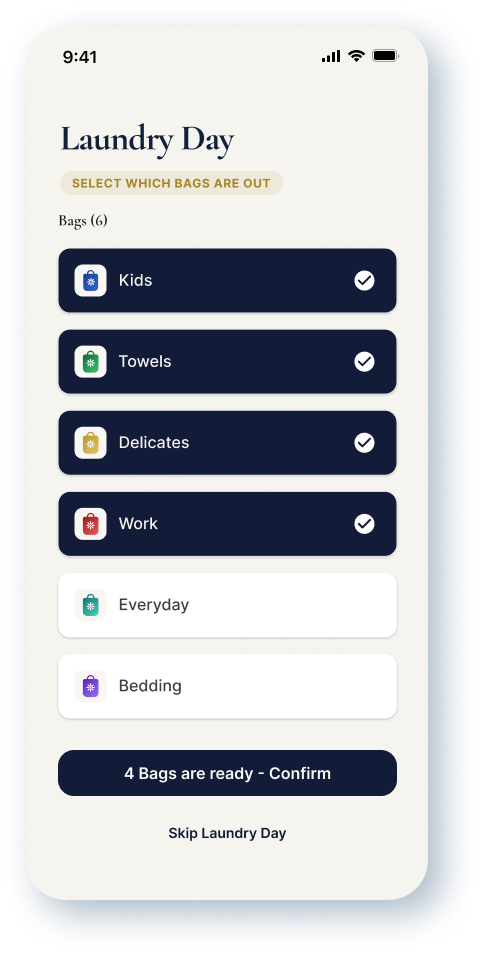
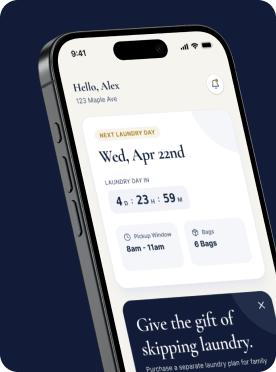
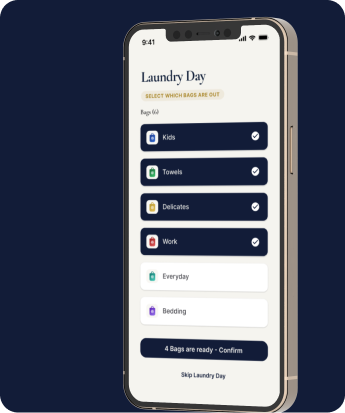
Households pick a day of the week and a pickup window, and Renity builds the rhythm from there. The home screen shows the next Laundry Day with its date, window, and expected bag count. A reminder notification arrives the day before inviting the household to confirm which bags are going out and update pickup notes, with an optional morning-of reminder as well. On the day itself, an active order card presents a checklist of bags and an editable note field for instructions like leaving them on the back porch. Tapping Bags Are Out moves the order to awaiting pickup and triggers dispatch. A Skip This Laundry Day action stays available until a cutoff, updating operator and admin views immediately so no pickup task gets generated for a household that is away. Future dates and routines remain editable throughout.
Order Tracking with Roadie Integration and a Full Timeline
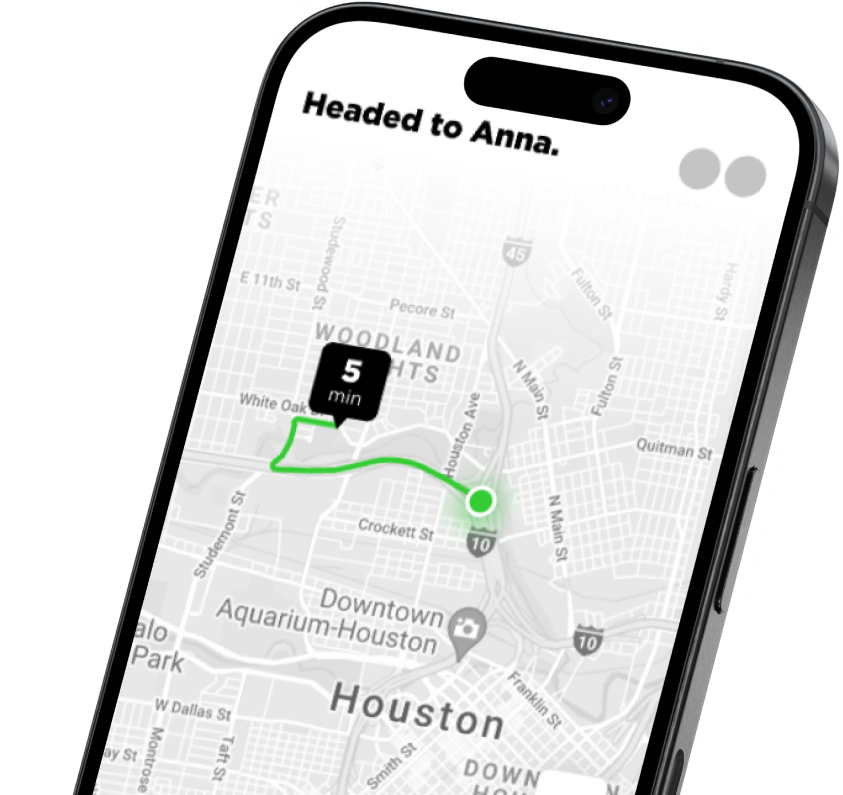
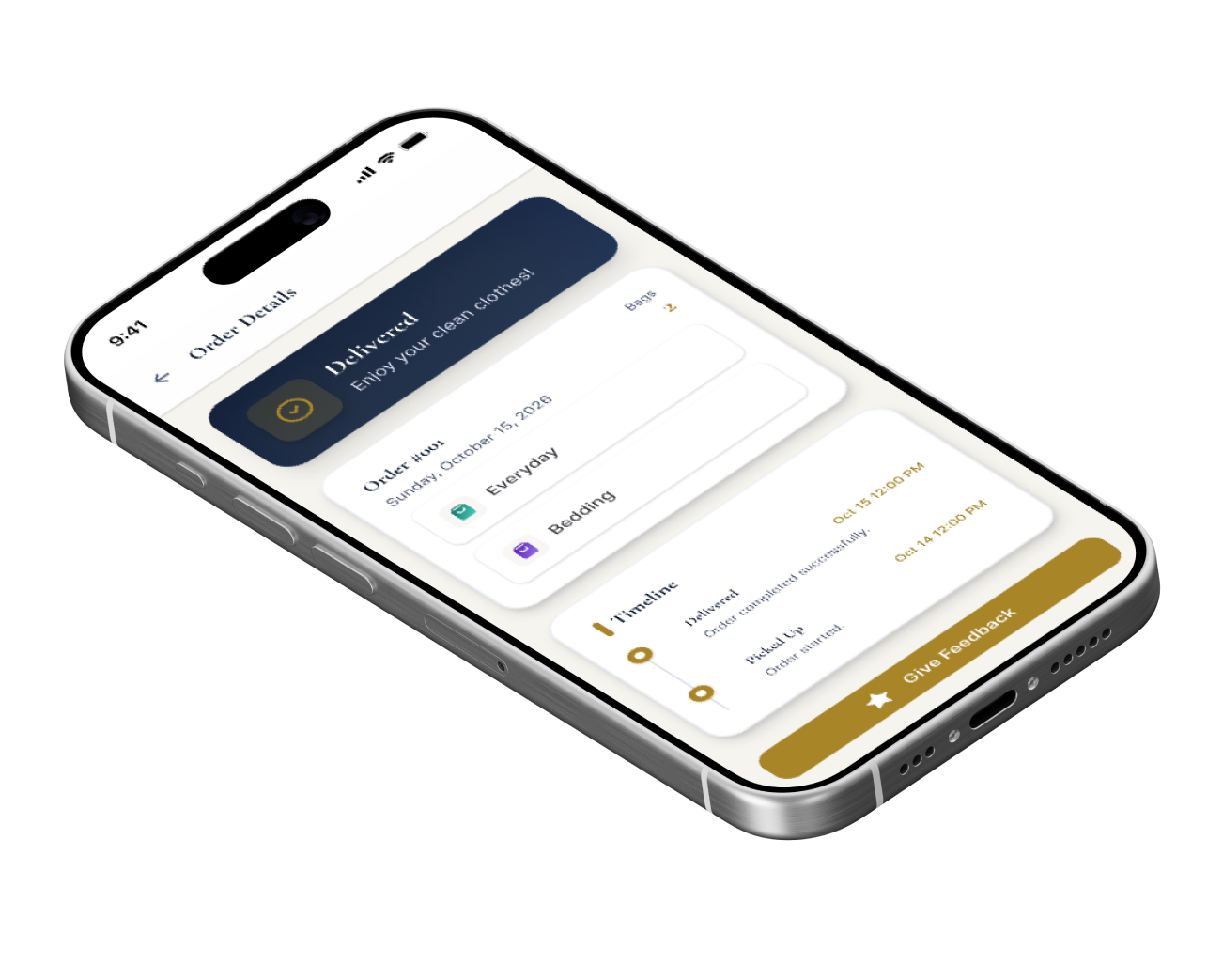
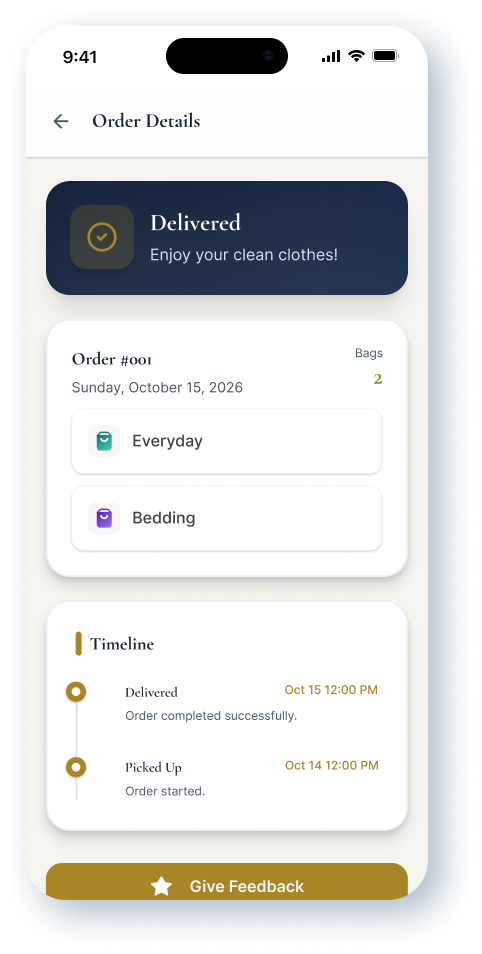
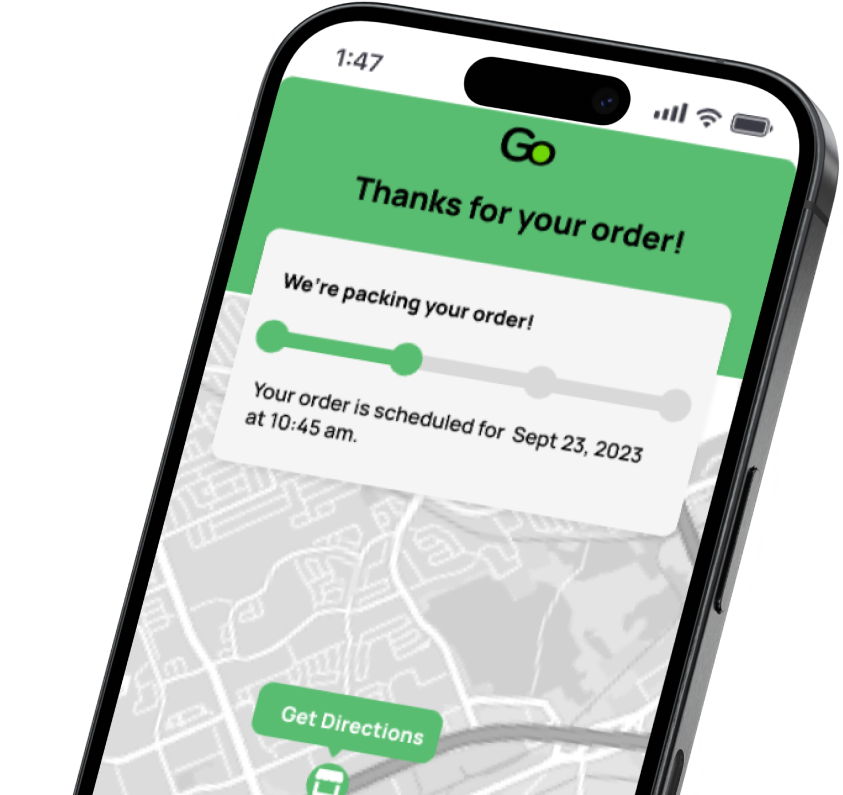
Every Laundry Day creates an order that groups the bags going out, then moves through a consistent sequence: planned, awaiting pickup, picked up by driver, delivered to laundromat, in wash, in dry, folding and bagging, ready for return pickup, out for delivery, and delivered. Roadie serves as the system of record for the pickup and delivery legs, with shipment status, tracking links, and proof of pickup and delivery flowing back into the app. Laundromat events fill in the processing stages. The timeline view shows each status change with a timestamp alongside relevant notes such as a driver delay or special instructions received. When Roadie updates lag, the app holds the last known state with a note showing when it was last confirmed rather than going silent. Completed orders keep a permanent timeline and prompt a simple rating.

Operator Mode with Job Offers, Bag Processing, and Payout Visibility

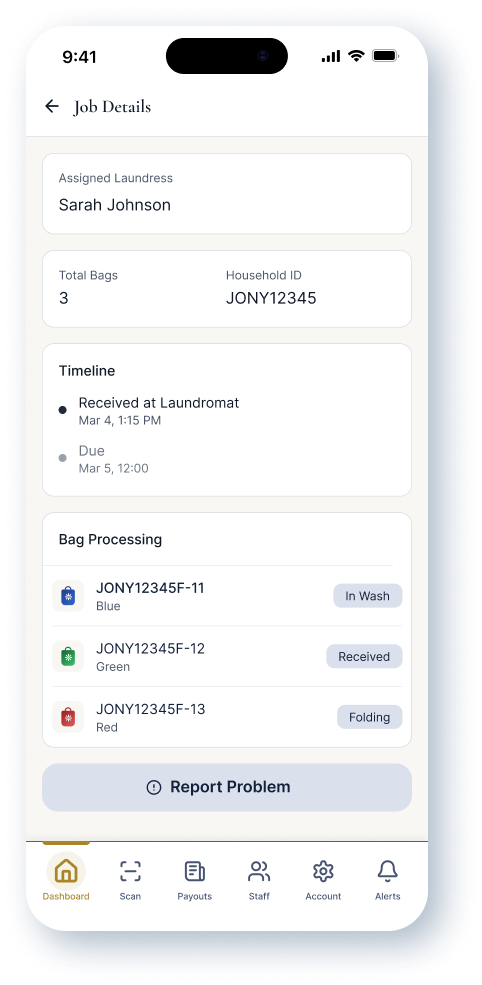
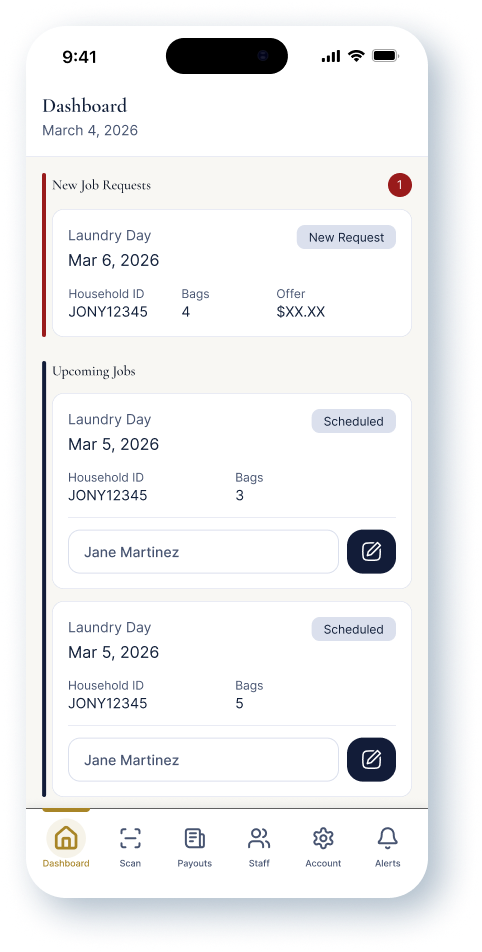
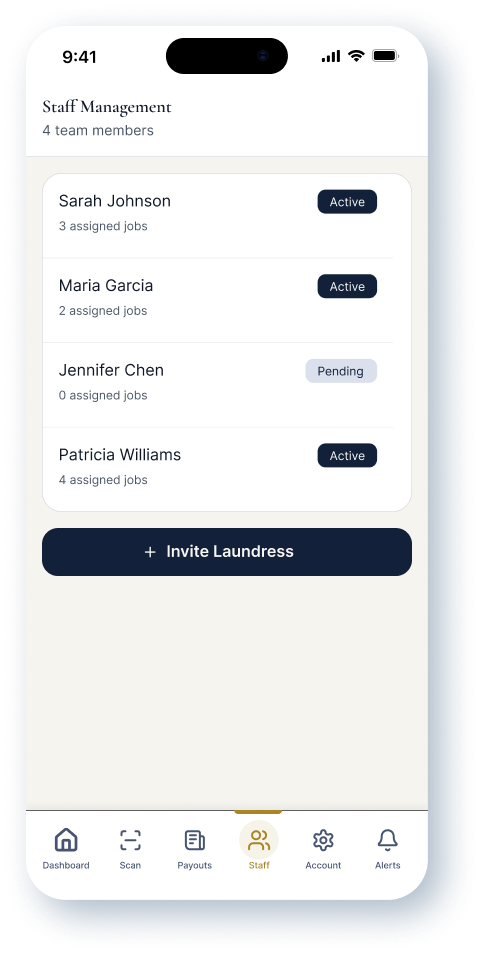
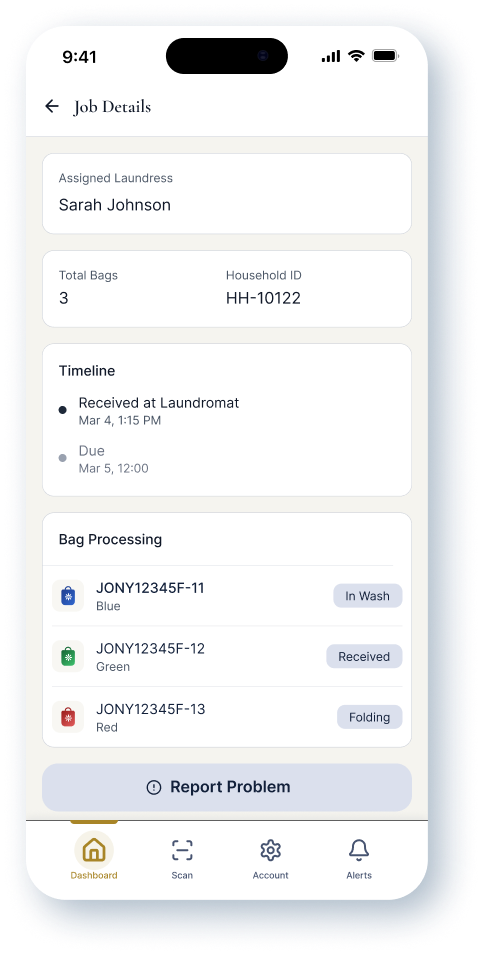
The same app carries a distinct operator experience for laundromats and their launderesses. Owners complete onboarding with business hours, non peak windows, maximum bags per day, and Stripe payout details, then receive job offers showing bag counts, timing, and estimated payout before they accept or decline. The dashboard separates today, upcoming, and recently completed work, and owners assign specific orders to launderesses who see only their own queue. Processing moves through received at laundromat, in wash, in dry, folding and bagging, and ready for return pickup, with bag-level toggles for loads that finish early and issue flags for heavy staining or damage noticed at intake. A payouts view shows the current period total, recent payouts, and per-order earnings with bags processed and rate applied. Owners can invite and remove launderesses, see when each last logged in, and connect or update the bank account that must stay valid to receive assignments.

Household Messaging, Safety Reporting, and Multi-User Access

Every active order carries a messages section where households can send notes directed to the laundromat, to support, or both, with read receipts and clearly labeled replies in the same thread. Image sharing is deliberately excluded from customer and operator messaging for safety reasons. A separate Report a Problem flow captures a category such as pickup issue, missing item, or quality concern along with a description and optional photos, generating a ticket in the admin console and an email to a monitored support address. Notification previews avoid addresses and bag contents entirely, referencing states like your laundry has been picked up. Primary subscribers can invite a spouse or family member with a generated code shared by text, granting full feature access to bag registration, scheduling, and messaging while keeping billing and invitations restricted to the account holder, with removal revoking access instantly across every platform.

Empowering the Renity Team with Operations Control Across Every Side of the Marketplace

Beyond the mobile experience, we developed a React administrative web application that gives the Renity team command of households, laundromats, bags, shipments, and payouts without engineering support.

Laundromat Onboarding, Bulk Import, and Automated Invitations

Growing supply is the hardest part of a marketplace, so we built the tooling to seed entire markets at once. Administrators upload a spreadsheet of known laundromats, and the import validates each row, previews valid entries alongside errors with specific messages, and flags duplicates by name, address, or email before anything is created. Confirmed rows generate laundromat profiles with details pre-filled and provisioned status, then trigger automated invitation emails carrying a secure password link, app download links, and instructions to finish configuring hours, non peak windows, machines, and launderesses. A tracking view shows invitation sent date, password set date, and setup completion for every imported partner, with resend and revoke available and failed deliveries recorded for manual follow-up. Individually signed-up laundromats flow through the same approval gate, where staff review details before marking them approved and unlocking operator functionality.

Bag Inventory, QR Lifecycle, and Household Subscription Support

Because Renity depends on physical assets moving through the world, the digital record has to match reality exactly. The inventory dashboard counts unassigned QR codes, bags in warehouse, bags assigned to households, and bags flagged as lost, replaced, or retired. Codes generate in batches, move to shipped when sent to a subscriber, and shift to registered when the mobile app scans them. Any bag detail shows its assigned household, registration date, last order, and current status, and retiring a damaged bag triggers a fresh code and shipment along with a notification email. On the household side, staff search by name, email, phone, or address and open a full profile showing contact details, subscription data pulled from RevenueCat including plan and renewal date, registered bags, upcoming Laundry Days, and internal notes. Staff can trigger transactional emails and reassign bags, but deliberately cannot modify store subscriptions, which remain the customer’s to manage.

Order Oversight, Roadie Exceptions, and the Support Console

The orders dashboard filters every Laundry Day by date, status, laundromat, or household, showing order ID, both parties, bag count, current status, and last update time. Order detail carries the complete timeline of operator and Roadie events, links to household and laundromat profiles, associated shipments with tracking links and delivery windows, and any notes or flags raised along the way. Staff filter for at-risk orders that have not advanced as expected, then mark one delayed with a reason and updated expectation or failed with a plan for rework, and those changes propagate to household and operator views immediately. The support console consolidates every messaging thread filterable by household, laundromat, order, or status, letting staff reply as Renity and mark threads resolved. Safety reports submitted from mobile appear as their own queue with category, linked order, description, and attachments, moving through acknowledged, in progress, and resolved.

Coverage Configuration, Payout Reconciliation, and Operational Reporting

Configuration keeps the business tunable without code changes. Coverage management defines which zip codes, cities, and regions are served, each with available days, pickup windows, and preferred laundromat partners, and warns staff when a change would conflict with active Laundry Days. Operational thresholds cap orders per laundromat per day and set buffer time between pickup and delivery, feeding directly into matching logic. Payout summaries show completed orders and bags processed per laundromat for each period with calculated amounts based on configured rates, plus per-laundromat history detailing which orders fell into each payout, and CSV exports built for reconciliation against Stripe. Disputed orders can be excluded with a documented reason, and retroactive changes to a closed period require an adjustment line for transparency. The reporting dashboard tracks active subscribers, Laundry Days completed, on-time pickup and delivery rates, open tickets, volume by laundromat, and average turnaround, all filterable and exportable.

End-to-End Guidance and Support

Our partnership extended beyond design and development. We served as strategic advisors, helping the Renity team make confident decisions about integration realities, trust and safety, and launch presence so the platform could operate honestly from day one.

  • Integration Strategy Built Around What Partners Actually Support

    The most valuable early guidance we offered was to design around real API capabilities rather than assumed ones. Roadie becomes the system of record for pickup and delivery legs, with their shipment statuses mapped into customer-facing language and their proof of pickup and delivery surfaced directly, while acknowledging openly where their API limits what Renity can control programmatically and deferring to Roadie’s own tools in those cases. RevenueCat handles store subscription entitlements so Apple and Google billing stays compliant, while Stripe covers bag purchases and laundromat payouts as physical goods and services outside store commission. Cloud Functions orchestrate subscription events, QR assignments, shipment creation and status syncing, payout calculation, notification fanout, and laundromat imports. This division means Renity never rebuilds logistics, billing, or payments from scratch, and every integration boundary is documented so nobody discovers a limitation in production.

  • Trust, Safety, and Store Compliance Across Three User Types

    A platform handling family clothing, home addresses, and worker payouts has to earn trust on every side. Firebase Authentication secures sign-in with email verification required before a household can subscribe or a laundromat can complete onboarding, alongside biometric unlock where the device supports it and explicit logout that revokes sessions server-side. Household, laundromat, and launderess accounts stay strictly separated, and launderess logins never surface household controls. Permissions are requested only at the point of need with in-app explainers, and notification previews carry no address or content details. Image sharing is excluded from customer and operator messaging by design, reserved solely for reporting to administrators. In-app account deletion is easy to find and states plainly that deleting a Renity account does not cancel store billing, with instructions for managing that through Apple or Google. Apple privacy labels and Google Play Data Safety forms reflect actual SDK usage and data flows.

  • Branding, Store Creative, and a WordPress Marketing Presence

    Beyond the applications, we delivered the identity and public presence Renity needed to launch as a real service. Brand work covered a primary logo, secondary mark, monochrome variants, usage guidelines across app, web, and print, plus a calm and trustworthy palette with accessible contrast and typography that renders cleanly on every platform. Store creative included the full iOS icon catalog, Android adaptive and monochrome icons, screenshot sets highlighting subscription, bag setup, Laundry Day scheduling, live status, operator mode, and messaging, along with Play Store feature graphics and listing copy. Transactional email templates cover welcome and subscription confirmation, bag shipment and registration, Laundry Day reminders, pickup and delivery confirmations, missed pickup notices, laundromat invitations, and account changes. The WordPress marketing site explains the service in plain language for both households and laundromats with how-it-works walkthroughs, pricing guidance, a partner recruitment section, FAQ, blog, and the legal pages both stores review, block-edited so the team updates content without a developer.

Seamless Collaboration, Every Step of the Way

Our partnership with the Renity team was built on a shared belief that laundry should just happen for families while turning idle machines into weekday revenue for neighborhood businesses. Weekly meetings during design provided alignment on the decisions that shaped the product most, including how status language should stay identical across all three audiences, where messaging needed safety limits, and how much of the matching algorithm belonged in configuration rather than code. Bi-weekly meetings during programming kept development on track across the household app, operator mode, the administrative console, the website application, and the marketing site. Figma served as our collaborative design canvas where feedback happened in real time. Jira tracked every feature and bug through completion while Confluence captured shipment sequences, laundromat import flows, and operational runbooks. GitHub stored version-controlled code with complete commit history. A dedicated project manager coordinated across design, development, and quality assurance teams spanning the United States, Brazil, India, and Pakistan, with testing covering subscriptions, QR registration, scheduling, Roadie shipments, operator workflows, messaging, admin actions, and accessibility touchpoints.

From Overflowing Hampers to a Routine That Runs Itself: Renity's Service Transformation

  • Predictable Routine

    A Mobile Experience Where Laundry Day Takes Care of Itself

    Renity gives families back their weekends. A household in a New Jersey suburb picks Wednesday as their Laundry Day. Tuesday night a reminder arrives, they fill their bags, and Wednesday morning they tap check-in and set them on the porch. They watch the driver approach, see the status move through pickup, wash, and fold, and that evening clean folded clothes arrive with photo confirmation. Nobody made a phone call, wondered where the clothes were, or touched the washer once. The QR codes mean every bag is accounted for at every step, and the timeline means the answer to where are my clothes is always one tap away rather than a guess.

  • Weekday Revenue

    A Platform Where Idle Machines Become Steady Income

    Renity turns the quietest hours of a laundromat’s week into its most predictable revenue. A Philadelphia owner joins, sets non peak hours from ten to three, and starts receiving job offers with bag counts, timing, and payout visible before accepting. Bags arrive by Roadie, staff mark them received and move them through wash, dry, and fold in the app, and the payouts view shows exactly what the week earned and which orders produced it. Launderesses work assigned queues with clear status rather than shouted instructions, and their work becomes visible and trackable for the first time. The machines that used to sit empty on a Tuesday now fill with work that pays.

  • Operational Command

    An Administrative Console Built for Running a Real Business

    The administrative web application lets the Renity team open a new market without opening a ticket. They import a list of laundromats from a partner spreadsheet, the system generates profiles and sends invitations, and partners onboard themselves over the following week while staff watch completion status. Coverage zip codes, pickup windows, daily capacity caps, and buffer times adjust from a settings screen and feed matching immediately. At-risk orders surface before customers notice, delays get documented and communicated, and safety reports never get lost inside general conversation. Payout summaries export clean for Stripe reconciliation. The scaling that would have meant more spreadsheets and more human glue now happens from one console.

Want To Dive Deeper Into What We've Created? Discover More Of The 500+ Success Stories We've Achieved Since 2009

Ready to Build a Service Platform That Coordinates Every Side of the Market Like We Did with Renity?

Imagine giving your customers a routine so predictable they stop thinking about it, your operators work sized to the capacity they already have with the money visible before they commit, and your own team a console that turns opening a new market into an afternoon rather than a project. That is what we built with Renity, and it is the same level of strategic thinking, technical excellence, and user-centered design we can bring to your own platform. Whether you are coordinating home services, field logistics, healthcare, hospitality, or any other business where physical work and digital tracking have to stay in sync, our team is ready to partner with you from vision through development and beyond.