A mother in Santo Domingo worried about her withdrawn teenage son has nowhere to search. A tourist in Punta Cana who wants to keep seeing a therapist while traveling cannot find a bilingual provider offering virtual sessions. A psychology graduate in Santiago with her CODOPSI registration and a dream of private practice has no office, no marketing budget, and no channel. The talent is there and the need is there, but the connection between them does not exist.
Embrazed becomes that connection. Visitors select English or Spanish and browse a directory of verified therapists without creating an account, filtering by city, specialty, session type, and language. Clients create an account, complete intake on their phone, request an appointment, pay, and join a video session from wherever they are. Providers apply, submit credentials, and once approved go live in the directory, receiving leads through a masked phone number while managing intake forms, evaluations, treatment plans, session notes, and progress tracking inside the platform. To bring this vision to life, Chop Dawg designed and developed a responsive React web platform, a desktop-only Administrative Website Application, a bilingual WordPress marketing website, and the Embrazed brand identity, all running on Google Cloud Platform with Firebase Authentication, Cloud Firestore, and Node.js.
Before Embrazed, a client looking for help relied on referrals and luck, and a provider looking for clients relied on signage, radio appearances, or an Instagram following that only a handful ever build. There was no searchable directory, no credential verification, no digital clinical workflow, and no lead system. The other 25,000 psychologists were left without a channel.
Embrazed needed to solve multiple challenges simultaneously. The directory had to be bilingual from the first screen, not translated later, serving Dominican clients and English-speaking visitors alike. Provider listings had to be gated behind credential verification against CODOPSI and Law 22-01 so patients could trust every profile. The full clinical workflow, from intake through psychosocial and psychiatric evaluations, treatment plans, session notes, and measurable progress, had to live securely in the platform with a five to seven year retention policy. Lead intake needed masked phone numbers and notifications so providers could receive calls without exposing personal lines. Payments had to reflect how the market actually pays, spanning cards, Zelle, Cash App, and local insurance. And the founder needed to run verification, subscriptions, safety escalation, and analytics without a developer.
Designing a Marketplace with a Practicing Clinician
From the very first conversation, this idea came from living the work rather than a whiteboard. The founder walked us through his own daily workflow as a practicing psychotherapist, from how a masked phone number rings through to his real phone, to how intake and progress tracking flow session to session on a 1 to 10 scale, to the week he received six client calls through a lead system. He also arrived through an existing partner who had watched us design, prototype, and build ZBritt for Lifeguard Home Care, so trust was established before the first call. We mapped journeys for the client searching in Spanish, the tourist searching in English, the graduate applying to join, the therapist requesting a psychiatrist consultation, and the admin reviewing credentials on a Monday morning.
Figma served as our collaborative design hub where wireframes evolved into polished, high-fidelity screens in both languages across the client, provider, and administrative experiences. Weekly meetings during design and bi-weekly meetings during development kept alignment as we worked through verification workflows, retention rules, and the mixed payment model. The stack settled on React for both web applications, Node.js on Google Cloud Platform, Firebase Authentication, Cloud Firestore, Google Cloud Storage, Twilio for video, masked calling, and SMS, and Stripe for payments and subscriptions. Through Slack, Jira, and Confluence, every decision stayed documented.

We designed and developed a responsive web platform serving clients, therapists, and psychiatrists, built around one loop: discover, connect, onboard, treat, track, return.
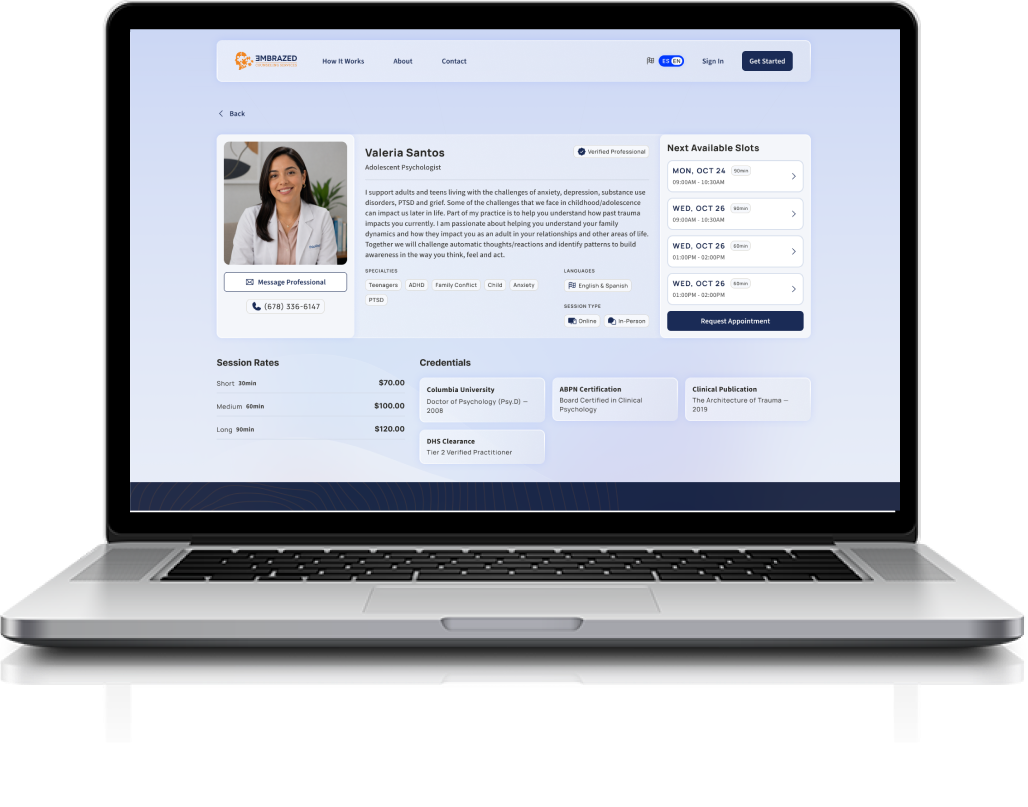
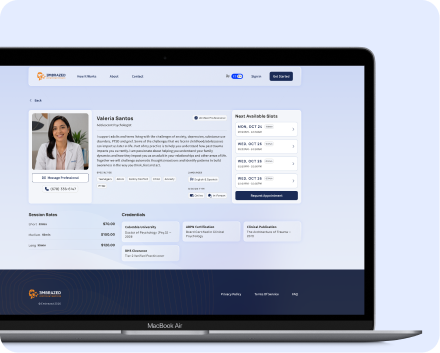
Embrazed opens the front door before asking for an account. Visitors choose English or Spanish through a persistent toggle and browse the directory, filtering by city and region such as Santo Domingo or Punta Cana, by specialty including trauma, ADHD, family conflict, child therapy, and autism support, by in-person or virtual session type, and by bilingual capability. Each profile presents credentials with verification status indicators, specialty tags, languages, rates, availability, session types offered, a background summary, and a photo. Only providers approved by the admin team with an active subscription appear in results, so every profile a visitor sees has already been vetted. Clear calls to action invite clients to create an account and providers to apply. Language preference persists for authenticated users, and every page, form, and system message exists in both languages.
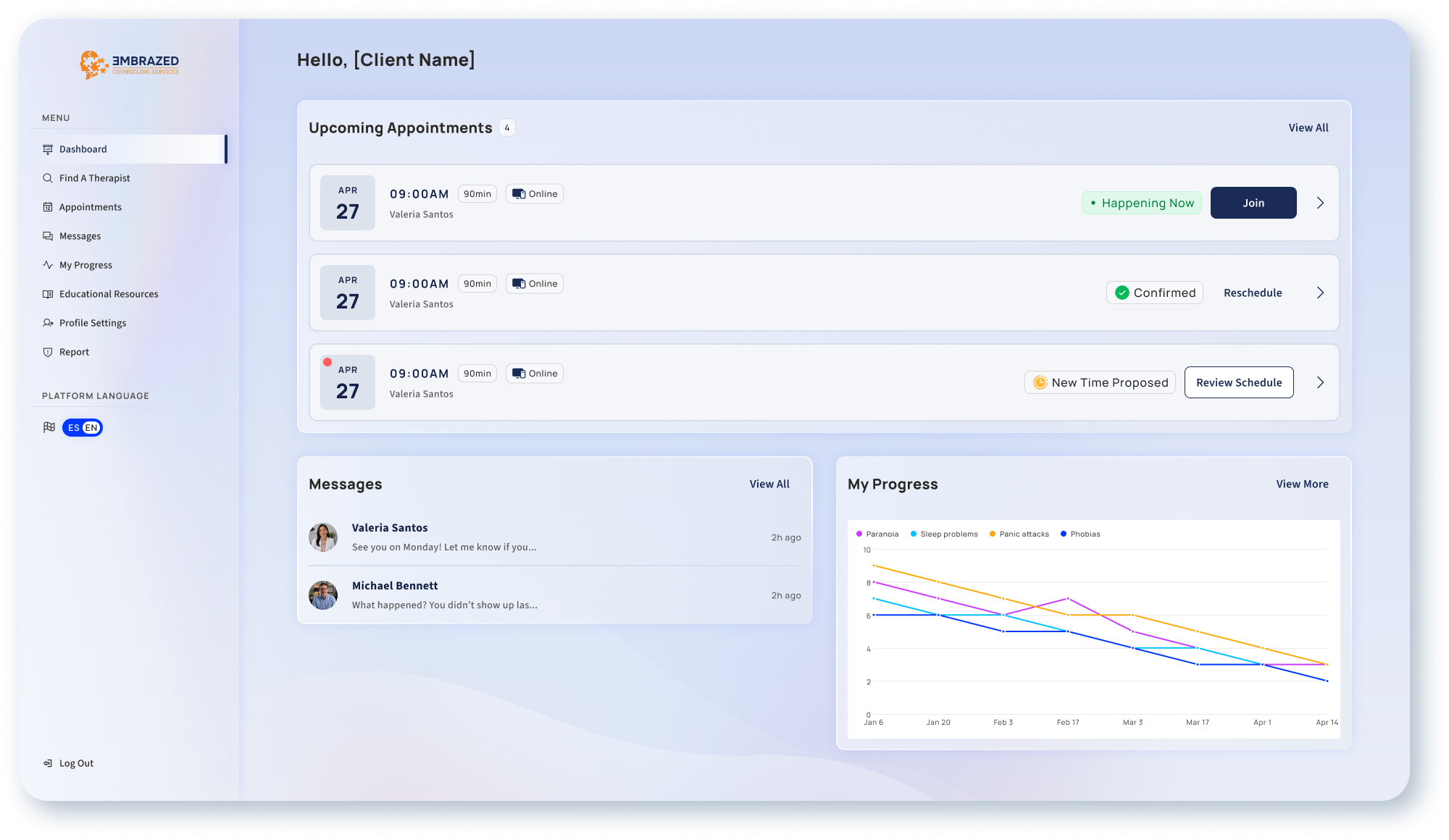
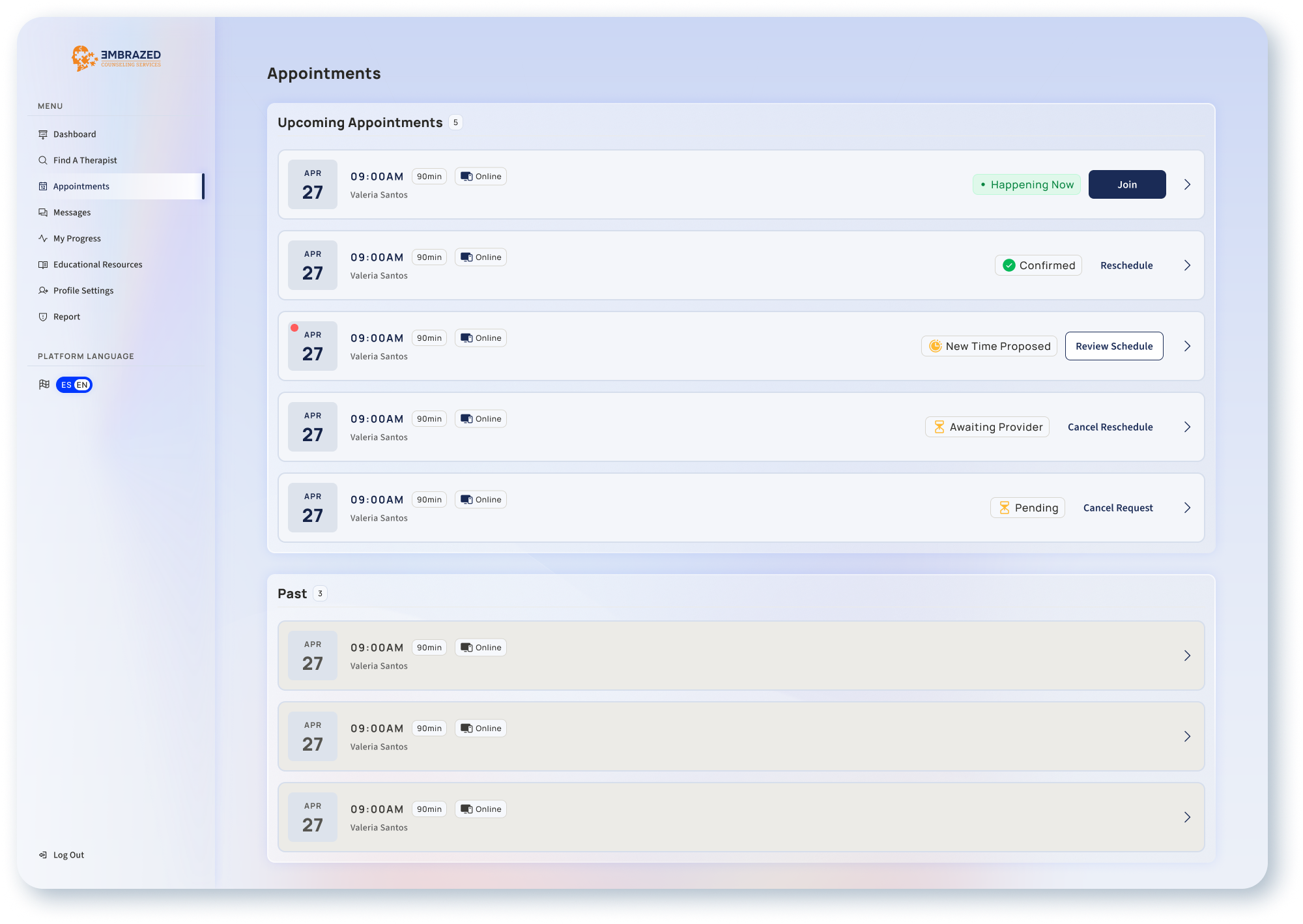
After creating an account and verifying their email, clients complete basic profile information, the intake forms the provider workflow requires, and clinical safety fields covering disclosures, medication, and risk screening, all stored in the client record and visible to the assigned therapist. From any profile, the client submits an appointment request with preferred session type, time windows, and a high-level reason for seeking therapy, which reaches the provider as a new inquiry. Providers configure availability, accept or decline requests, reschedule, and manage a calendar view. At the scheduled time, both parties join a Twilio-powered video session from the appointment details page. Clients view upcoming and past appointments from their dashboard, request rescheduling within provider rules, and message their provider through in-platform messaging tied to that relationship, keeping communication centralized and private.
Embrazed supports the payment methods clients actually use rather than forcing a single rail. Stripe handles card payments with confirmation and webhook handling. Zelle and Cash App run through payment instructions at checkout, with the payment recorded as pending until the provider or admin confirms receipt. Dominican Republic health insurance is supported through field capture that records the method and the details a therapist needs for their process. Providers see payment status per appointment as paid, pending confirmation, or insurance recorded, and mark pending payments confirmed when funds arrive. On the provider side, a monthly subscription through Stripe keeps a profile listed and searchable, with a free trial or promotional period so new providers build a client base before paying. Active subscriptions keep profiles visible and inactive ones hide them according to admin rules.
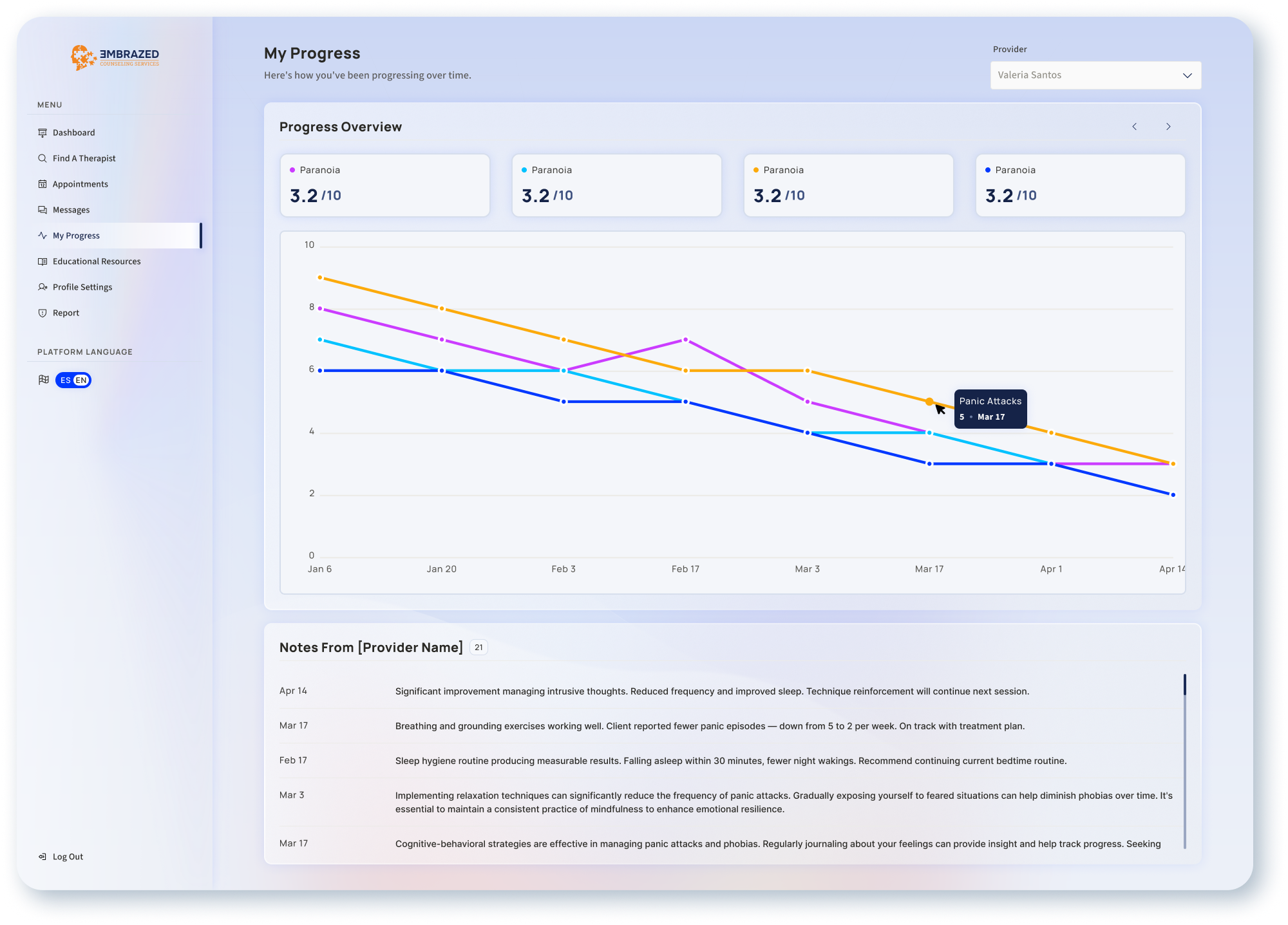
The full clinical workflow lives inside Embrazed so providers stop managing paperwork on their own. Each client record carries intake forms and disclosures, a psychosocial evaluation, a psychiatric evaluation for psychiatrist provider types, a treatment plan, session notes, and progress notes, completed and updated from the client roster. Progress tracking uses a 1 to 10 measurable scale with time-based history, so a provider records a value and optional narrative after each session and the client sees their anxiety or depression trending month over month from their own dashboard. Providers view active and past clients and open any record to see intake, documentation, appointments, and progress history in one place. All documentation is stored securely with a retention policy holding records for five to seven years and a mechanism removing records beyond that window according to platform rules.
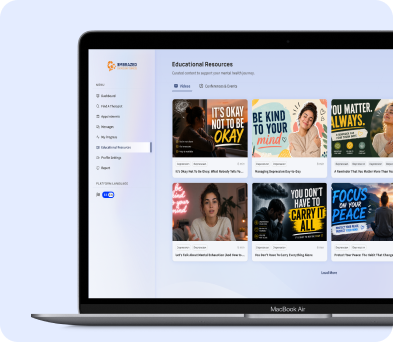
Beyond the client and provider experience, we developed a desktop Administrative Website Application that lets the founder and his team protect the quality of the marketplace without engineering dependency.
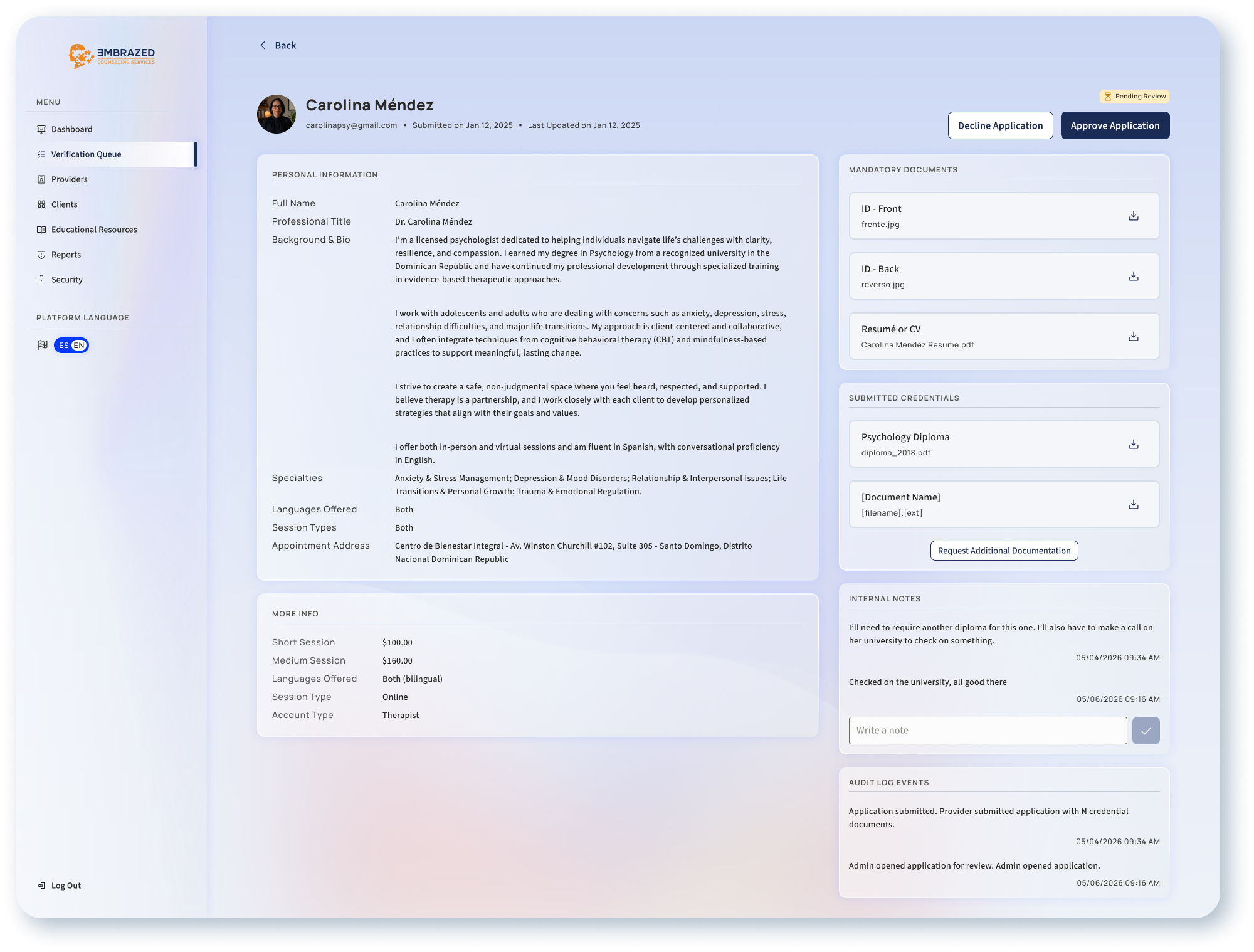
Nothing protects a mental health marketplace more than who gets in. New provider applications land in a verification queue where admins view and download submitted diplomas, licenses, school certifications, and the registration or license numbers required to practice under CODOPSI and Law 22-01, then set a status of pending review, approved, rejected, or needs additional documentation. Internal notes attach to every application for audit history, the provider is notified of the result, and nothing appears publicly until approval. Lifecycle controls let admins approve, suspend, revoke, or reactivate accounts and govern profile visibility at any time. Directory integrity tools handle reported profiles and suspicious activity, allowing admins to temporarily disable a profile, request re-verification, or remove a provider from search results, with every action recorded in an audit trail capturing who acted, when, and what changed.
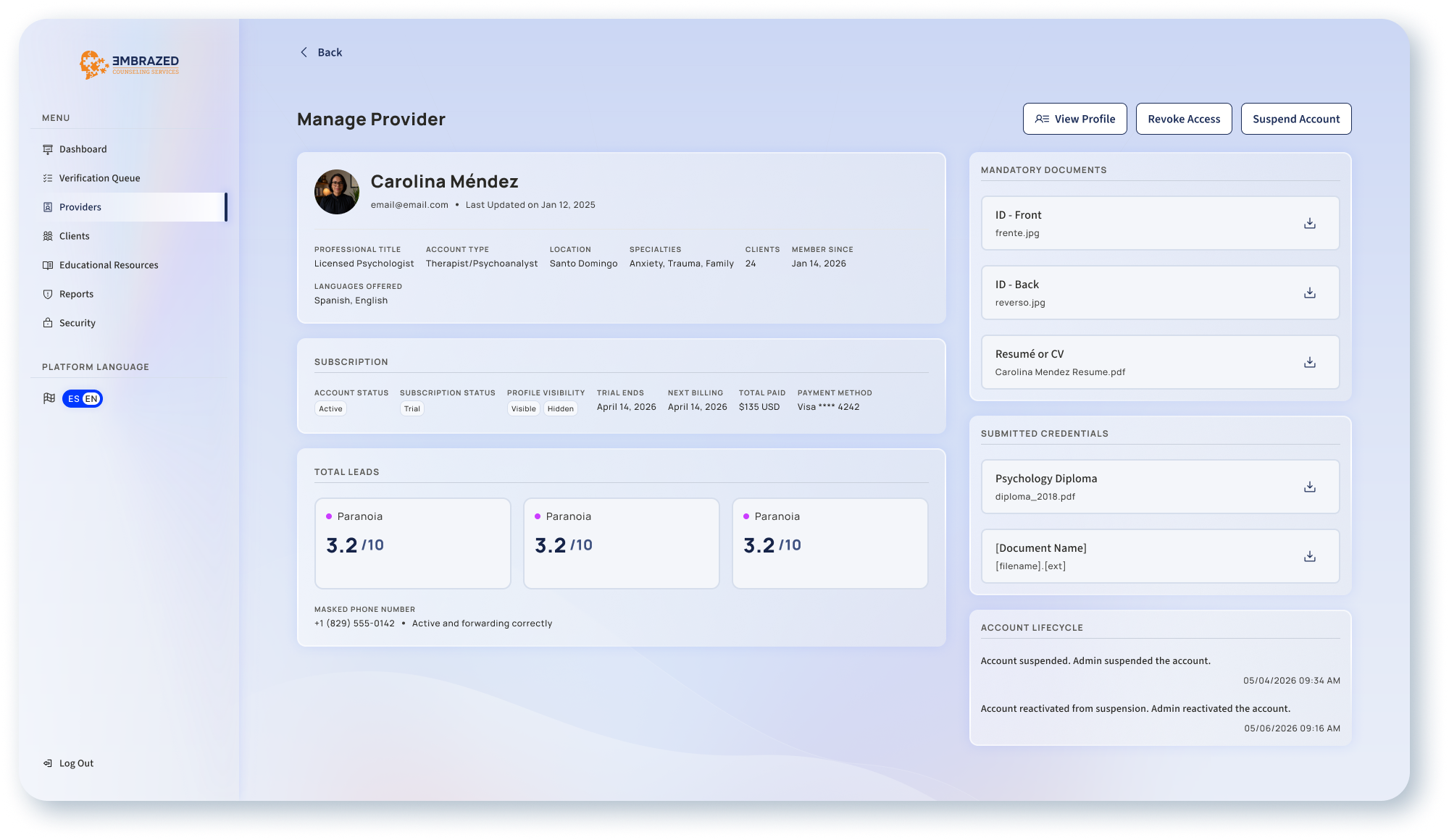
Admins hold the levers that keep the marketplace healthy. Subscription management shows status per provider and controls trial and promotional periods, active state, cancellation or nonpayment outcomes, and the visibility rules that follow, so a lapsed provider disappears from search according to policy rather than lingering. Lead routing management enables or disables masked phone number assignment per provider, reviews lead volume and inquiry flow health, and confirms notifications are reaching providers by email and text. User management covers both client and provider accounts for customer service workflows including account status review, access assistance, and dispute handling related to appointments, payments, or behavior. Role-based access separates full-access admins from limited tiers, idle timeout and manual logout protect sessions, and confirmations are required before changing verification status, overriding subscription state, or deactivating any account.
The admin portal also runs the content and oversight that keep Embrazed credible. Content management controls continuing education and conference listings, the organized YouTube educational sections, and the social media links displayed across public areas. Safety and escalation tools surface flagged events whenever high-risk indicators are captured during intake or messaging and track follow-up actions under the defined safety protocol. The dashboard presents registered clients, approved providers, pending applications, active subscriptions, subscription revenue, appointment volume and trends, payment status breakdowns across paid, pending, and insurance recorded, and lead volume per provider and overall, with quick links into every module. On a Monday morning the founder reviews four new applications, approves two, requests documents from one, rejects one, checks revenue and lead volume, and confirms notifications are flowing, without contacting a developer.
Our partnership extended beyond design and development. We served as strategic advisors, helping the Embrazed team make confident decisions about security, integrations, and market presence so the platform could earn trust from patients, providers, and regulators alike.
A platform holding clinical records demands protection from the first commit. Firebase Authentication secures client, provider, and admin accounts with email verification, encrypted credentials, and time-limited password reset links. Provider visibility is gated behind admin verification so unvetted profiles never reach the public. Role-based access controls what each admin tier can see and do, and every sensitive action is written to an audit trail. Credential documents and profile media live in Google Cloud Storage with access controls, and all clinical documentation is stored securely under a five to seven year retention policy with defined purge behavior. Messaging stays tied to client-provider relationships rather than open chat. Safety guidance states throughout that Embrazed is not an emergency service, with escalation resources surfacing when high-risk indicators appear and flagged events tracked for follow-up, with exact language finalized alongside legal guidance.
Together we chose integrations that fit the realities of the market. Twilio carries three responsibilities in one relationship: video conferencing for telehealth sessions tied to scheduled appointments, masked phone number assignment and call forwarding for the lead system, and SMS lead notifications. Stripe handles card payments and provider subscription billing with webhook confirmation, while Zelle and Cash App run through instruction display and pending confirmation because many clients in the Dominican Republic pay that way. Insurance is captured as a method and fields today, with claim processing deliberately deferred until requirements are confirmed in writing rather than guessed. Node.js on Google Cloud Platform serves both applications, with Cloud Firestore and composite indexes powering fast directory filtering across thousands of providers. Every integration boundary is documented so nothing surprises the team in production.
Beyond the applications, we delivered the identity and public presence Embrazed needed to launch professionally. Brand work covered the primary logo in standard formats for the web app header, social profiles, and favicon, a palette and typography chosen for bilingual readability, and usage basics including light and dark background variations. The bilingual WordPress marketing website carries Home, About, separate How It Works pages for clients and providers, Pricing, Resources with embedded YouTube and continuing education highlights, FAQ, Contact, and legal pages, with SEO tuned for the Dominican Republic and bilingual markets and calls to action routing Find a Therapist into the directory and Provider Sign Up into the application flow. The architecture leaves room for the roadmap: native mobile applications with push notifications, United States expansion, advanced insurance integrations, and additional countries including El Salvador, all buildable without rewriting the core.
Our partnership with the Embrazed team was built on a shared belief that a country with 26,000 psychologists and no way to find them deserves better. The founder brought clinical expertise, firsthand experience with the model that works in the United States, and a vision that reached from university psychology departments to government advocacy for insurance coverage. Weekly meetings during design provided alignment on the decisions that mattered most, including what verification should require under Dominican regulation, how progress tracking should read to a client, and where safety guidance needed to appear. Bi-weekly meetings during programming kept development on track across the web platform, the administrative console, and the marketing website in two languages. Figma served as our collaborative design canvas where feedback happened in real time. Jira tracked every feature and bug through completion while Confluence captured the verification logic, retention rules, lead routing workflows, and payment handling. GitHub stored version-controlled code with complete commit history. A dedicated project manager coordinated across design, development, and quality assurance teams spanning the United States, Brazil, India, and Pakistan, with testing covering authentication, directory search, intake, scheduling, video sessions, every payment method, clinical documentation, lead notifications, admin verification, and the full bilingual experience.


A mother in Santo Domingo opens Embrazed, selects Spanish, and searches for child and family therapists near her. She finds a provider experienced in adolescent trauma, sees the credentials are verified, completes intake on her phone, and requests an appointment. By the end of the week her son is in his first session. A tourist in Punta Cana switches to English, filters for bilingual providers offering virtual sessions, books Thursday, pays through the platform, and joins from her hotel. Neither had to ask around or hope for a referral. The platform made the right person findable.
A graduate in Santiago with her CODOPSI registration and no office applies, uploads her diplomas and credentials, and waits for verification. After approval her profile goes live, and within the first month leads arrive through her masked phone number and email. She manages intake, evaluations, treatment plans, and session notes inside the platform and watches her clients’ progress scores climb month over month. When one client needs medication management, she requests a psychiatrist consultation and the collaboration lands in the client file. She never needed television, radio, or an Instagram following. She needed a platform that did not exist until now.
The Administrative Website Application lets the founder run a trusted marketplace from his laptop. Applications queue with every diploma and license number attached for review against CODOPSI requirements. Approvals, rejections, and document requests take minutes and leave a full audit trail. Subscription status, lead volume, appointment trends, and revenue read in plain language on one dashboard. Reported profiles get disabled or re-verified without a support ticket, and flagged safety events track through follow-up. The quality of care on Embrazed is governed by a clinician with the tools to enforce it, not by whoever managed to get listed.
Imagine giving your users a verified, searchable way to find the professional they need in their own language, giving providers a real channel to build a practice, and giving your team the verification and oversight tools that keep the whole marketplace trustworthy without a developer in the loop. That is what we built with Embrazed, and it is the same level of strategic thinking, technical excellence, and user-centered design we can bring to your own platform. Whether you are connecting patients with providers, clients with professionals, or any underserved market with the expertise it has never been able to reach, our team is ready to partner with you from vision through development and beyond.