























 14 Min

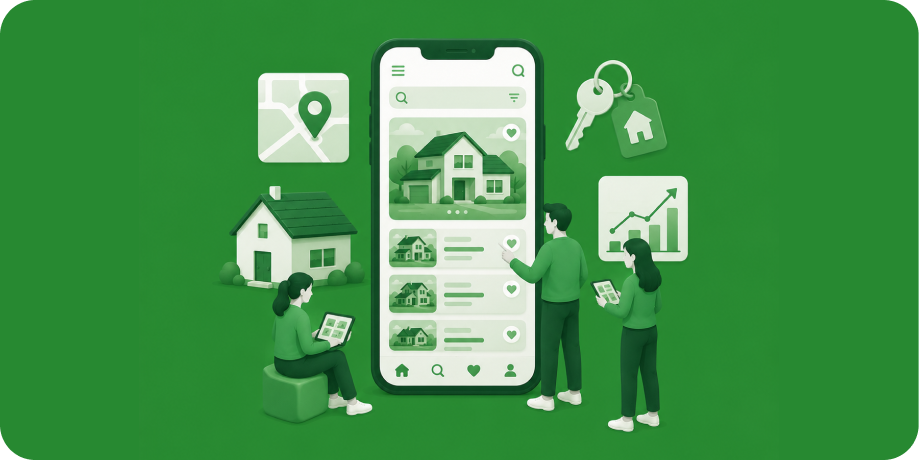
The short answer: the cost to build an app like Zillow in 2026 runs $75,000 to $200,000, with a focused regional real estate portal landing near the low end and a data-rich platform with valuations, alerts, and agent lead routing reaching the top. The reason the range is wide is that Zillow is less an app than a data machine with a map on top. And the audience is enormous: Zillow averaged 228 million monthly users and drew 9.3 billion visits in 2024, according to Business of Apps. Most founders underestimate the listings-data plumbing and overestimate the map. This guide prices both correctly, feature by feature.
Key Takeaways
- A real estate portal app like Zillow costs $75,000 to $200,000 to build in 2026; most credible first versions land between $90,000 and $150,000.
- Listings data ingestion and map-based search are the two heaviest line items, often a third of the entire budget together.
- Saved-search alerts are the retention engine: portals live or die on bringing buyers back when new inventory hits.
- AI and agent-assisted coding have cut real estate platform costs and timelines roughly in half since the 2020 to 2023 era.
- Portals monetize through agent connections and leads, so Apple’s 30% commission does not apply to your core revenue.
What It Costs to Build an App Like Zillow in 2026
Budget $75,000 to $200,000 for a Zillow-class portal MVP. That covers the four systems that define the category: a listings database fed by external data sources, map-first search, saved searches with instant alerts, and the valuation and agent-connection features that turn browsers into leads.
The cost driver people miss is data. Residential listings flow through multiple listing service (MLS) feeds, internet data exchange (IDX) integrations, and public records, each with its own format, refresh schedule, and compliance rules. Your platform has to ingest, deduplicate, geocode, and refresh that inventory continuously, because a portal showing sold homes as active loses users in one session. Simple consumer apps can start in the $25,000 to $60,000 minimum viable product (MVP) range; data-heavy marketplace-class platforms like this start around $75,000 because the invisible plumbing is most of the build.
Feature-by-Feature Cost Breakdown
These 2026 bands cover user interface and user experience (UI/UX) design, development, and quality assurance (QA) with a senior-led, AI-accelerated team.
| Feature | What It Includes | Typical Cost Band |
|---|---|---|
| Listings data ingestion | MLS/IDX feed integration, public records, deduplication, geocoding, refresh jobs | $15,000 to $35,000 |
| Map search | Interactive maps, draw-your-own boundaries, clustering, school and neighborhood layers | $12,000 to $25,000 |
| Search and filters | Price, beds, baths, lot size, home type, keyword search, sorting | $8,000 to $15,000 |
| Listing detail pages | Photo galleries, virtual tour embeds, price history, tax records, similar homes | $8,000 to $15,000 |
| Saved searches and alerts | Favorites, saved filters, instant push and email alerts on new inventory | $7,000 to $14,000 |
| Valuation displays | Estimate presentation, value history charts, comparable sales, disclaimers | $8,000 to $20,000 |
| Agent connections | Agent profiles, tour requests, lead capture and routing, contact workflows | $8,000 to $18,000 |
| Accounts and admin | User profiles, roles, listing management, analytics, moderation | $8,000 to $15,000 |
| QA, launch, store submission | Device testing, data validation, Apple and Google submissions | $8,000 to $15,000 |
Those bands sum to roughly $82,000 to $172,000, which is why the honest quoted range is $75,000 to $200,000 depending on data sources, market count, and valuation ambition. React Native delivers iOS and Android from one codebase, and most portals pair it with a React web app because home search still happens heavily on desktop.
What Moves the Number Up or Down
Data scope moves this budget more than any visual feature. The questions that matter: how many markets, how many data sources, and whether your valuations are displayed, licensed, or computed.
- Market coverage: One metro area with one or two MLS feeds is dramatically cheaper than statewide or national coverage with dozens of feeds and rule sets.
- Valuation approach: Displaying licensed third-party estimates through an application programming interface (API) is affordable; building your own automated valuation model adds $15,000 to $40,000 and ongoing data science work.
- Audience type: Buyer-only portals are simpler than platforms serving buyers, sellers, renters, agents, and investors at once.
- Media richness: Virtual tours, 3D walkthroughs, and video add integration and storage costs.
- Lead economics: Basic contact forms are cheap; routed, tracked, and billed agent leads with dashboards are a product of their own.
The AI and Agent-Assisted Coding Cost Reality
A portal of this class cost $250,000 to $400,000 in the 2020 to 2023 market. AI and agent-assisted coding tools like Claude Code and Cursor, with senior engineers reviewing every change, have cut that roughly in half, which is how 2026 budgets land at $75,000 to $200,000 across 5 to 9 months.
The place discipline pays is the data layer. AI can scaffold feed parsers and map components in hours, but MLS compliance rules, deduplication logic, and geocoding edge cases need experienced humans making judgment calls. A portal that maps homes to the wrong block or shows stale prices burns trust it never gets back. We treat AI as acceleration for senior engineers, never a substitute, and never vibe coding.
A Note on Apple, Google, and Portal Revenue
Real estate portals earn from agent connections, advertising, and premium placement, all real-world services, so Apple In-App Purchase and Google Play Billing rules do not take a cut of your core revenue. You will still need developer accounts in your own name (2 to 3 weeks for approval) and a DUNS number (about a month), and a clean submission typically clears Apple review in 24 to 48 hours in 2026. If you later sell digital subscriptions inside the app, those specific purchases would route through the stores at 30%, or 15% under the App Store Small Business Program.
Where Chop Dawg Fits
Proptech is a lane we have shipped in repeatedly. For REI Push, a multi-platform real estate investing suite founded by Chris Goff and Bo Manry, we built iPhone and Android apps, a web portal, and an admin backend: push alerts for vacant, pre-foreclosure, and bank-owned properties, built-in skip tracing with a credits system, one-click direct mail campaigns, and a color-coded interactive lead map with geolocation mileage tracking. Milestones were delivered on time and on budget, exactly the discipline a data-heavy portal needs.
For MyVilla, we built a responsive web application that lets non-technical landlords manage properties, onboard tenants with digital signatures, and collect rent through Stripe with automated reminders. And for Jeani, a centralized subleasing marketplace, we delivered a complete clickable Figma prototype, wireframes through high-fidelity product flows, designed for iOS, Android, and web. Founder Alex Harden said: “I’m incredibly impressed by the team at Chop Dawg. They transformed my long-held idea into a modern-looking app that surpasses my wildest imagination and continuously improves upon it. With this completed product, I’m confident in entering the market with something truly exceptional.” Organizations that have trusted Chop Dawg include Choice Home Warranty and the City of Philadelphia.
The structure behind those wins: Chop Dawg is US-headquartered and US-led, with Americans owning leadership, product and project management, senior development, senior design, and senior QA, backed by our in-house Brazilian design team and in-house development, QA, and project-management teams in Pakistan and India. Everyone is in-house and assigned directly to your project, fluent English, US hours. That answers the two fears founders bring to this industry: the American front man hiding subcontracted offshore developers with no accountability, and the faceless overseas shop with no US norms and no time-zone overlap. Fixed monthly budgets, precise timelines, daily Slack, and you own all code and intellectual property (IP) from day one. Start with design, move through development, and keep growing with post-launch support.
Frequently Asked Questions
How much does it cost to build an app like Zillow?
An app like Zillow costs $75,000 to $200,000 in 2026. A single-metro portal with licensed valuations and standard map search lands near $75,000 to $110,000, while multi-market coverage, custom valuation models, and full agent lead routing push budgets to $150,000 and beyond.
How long does it take to build a real estate portal app?
Plan 5 to 9 months from kickoff to launch in 2026. Listings data integration drives the schedule, since MLS approvals and feed testing run on external timelines you do not fully control. Design takes 4 to 8 weeks, with development and QA making up the remainder.
How do I get listings data for a Zillow-style app?
Through MLS and IDX feeds licensed in each market, supplemented by public records and direct listing agreements. Each MLS has its own approval process, rules, and technical format, so budget both time and engineering for ingestion. Rental and investor platforms can sometimes launch on aggregated or user-generated inventory instead.
How do apps like Zillow make money?
Primarily by selling buyer leads and premium placement to agents, plus advertising from lenders and movers. Some add rental listing fees, tenant screening, or mortgage referral revenue. Because these are real-world services billed outside the app stores, your margins are not reduced by Apple or Google commissions.
Do I need my own Zestimate-style valuation model at launch?
No. Most portals launch with licensed valuation data displayed through an API, paired with price history and comparable sales. That earns user trust for $8,000 to $20,000. Building a proprietary automated valuation model is a phase-two investment once you have traffic and transaction data of your own.
What does it cost to maintain a real estate portal after launch?
Budget from about $2,500 per month for maintenance, plus data licensing fees that vary by MLS and market count. Feeds change formats, operating systems update, and alert systems need tuning as inventory grows. Plan roughly 15% to 20% of the original build cost annually to keep data fresh and rankings strong.
Put Your Market on the Map
A Zillow-style portal costs $75,000 to $200,000 in 2026, and the fastest way to your exact number is scoping your markets, data sources, and monetization in one conversation. Founded in 2009 and now in our 18th year, Chop Dawg has launched 500+ products used by over 1 billion people, keeps a 92% repeat-partner rate, and holds 300+ five-star reviews across trusted directories like Clutch, GoodFirms, G2, Google, and TopDevelopers. Whether you are a founder eyeing a niche your local market underserves or an established brokerage building your own portal, grab a free 45-minute consultation. You will leave with a scoped plan and honest numbers, whether or not we ever build it together. Full pricing detail lives at app development costs and pricing.




 16 Min